

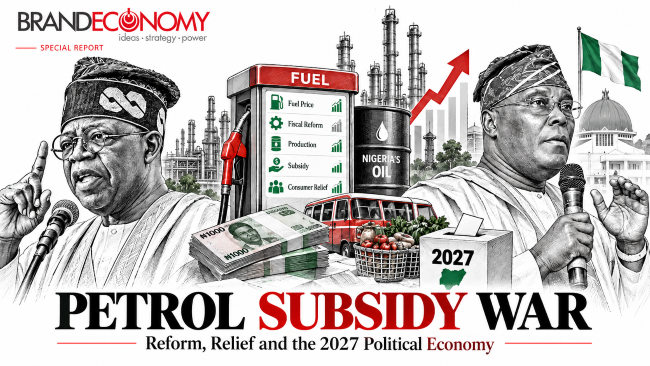
 The Federal Government has rejected former Vice President Atiku Abubakar’s proposal to restore a form of petrol subsidy if elected president in 2027, warning that such a move could reverse petroleum-sector reforms, weaken public finances and unsettle investment in domestic refining.
The presidency’s position, articulated by Mr Bayo Onanuga, Special Adviser to the President on Information and Strategy, frames the debate as a choice between painful reform and political retreat. Onanuga described Atiku’s proposal as retrogressive and fiscally unsustainable, arguing that Nigeria’s petroleum market has changed fundamentally since President Bola Tinubu announced the removal of fuel subsidy on May 29, 2023.

Tinubu, receiving Governor Ademola Adeleke of Osun State at the State House recently, also dismissed Atiku’s position, describing it as evidence of poor understanding of governance and economics.
The subsidy debate is now returning as one of the defining issues of the 2027 political season. Atiku, now associated with the African Democratic Congress, has argued that Nigerians have not seen enough benefit from subsidy removal. His case is simple and politically potent: citizens accepted pain, but food prices, transport costs and living standards have worsened.
That argument speaks directly to the street. Since subsidy removal, petrol has moved from below N200 per litre to above N1,000 in many locations, pushing up transport fares, food distribution costs, generator expenses and the general cost of survival.
But Atiku says his proposal is not a return to the old opaque import-subsidy regime. He argues for a controlled intervention tied to domestic refining, budgeted support, verifiable barrels of crude and measurable consumer benefits. Under his plan, crude supplied to local refineries would receive targeted support so that lower feedstock costs can translate to cheaper petrol for Nigerians.
The Federal Government disagrees. It argues that reopening subsidy would create legal, fiscal and market complications, while discouraging investments in Dangote Refinery, modular refineries and other domestic refining projects.
Minister of Finance and Coordinating Minister of the Economy, Mr Taiwo Oyedele, has said subsidy removal generated N15.8 trillion for the federation between June 2023 and December 2025, with N5.4 trillion accruing to the Federal Government and N10.4 trillion shared by states and local governments.
That number is politically important. It supports the government’s claim that subsidy removal has strengthened public resources. But it also sharpens the citizen’s question: if trillions have been freed, why does daily life still feel harder?
Reform Without Relief
The removal of petrol subsidy was economically defensible. The old system consumed vast public funds, encouraged smuggling, enabled rent-seeking, distorted prices and rewarded those with access to import and claims channels. Few serious economists defend the old regime as it existed.
Yet reform is judged not by theory but by delivery. Prof. Uche Uwaleke, President of the Capital Market Academics of Nigeria, captured the central issue: the success of subsidy removal should not be measured only by government’s ability to stop payments. It should be measured by whether the sacrifice produces stronger public services, productive investment, domestic output and better welfare for ordinary Nigerians.
That is where the Tinubu administration remains vulnerable. Roads, schools, hospitals, mass transit, power, food systems and wage adjustments have not moved fast enough to convince many citizens that subsidy savings are being converted into visible relief.
A civil servant, Ibrahim Abbas, said Nigerians expected subsidy removal to release funds for infrastructure and growth, but what many workers have experienced is a sharp fall in purchasing power. For retirees like Mr Sule Aliu, the hardship has been even harsher, because fixed incomes rarely adjust to energy-driven inflation.
This is the emotional space Atiku is entering.
Consumption or Production Subsidy?
Prof. Ken Ife, a global financial analyst and development economist, faulted a blanket return to petrol subsidy, warning that Nigeria cannot solve structural fuel problems by artificially lowering pump prices. His argument is that governments should subsidise production, not consumption.
That distinction matters. A consumption subsidy lowers the price paid by everyone at the pump, including the rich, smugglers, inefficient users and cross-border arbitrage networks. A production subsidy, if properly designed, supports domestic output, improves supply, protects jobs and can be tied to measurable performance.
Atiku is trying to occupy that middle ground by calling his proposal a targeted production support scheme rather than a return to the old order. The credibility of such a proposal would depend on hard safeguards: transparent budgeting, independent audits, clear ceilings, published beneficiaries, refinery performance metrics, anti-smuggling controls and direct evidence that consumers receive the benefit.
Without those safeguards, “targeted subsidy” could become the old subsidy wearing better perfume.
Market Implications
The market is watching closely because subsidy policy shapes refinery economics, fuel imports, foreign exchange demand, logistics, consumer prices and investor confidence. A sudden return to subsidy could distort competition and create uncertainty for investors who entered the market believing Nigeria was moving toward deregulation.
Dangote Refinery, modular refinery developers, marketers and logistics operators need policy predictability. If government begins to manipulate pump prices without transparent compensation, refineries may face margin pressure. If compensation is delayed or politicised, supply could be disrupted.
At the same time, a fully deregulated market without strong competition and consumer protection can create its own problem: price spikes that households cannot absorb. Nigeria therefore needs not just deregulation, but intelligent market governance.
Brand Implications
For Tinubu, subsidy removal is now a defining brand issue. It is the flagship symbol of his reform identity. If the policy eventually produces infrastructure, stability and productivity, it could become the hard medicine that worked. If hardship persists without visible benefits, it becomes the emblem of elite indifference.
For Atiku, the subsidy proposal is politically attractive but risky. It may connect with suffering voters, but it also exposes him to accusations of opportunism because he previously supported subsidy removal during the 2023 campaign. His brand challenge is to prove that this is policy refinement, not electoral convenience.
For Dangote Refinery and other domestic refiners, the debate is equally sensitive. They are being pulled into a national argument over affordability, monopoly fears, crude supply, imports and price formation. Their brand equity will depend on transparency, supply reliability and the perception that domestic refining benefits Nigerians.
Investor Relevance
Investors prefer clarity. They can price market risk; they struggle with policy reversal risk. The subsidy debate raises questions about Nigeria’s reform durability, fiscal discipline and energy-market design.
A credible production-support mechanism could attract investment if it is transparent, limited and tied to domestic value creation. A politically driven return to pump-price subsidy would likely frighten investors, weaken fiscal credibility and complicate refinery financing.
The broader investment signal is this: Nigeria must decide whether its petroleum market will be ruled by reform discipline or campaign-season improvisation.
BRANDECONOMY Insight
Nigeria’s fuel-subsidy debate should not be reduced to Tinubu versus Atiku. The real issue is whether the country can build an energy-pricing system that is fiscally sane, socially bearable and investment-friendly.
Petrol Subsidy removal was necessary, but necessity is not success. Citizens were asked to endure pain; government must now prove that the savings are building something better. Atiku’s proposal is powerful because it speaks to that pain. The government’s rejection is valid because the old subsidy regime was ruinous.
The way forward is not a lazy return to blanket subsidy. It is a transparent production-linked support framework, stronger local refining, competitive downstream regulation, mass transit investment, targeted cash relief, lower logistics costs and public reporting on subsidy-savings deployment.
Nigeria does not need cheaper petrol by political decree. It needs an economy where energy reform produces cheaper living.