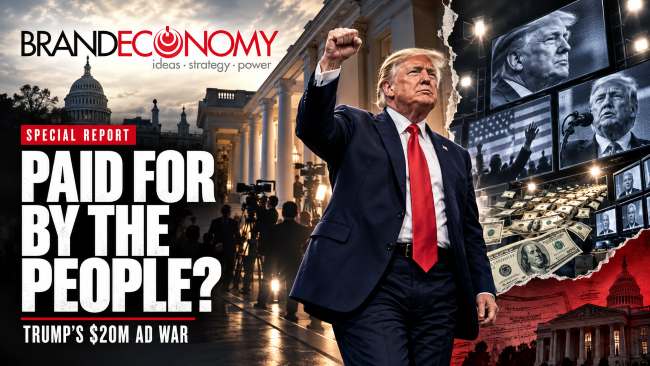
 Five weeks before the United States’ November midterm elections, President Donald Trump has found himself at the centre of an advertising controversy that reaches far beyond creative taste or partisan disagreement. At issue is a democratic boundary: when does legitimate government communication become publicly financed political promotion?
Three nationally broadcast television advertisements featuring Trump—and carrying the disclosure “Paid for by the U.S. Government”—have drawn criticism from Republican and Democratic lawmakers, ethics specialists, artists and public-interest organisations.



New disclosures have raised the stakes. The Department of Homeland Security reportedly committed $20 million to the broader advertising campaign, drawing the money from funds intended for U.S. Customs and Border Protection. Advertising-monitoring data indicated that more than $2.5 million had already been spent on the three commercials over seven days, although total expenditure could be higher depending on how broadcasters classified the placements.
What began as a dispute over a television spot has consequently evolved into a larger test of public accountability, institutional restraint, copyright compliance and the proper distinction between the American presidency and the personal political brand of its occupant.
“The final battle”—but whose bill?
The most contentious of the advertisements is a stark, black-and-white production showing Trump walking down a corridor as his voice warns against the “deep state,” “warmongers,” “globalists,” “Marxists,” “communists” and “fascists.”
“This is the final battle,” Trump declares.
The language is not new. Trump shared an almost identical video on his Truth Social account in 2023 as part of his presidential campaign. That version concluded with an appeal to join his political movement and disclosed that it had been paid for by Donald J. Trump for President 2024, Inc.
The 2026 version carries a crucially different funding declaration: “Paid for by the U.S. Government.”
The ad reportedly aired during National Football League games and other high-profile programming. Its transformation from a privately financed campaign asset into a government-funded message is at the heart of the controversy.
The absence of an explicit instruction to vote Republican does not necessarily neutralise its electoral value. Political branding is often accomplished through emotional association rather than a direct ballot appeal. By presenting Trump as the embattled defender of the nation against an extensive catalogue of enemies, the spot reinforces the same narrative architecture that powered his electoral movement.
In marketing terms, the execution performs all the important functions of a campaign advertisement: it identifies a hero, names a collection of villains, heightens the stakes and presents political loyalty as national salvation.
The question is whether removing the campaign disclaimer—and replacing it with the imprimatur of the U.S. Government—changes the legal character of the message or merely transfers its cost to taxpayers.
From “Love Me” to a copyright dispute
A second 30-second advertisement presents a rapid montage of Trump at political rallies and official events, accompanied by the song “Love Me” by American singer-songwriter Christian Berishaj, who performs under the name JMSN.
The images are interspersed with administration-friendly claims about tax reductions, American manufacturing, law and order, border protection and national strength. UFC President Dana White also appears praising Trump’s personal resilience.
The White House describes the commercials as public-service announcements promoting patriotism and American exceptionalism. It argues that government-funded presidential messages are not unprecedented and that the current ads are not electoral because Trump is not personally on the November ballot.
That defence has not satisfied critics—and the music has created an additional legal and reputational problem.
JMSN said he did not authorise the use of “Love Me” for any political campaign or agenda. His lawyers subsequently sent the White House a cease-and-desist letter demanding that the administration stop using the song.
The dispute illustrates a recurring risk in modern political communication. Music does more than decorate a commercial; it transfers mood, identity and cultural meaning to the subject. Using an artist’s work without clear permission can create an implied association the artist neither supports nor accepts.
For a government insisting that the advertisement is lawful and educational, a public dispute over music rights weakens the campaign’s broader claim to procedural responsibility.
A third, one-minute advertisement combines scenes of Mount Rushmore with portions of Trump’s Fourth of July address. Viewed in isolation, patriotic imagery and presidential speeches may resemble conventional government communication. Viewed as part of a coordinated media campaign immediately preceding congressional elections, however, the cumulative political effect becomes harder to dismiss.
The money trail changes the story
Initial reports placed identified spending on individual spots in the hundreds of thousands of dollars. Subsequent reporting revealed a much larger financial architecture.
The Department of Homeland Security reportedly allocated $20 million to what federal contract records described as a “National Media Campaign.” The contract was awarded to Maryland-based LMD Agency, Inc., shortly after the funds were moved into a Customs and Border Protection account reportedly designated for commemorative activities.
This does not mean that the entire $20 million has already been spent. It represents the reported value committed to the advertising programme. Media-monitoring figures showed more than $2.5 million in placements over one week.
The distinction matters. A committed budget, an awarded contract and actual expenditure are three separate figures and should not be carelessly presented as interchangeable.
Yet the source of the money sharpens the central policy issue. Funds authorised for border protection and immigration enforcement now appear to be supporting a media campaign centred overwhelmingly on the President’s personality and political narrative.
That raises a basic public-finance question: what measurable government service is the campaign delivering?
Traditional public-service advertising normally has a specific behavioural purpose—encouraging vaccination, warning against fraud, recruiting personnel, explaining eligibility for a programme or communicating emergency information. The Trump advertisements, by contrast, are heavier on ideological positioning, personal praise and political symbolism than on actionable public information.
Republicans join the criticism
The criticism is notable because it is not confined to Trump’s Democratic opponents.
Louisiana Republican Senator John Kennedy argued that no public officeholder—including Trump, himself or any cabinet official—should spend public funds on advertisements promoting the individual officeholder.
North Carolina Senator Thom Tillis called the practice inappropriate and compared the use of state-financed promotional messaging to the political communication associated with Hungary’s former far-right prime minister, Viktor Orbán.
Kentucky Republican Representative Thomas Massie was more caustic, suggesting that taxpayer-financed, ominous presidential campaign advertising may be considered normal only in a “banana republic.”
Senate Majority Leader John Thune also questioned why taxpayers should pay for the commercials.
The bipartisan objection is consequential. It reframes the dispute from a routine conflict between the White House and opposition lawmakers into a question of institutional principle: should any president, regardless of party, be allowed to convert government communication budgets into instruments of personal political branding?
Democrats demand records and accountability
Democratic lawmakers have pursued the funding and legal questions through formal correspondence.
New Hampshire Senator Maggie Hassan requested detailed information from White House Chief of Staff Susie Wiles about the production and placement costs of the “Love Me” commercial, the federal agencies and contractors involved, the source of the money and the legal and ethical reviews undertaken before broadcast.
Hassan argued that the commercial lacked an obvious official-government purpose and appeared inconsistent with restrictions on using appropriated funds to assist a political party or candidate.
Senior congressional Democrats on appropriations committees separately demanded that the advertisement be withdrawn. They characterised it as government propaganda and alleged that it violated Section 718 of the 2026 appropriations legislation, which prohibits the use of federal funds for unauthorised publicity or propaganda within the United States.
Public Citizen subsequently filed complaints with the Federal Communications Commission and Federal Trade Commission, asking regulators and broadcasters to stop airing the commercials.
At the time of reporting, these remain allegations and requests for investigation—not final judicial or regulatory findings that the campaign is unlawful.
That distinction is vital. The controversy presents credible legal questions, but the administration is entitled to advance its defence, and the appropriate oversight institutions must determine whether the specific content, funding and production process crossed statutory lines.
The complicated legal boundary
Federal appropriations rules have long restricted the use of public money for publicity or propaganda. The U.S. Government Accountability Office has generally identified three problematic categories: covert propaganda, purely partisan communication and self-aggrandising material.
The Trump ads are not covert in the conventional sense because they openly state that they were paid for by the government. The more difficult questions are whether their emphasis on the President’s personality amounts to self-aggrandisement and whether their rhetoric and timing make them effectively partisan.
The Hatch Act adds another dimension by restricting partisan political activity by federal employees. The President and Vice-President are generally exempt from its employee restrictions, but other officials and civil servants involved in creating, authorising or distributing the advertisements may face different obligations.
Campaign-finance specialists have also cautioned that the spots may not constitute conventional campaign advertisements under election law because Trump is not on the ballot and the commercials contain no express appeal to vote for identified candidates.
Legality, however, is not the only standard governing public trust.
A communication programme may exploit gaps between appropriations law, election law and ethics regulation without meeting the higher democratic expectation that public resources should serve a clear, non-partisan public purpose.
When the government becomes the brand agency
The episode is also an important case study in brand governance.
Every government communicates. Presidents appear in public-interest campaigns because their office commands visibility, authority and attention. The danger begins when the distinction between “the government is informing you” and “the leader is promoting himself” becomes indistinguishable.
Trump has always approached politics as brand theatre. His messaging relies on repetition, spectacle, conflict, personal centrality and the construction of a permanent existential contest. Those techniques can be extremely effective in private campaigning.
When financed by government, however, the same techniques create a different brand meaning. The state no longer appears as an impartial institution serving citizens with varied political beliefs. It risks appearing as the media department of the ruling personality.
That may energise committed supporters in the short term. In the longer term, it can damage trust in public information itself. Citizens who believe that official messaging is disguised campaigning may become more sceptical when government communication concerns genuine emergencies, public health, national security or disaster response.
The cost is therefore not limited to the advertising bill. Institutional credibility is also being spent.
Market and advertising-industry implications
For agencies, broadcasters, music licensors and media-buying platforms, the controversy demonstrates the commercial risks attached to politically sensitive government work.
A lucrative government contract does not eliminate the obligations to establish:
- The statutory purpose of the campaign
- The precise funding authority
- Music and image rights
- Contractor accountability
- Political-advertising classification
- Appropriate disclosures
- Brand-safety safeguards
- Independent legal review
Broadcasters must also consider whether classifying such spots as ordinary public-service communications understates their political character. Their decisions could affect rate structures, disclosure obligations and public confidence in the neutrality of their advertising systems.
Government contractors face a particularly delicate responsibility. “The client approved it” is not a complete defence when the client is spending public money and the content could affect an election.
BRANDECONOMY Insight
The true scandal may not ultimately be the amount spent, but the attempted merger of three identities that democratic systems deliberately keep apart: the country, the government and the leader.
Trump’s defenders say the advertisements promote patriotism. His critics say they promote Trump. The ads themselves make the distinction difficult to sustain because national pride, presidential achievement and loyalty to Trump are woven into a single proposition.
That is powerful political branding—but precarious democratic governance.
The enduring principle should be straightforward: a president may use campaign money to advertise a political brand and public money to communicate a legitimate government service. The same creative asset should not be able to migrate casually from the first category into the second merely by changing the funding disclaimer.
Public money belongs to citizens who support the President, citizens who oppose him and citizens who support neither party. Government communication must respect them all.