


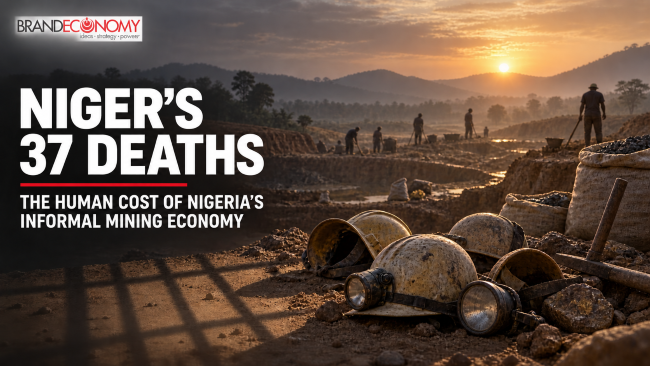
 Thirty-seven people entered the custody of the Nigeria Security and Civil Defence Corps (NSCDC) as suspects in Niger state. The artisinal miners did not emerge to face charges, defend themselves or receive a judicial verdict. They were reported dead. That brutal fact has transformed what began as an operation against suspected illegal mining into a national reckoning over human rights, public-sector accountability and the governance of Nigeria’s largely informal solid-minerals economy.
The dead were among dozens of people reportedly detained after raids on suspected illegal gold-mining sites in the Wushishi-Lukoto area of Niger State on September 15 and 16, 2026. Reports put the number arrested at 67. Many of those who died were said to be teenagers between 14 and 18, a detail that deepens the legal and moral gravity of the episode.




The NSCDC initially linked the deaths to a suspected illness. Survivors, however, gave a sharply different account. They described a crowded, poorly ventilated cell, panic as detainees struggled to breathe and alleged mistreatment. Survivor accounts reported by international media included claims of beatings and dangerous confinement. These allegations remain subject to investigation, but the divergence between the official explanation and eyewitness testimony makes an independent, evidence-led inquiry indispensable.
From enforcement operation to national crisis
Public anger quickly spilled onto the streets of Minna. Protesters demanded justice, security personnel deployed tear gas and reports indicated that live rounds were also fired during clashes. At least one protester was reportedly killed. The Niger State Government imposed an overnight curfew, while Governor Mohammed Umaru Bago declared three days of mourning and confirmed the death toll at 37.
President Bola Tinubu ordered an investigation and made the important point that suspensions could not substitute for justice. Interior Minister Olubunmi Tunji-Ojo suspended the Niger State NSCDC Commandant, Suberu Siyaka Aniviye, pending investigation. Subsequent reports said 21 personnel were suspended and a 10-member investigative committee established. Information Minister Mohammed Idris promised accountability while cautioning against reaching conclusions before the inquiry was completed.
That caution is procedurally fair, but it cannot become a shelter for delay. A credible investigation must establish who authorised the arrests, the number and ages of detainees, the capacity and ventilation of the cell, the availability of water and medical care, the custody log, the conduct of individual officers and the precise medical cause of each death. Reporting has differed on whether bodies were sent for examination before burial. The inquiry must therefore disclose what forensic work was undertaken and how evidence will be preserved.
Nigeria has seen too many investigative panels produce statements rather than consequences. This case requires a public timetable, an independent forensic component, participation by human-rights and legal bodies, protection for survivors and witnesses, and a report whose findings are published rather than buried inside government files.
Illegal does not mean disposable
The victims were suspects, not convicted offenders. Even where an arrest is lawful, custody transfers responsibility for a person’s safety to the state. Nigeria’s constitutional protections of life and human dignity do not disappear because a citizen is poor, works at an unlicensed pit or is accused of violating mining regulations. Where minors are involved, the duty of protection becomes still more demanding.
This distinction matters because the language of ‘illegal miners’ can erase the economic hierarchy inside the trade. The labourer digging by hand is often the most visible and expendable participant, but rarely the most powerful. Above the pit may sit financiers, mineral buyers, transporters, licence racketeers, smugglers, politically connected intermediaries and armed groups that tax access to sites. Enforcement that concentrates on impoverished diggers while the commercial network remains intact may create arrests without dismantling the illicit economy.
A mineral-rich country with a poverty-driven mining model
Nigeria has deposits of gold, lithium, limestone, iron ore, zinc, copper, tantalite and other minerals. Government officials have identified about 23 mineral types in commercial quantities. Yet mining still contributes less than one per cent of gross domestic product. The contradiction is not a shortage of rocks beneath the ground; it is a shortage of institutions capable of converting geology into regulated production, taxable value, safe employment and community development.
For thousands of Nigerians, artisanal mining is not an investment thesis but a survival strategy. Rural unemployment, insecurity, weak agricultural incomes and limited access to formal credit push young people towards pits that offer immediate cash but little protection. They often work without reliable geological information, safety equipment, insurance, mechanisation, environmental controls or guaranteed buyers. In such circumstances, informality is not simply a criminal preference. It is also the economic outcome of exclusion from formal systems.
The federal government has attempted to clean up the sector. It has revoked hundreds of dormant titles, moved against licence racketeering, promoted local processing and said new licences should be tied to domestic value addition. Nigeria has also pursued cooperation on geological mapping and mineral data, including the use of drone technology. These reforms signal seriousness, but they largely address the formal top of the market. The crisis at the bottom – where artisanal labour, community claims, criminal finance and weak enforcement collide – remains insufficiently resolved.
Niger State illustrates the danger. Its gold and other mineral deposits attract artisanal workers, while criminal groups reportedly levy miners or demand a share of extracted ore. Gold can then move through opaque trading networks into international supply chains. When the origin of mineral output is difficult to trace, the rewards flow upward while the environmental, security and human costs stay with mining communities.
Technology can trace minerals but cannot replace justice
Nigeria has the technological tools to govern the sector more intelligently. Satellite imagery and drones can identify new pits and monitor changes in land use. A modern mining cadastre can clarify valid titles and expose overlapping claims. Biometric or digital registration can bring artisanal miners into cooperatives, while licensed buying centres and electronic payments can create transaction records. Mineral tagging, assay certificates and chain-of-custody systems can help buyers verify origin and reduce smuggling.
But technology is an instrument, not an ethical substitute. A drone can detect a pit; it cannot decide whether a teenage labourer should be treated as a criminal, a child requiring protection or a worker needing a pathway into formal employment. Digital surveillance without due process could merely make coercive enforcement more efficient. The operating model must therefore combine intelligence-led action against financiers and smugglers with lawful, proportionate treatment of workers and communities.
Market implications
The Niger deaths increase the governance discount already attached to Nigerian mining. Serious investors do not assess ore grades alone. They examine licence integrity, security, community consent, custody practices, environmental liabilities, traceability and the state’s capacity to enforce rules predictably. A jurisdiction in which an enforcement raid ends in mass deaths, conflicting explanations and uncertain forensic evidence looks less investible, not more disciplined.
The opportunity is equally clear. Formalising artisanal supply could expand reported production, tax receipts and rural employment while reducing smuggling. It could also give banks, insurers and equipment-leasing companies a new class of customers. The sector needs financial products built around cooperatives, verified offtake agreements and shared machinery, rather than conventional collateral that poor miners cannot provide.
Brand implications
For the NSCDC, the crisis threatens the brand promise embedded in its name: civil defence and protection. Institutional reputation will not be repaired through statements alone. It will depend on transparency, disciplinary consequences where wrongdoing is established, compensation where liability is proven and visible reform of detention standards.
For Nigeria, the issue is larger. The country wants to present itself as a credible source of gold, lithium and other minerals required by global manufacturing and the energy transition. Buyers and financiers increasingly demand responsible sourcing. A national mining brand cannot be built on untraceable production, abusive enforcement and communities that experience mineral wealth primarily through danger and dispossession.
Investor relevance
Investors should treat the tragedy as a material governance signal. Human-rights due diligence, community engagement and mineral traceability are no longer peripheral corporate-social-responsibility items; they influence financing, insurance, offtake agreements and access to international markets. Operators entering Nigeria must understand not only federal licences but also local power structures, land expectations, artisanal activity and security-agency conduct around their concessions.
Responsible capital can help create a better model by funding safer processing hubs, geological services, formal buying centres, equipment pools and transparent community-benefit agreements. But investors should resist arrangements that merely displace artisanal miners or outsource coercion to security agencies. Social legitimacy is an operating asset; without it, even a legally valid licence can become commercially stranded.
What meaningful reform should now deliver
- Independent accountability: Publish the investigation’s terms of reference, preserve custody and medical evidence, protect witnesses and release the final report with clear prosecutorial and disciplinary recommendations.
- Custody reform: Audit all NSCDC detention facilities, enforce maximum occupancy and ventilation standards, guarantee prompt medical screening and legal access, and prohibit the detention of children with adults.
- Target the economic command structure: Differentiate subsistence workers from organisers, armed protectors, financiers, corrupt officials, smugglers and bulk buyers. Enforcement should follow money and mineral flows, not merely arrest those easiest to reach.
- Build a route into legality: Simplify cooperative registration and small-scale licensing, establish transparent buying centres and give miners access to safety training, cleaner processing, equipment leasing and working capital.
- Create traceable markets: Link digital miner identities, licensed sites, assays, transport documentation, payments and export records so that mineral origin can be verified from pit to purchaser.
- Make communities visible beneficiaries: Publish local production and revenue data, strengthen remediation obligations and embed credible community-development agreements in operating approvals.
BRANDECONOMY Insight
Nigeria cannot build a globally credible minerals industry by treating the poorest people in its value chain as expendable. Nor can it formalise mining through force alone. The strategic task is to replace a shadow economy with a governed market – one that identifies miners, traces output, finances safer production, rewards host communities and prosecutes the powerful actors who profit from illegality.
The Niger deaths are therefore more than a custody scandal. They expose a development model in which mineral wealth coexists with institutional weakness, youth poverty and unaccountable power. The government’s response will show whether Nigeria’s mining reforms are principally about controlling resources or building a lawful industry that protects citizens while creating value.
Justice for the dead miners and reform of the sector are not competing objectives. They are inseparable. A state that cannot keep suspects alive in custody will struggle to persuade communities, investors or global buyers that it can responsibly govern the wealth beneath its soil.