

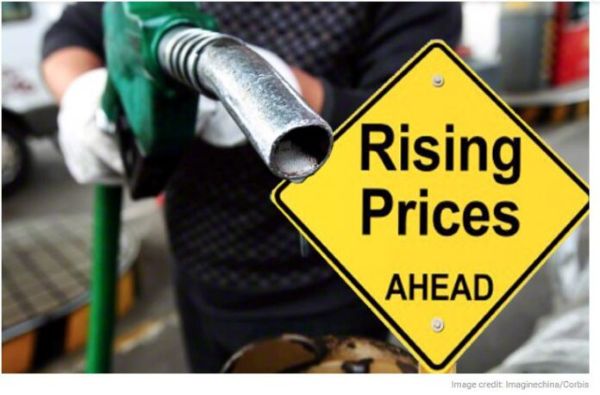
 Petrol prices across the Federal Capital Territory have begun another upward march, reminding Nigerians that the end of fuel subsidy did not end fuel anxiety. It merely transferred the anxiety from government accounts to household budgets, transport fares, business margins and filling-station forecourts.
Checks by the News Agency of Nigeria on Sunday showed that several Abuja retail outlets had adjusted the pump price of Premium Motor Spirit, popularly called petrol, following Dangote Petroleum Refinery’s latest gantry-price increase from N1,265 to N1,350 per litre. The N85 adjustment represents a 6.7 per cent rise and places the refinery’s wholesale price above the reported petrol landing cost of about N1,311 per litre.

Across parts of the FCT, the response was swift. MRS outlets reportedly moved from N1,350 to N1,395 per litre. NIPCO stations raised pump price from N1,350 to N1,430 per litre, while Mobil outlets adjusted from N1,350 to N1,400 per litre. At one MRS station, an attendant who asked not to be named said the station was still selling old stock, warning that new deliveries could trigger higher prices.
The immediate cause is crude. Brent crude, the benchmark closely watched in global oil markets, has traded above $100 per barrel amid geopolitical tensions and supply concerns. Nigerian market reports placed the price around the $107 to $108 per barrel range, with downstream operators bracing for higher replacement costs.
But the bigger story is not just the price on the pump. It is the structure of Nigeria’s new downstream petroleum economy.
For years, Nigerians were told that domestic refining would soften the country’s exposure to imported petrol, shipping costs, foreign refining margins and landing-cost volatility. That argument remains broadly valid. Local refining should reduce some logistics and import-dependency costs. But it does not magically detach petrol from global crude prices, especially when crude feedstock is priced against international benchmarks and the naira remains under pressure.
That is the hard lesson now playing out in Abuja.
The Domestic Refining Paradox
Dangote Refinery has become the dominant symbol of Nigeria’s industrial ambition in petroleum processing. Its emergence has reduced the psychological helplessness that came with decades of importing refined fuel despite being an oil-producing country. Yet its pricing decisions now carry enormous market power because of the scale of its output and the fragility of alternatives.
This creates a paradox. The refinery is a strategic national asset, but petrol is also a public welfare commodity. When Dangote’s gantry price moves, marketers respond, filling stations adjust, transporters recalculate, and households absorb the shock. In a deregulated market, that is expected. In a low-income economy with weak public transport, fragile wages and food inflation, it is politically explosive.
The National Publicity Secretary of the Independent Petroleum Marketers Association of Nigeria, Chinedu Ukadike, said marketers were adjusting prices in response to successive price reviews by Dangote Refinery. His point reflects the replacement-cost logic that drives downstream retail. A filling station may have old stock, but once the marketer expects the next truck to arrive at a higher price, the temptation to reprice becomes immediate.
That is where consumers feel cheated. They ask why old stock should suddenly behave like new stock. Marketers respond that they must sell today in a way that enables them to restock tomorrow. Both arguments reveal the trust deficit at the heart of Nigeria’s deregulated fuel market.
Inflation’s Second Engine
Dr Aliyu Ilias, an economist and development expert, warned that the latest fuel-price increase could worsen inflation and deepen hardship. His concern is grounded in Nigeria’s cost structure. Petrol is not merely a transport fuel. It is an input into food distribution, informal commerce, generator use, small manufacturing, logistics, personal mobility and service delivery.
When petrol prices rise, market women pay more to move goods. Workers pay more to commute. Schools adjust transport fees. Ride-hailing fares shift. Artisans increase charges. Food traders add fuel cost to tomatoes, rice, garri, beans, meat and cooking essentials. The burden eventually lands on consumers whose wages rarely adjust with the same speed.
This is why fuel inflation is never isolated. It becomes food inflation, service inflation, rent pressure, school-fee pressure and wage agitation.
For the Central Bank of Nigeria, higher petrol prices complicate monetary policy. Even if headline inflation moderates statistically, energy shocks can reignite cost-push pressure. For fiscal authorities, it creates a political challenge: subsidy savings may look sensible on paper, but households judge reform by daily survival.
The Lakemfa Argument
Mr Owei Lakemfa, former Secretary-General of the Organisation of African Trade Union Unity, argued that Nigeria should not allow global oil-market turbulence to pass automatically into domestic pump prices. His position is rooted in a governance question: what is the advantage of being an oil-producing country if citizens are fully exposed to every international price shock?
Lakemfa pointed to geopolitical tensions involving major oil-producing and consuming countries, including the United States and Iran, as foreseeable risks that policymakers should plan for. He argued that refining in Nigeria should confer some advantage over importing refined products because imports carry additional costs such as shipping, insurance, foreign labour and logistics.
His deeper concern is market concentration. If the downstream structure tilts toward oligopoly or monopoly, a few major players can exert outsized influence over a critical national commodity. That is not a theoretical fear. Petrol determines movement, food prices, business confidence and public mood. A country cannot treat it as an ordinary product.
This is where regulators must earn public trust. Deregulation should not mean regulatory absence. The Nigerian Midstream and Downstream Petroleum Regulatory Authority, the Federal Competition and Consumer Protection Commission and other relevant institutions must ensure transparency, competition, fair dealing and consumer protection.
Market Implications
The latest Abuja pump-price movement will likely trigger fresh cost adjustments across logistics, retail, food distribution and urban mobility. Transport operators will reprice quickly. Small businesses running petrol generators will either raise prices, cut hours or absorb margin pressure. Informal workers, already squeezed by inflation, will face tougher choices.
For downstream marketers, volatility creates working-capital stress. When gantry prices move frequently, smaller marketers with weaker balance sheets struggle to plan inventory. Larger operators can hedge, stock, negotiate and absorb shocks better. That may gradually concentrate the market around better-capitalised players, reducing diversity and weakening competition.
For the broader economy, unpredictable fuel pricing undermines planning. Businesses cannot budget confidently. Households cannot forecast monthly spending. Investors struggle to model consumer demand. Even where deregulation is economically defensible, excessive volatility damages confidence.
Brand Implications
Dangote Refinery’s brand sits at the centre of a delicate national expectation. It is not seen merely as a private industrial project. It is seen as a Nigerian solution to a Nigerian embarrassment. That gives it enormous goodwill, but also unusual reputational exposure.
Every price hike tests the promise of domestic refining. If consumers conclude that local refining has not improved affordability, the refinery’s brand could face resentment despite operating within market realities. The challenge for Dangote is communication. Nigerians need clarity on crude cost, exchange-rate exposure, logistics, taxes, margins and why local production does not always mean lower prices.
Retail brands such as MRS, NIPCO and Mobil also carry trust risk. Pump-price changes must be transparent and defensible. Where consumers suspect arbitrary pricing, loyalty erodes. In fuel retailing, brand trust is built not only by availability but by perceived fairness.
Investor Relevance
For investors, the price movement reinforces three signals. First, Nigeria’s downstream sector is now more commercially open but still politically sensitive. Second, domestic refining creates opportunity but does not remove exposure to global crude cycles. Third, market structure and regulation will determine whether value creation is broad-based or concentrated.
Investors in logistics, power, manufacturing, FMCG, agriculture and retail must now price energy volatility into their models. Downstream investors will watch margins, regulation, competition and foreign-exchange dynamics. Development finance institutions will watch the welfare impact because fuel price shocks can weaken reform legitimacy.
The investment opportunity remains significant. Storage, distribution efficiency, modular refining, gas-powered mobility, electric transport, rail logistics and mass-transit systems become more urgent in a high-fuel-cost economy. Nigeria’s next energy opportunity may not be only refining; it may be reducing the economy’s dependence on petrol-powered movement.
BRANDECONOMY Insight
Nigeria is discovering that subsidy removal is not the same thing as market reform. A subsidy can be removed by policy announcement. A functioning market requires competition, data transparency, consumer protection, supply security, predictable regulation and social cushioning.
Domestic refining is a national gain, but it cannot be allowed to become a new mythology. It will not automatically deliver cheap fuel if crude is expensive, the naira is weak, logistics are inefficient and competition is thin. The real reform test is whether Nigeria can build a downstream market that is efficient, transparent and fair.
The Abuja pump-price increase is therefore more than another petrol story. It is a warning about the social contract of reform. Citizens were asked to accept pain today for a better tomorrow. Government, regulators and market leaders must now prove that tomorrow is not permanently postponed.