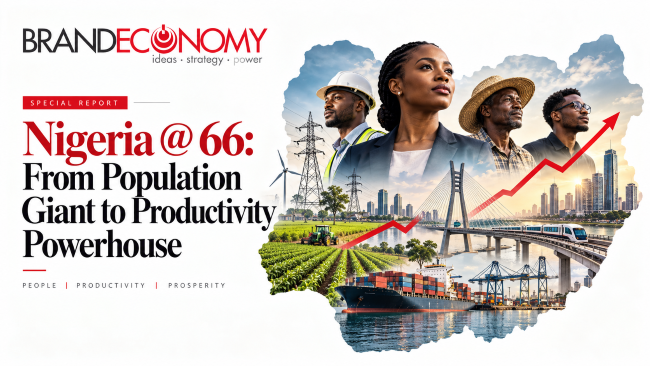
Nigeria @ 66: From Population Giant to Productivity Powerhouse

 By Nnanke Harry Willie
 By Nnanke Harry Willie
“The true strength and wealth of a kingdom or state consists in the number and opulence of its subjects.”
– Adam Smith, Scottish economist and philosopher (The Wealth of Nations)
Nigeria has spent decades celebrating its population size, natural resources, diversity and entrepreneurial energy. But prosperity does not come from potential alone. It comes from productivity. As Nigeria turns 66, the country’s greatest untapped resource lies not only beneath the soil. Nigeria’s greatest untapped resource is productive power of teeming Nigerians themselves.
Sadly, the focus of many past and present-day political leaders has been on building monuments for photo ops and viral videos. Unfortunately, many projects are not of world-class quality, but even worse, quite a few are misplaced priorities of federal and state governments. The key element of how such projects out to catalyse productivity, industry, commerce, economic boom, and elevate living standards has, to a large extent, been given scant consideration.
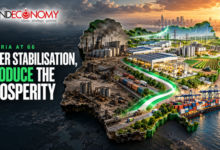


For instance, by early morning on almost any working day in Nigeria, the economy is already alive. A food trader is arranging tomatoes in Mile 12. A shoemaker in Aba is checking whether there is power before starting his machines. A young entrepreneur in Lagos is uploading new stock to WhatsApp Status. Somewhere outside Kano, a farmer is calculating whether transport costs will swallow his margin. At Apapa, an exporter is wondering whether his container will leave port on time.
Different people. Different sectors. Yet one economic question connects them all:
How much value can each Nigerian create from one hour of work, one naira of capital, one hectare of land and one kilowatt of electricity?
That question sits at the heart of Nigeria’s unfinished development story.
Sixty-six years after independence, Nigeria does not suffer from a shortage of potential. It suffers from a shortage of conversion.
It has people, but has not converted enough of them into highly productive human capital. It has farmland, but has not converted enough hectares into high-yield agriculture. It has gas, hydro resources and sunshine, but has not converted enough of them into dependable power.
It has entrepreneurs everywhere, yet too many remain trapped in survival-scale businesses. It exports commodities, but still captures too little value from processing, engineering, packaging and branding. It has one of Africa’s largest consumer markets, yet consumption has too often grown faster than production.
According to Elon Musk, “A larger population means more potential scientists, inventors, and entrepreneurs who can drive the progress of humanity.” An empowered and enabled population should be a major asset. Unfortunately, for Nigeria, it’s leaders have treated it like a liability for far too long. It is treated like a prop for presentations at poitical rallies and speeches at global sessions.
This is the Nigerian paradox at 66. And it suggests a deeper proposition: Nigeria’s greatest undeveloped economic resource is Nigerian productivity.
Not simply oil. Not gas. Not minerals. Not even population.
The decisive resource is the amount of economic value Nigeria can produce per worker, per hour, per hectare and per unit of capital.That is where the next Nigerian economic revolution must begin.
Stability Is Improving. Prosperity Must Follow
There is no need to pretend nothing has changed. Nigeria enters its 66th year with a macroeconomic picture stronger than during the turbulence that dominated the earlier phase of reform.
GDP expanded by 4.43 per cent year-on-year in the second quarter of 2026. Inflation has moderated from previous peaks. External buffers have improved. Nigeria also recorded a historic $6.1 billion in formal non-oil exports in 2025.
These are meaningful gains. But macroeconomic improvement is not yet the same thing as prosperity.
A Lagos family does not eat GDP.
A manufacturer cannot power machinery with foreign reserves.
A graduate cannot pay rent with an improved current-account balance.
And a farmer whose produce rots before reaching market does not experience economic stabilisation as prosperity.
That is why the next stage of reform is harder.
President Bola Ahmed Tinubu’s Independence address placed strong emphasis on reliable power, productive employment, agriculture, transportation, industry and access to finance. The Lagos Chamber of Commerce and Industry similarly acknowledged improving stability while warning that growth must now reduce business costs, improve purchasing power and create jobs. While these are sweet soundbites, the question remains if it is not just another swan song that ends at the end of the speech interlude.
Macroeconomic stability is the platform. Productivity is the transmission mechanism. Prosperity is the destination. It is also important to note that not much progress would be made if the macroeconomic stability is retained at its current asphyxiating levels.
Again, without transmission, Nigeria risks stabilising the economy without truly transforming it.
The Population Illusion
Nigeria has always loved big numbers: Africa’s largest population.One of its largest economies.A huge consumer market. Millions of young people. Vast agricultural potential.
All are genuine advantages.But population is not wealth.Population becomes wealth only when people are healthy, educated, skilled and connected to productive capital.
Imagine two Nigerians, both aged 22.
One leaves school healthy, digitally literate, technically capable and ready to solve problems. Give that young Nigerian electricity, broadband, finance and access to markets and the person becomes a productive economic asset.
The other reaches 22 after poor nutrition, weak schooling and inadequate skills, then spends years drifting between unemployment and low-value informal work. Same population statistic. Very different economic outcome. This is why demography is not destiny.
Nigeria’s education and human-capital challenge is fundamentally a productivity challenge. A child who cannot read properly at ten may become the under-skilled worker of 25. Multiply that across millions of people and the result is a low-productivity economy.
Education policy is therefore industrial policy. Health policy is competitiveness policy. Nutrition policy is productivity policy.
For so long, leaders across the divide have failed to hold supreme these eternal truths and Nigeria is now in a near decrepit state as millions of its youth are rendered rudderless with a booming almajiri population in the north and ‘area boys’ (street urchins) and touts in the south. These group of youth have also recently found a path to wealth and fame by porphing into bandits, terrorists, militants and kidnappers. It is eevn alleged that leaders not only empower such groups but even protect them for personal and political gains!
The Economy That Buys Versus the Economy That Makes
Walk through a Nigerian supermarket and one reality quickly becomes clear. Imported electronics. Imported machinery. Imported pharmaceuticals. Imported household goods. Imported industrial inputs.
Then travel into Nigeria’s agricultural and mineral belts and another picture emerges: commodities leaving the country with much of their potential value still unrealised. This is not an argument against imports. Successful economies import aggressively.
The real question is what those imports enable a country to produce. Nigeria imported roughly ₦9.51 trillion worth of manufactured goods in the second quarter of 2026.
Manufactured exports were about ₦393 billion. That gap captures the structural challenge.
Nigeria is still significantly better at consuming global industrial productivity than exporting Nigerian industrial productivity. Too often, commodities leave while value-added products return. Cocoa leaves. Chocolate returns. Raw crops leave. Processed foods return. Materials leave. Finished consumer goods return.
The answer is not economic isolation. It is competitive capability. Nigeria must increasingly ask not simply, “What can we stop importing?” but:
“What can Nigerian firms become good enough to produce competitively and export?” That is a far more ambitious question.
The Six Productivity Revolutions
The path from population giant to productivity powerhouse is neither mysterious nor impossible. It requires a series of connected revolutions.
The first is power.
For decades, the sound of a generator starting has been part of Nigeria’s economic soundtrack. A bakery becomes a power company before it can bake bread. A hotel solves electricity before selling rooms. A factory spends capital on generators, fuel and maintenance before producing a single unit.
That is productivity lost before production even begins.
Aba offers a glimpse of what greater predictability can achieve. Improved electricity supply around the Geometric Power network has helped businesses plan more confidently.
The lesson is simple. Electricity does not merely provide light. It provides certainty.
A factory that knows when power will be available can schedule production. A cold room can reduce spoilage. A shoemaker can promise delivery.
Nigeria’s electricity debate must therefore move beyond hours of supply to a tougher metric:
How many dependable, competitively priced kilowatt-hours are available for productive use?
Then comes agriculture.
A basket of tomatoes can explain Nigerian productivity better than many policy documents. A farmer may successfully grow the crop, only for a substantial portion of its value to disappear through poor storage, heat, weak transport, bad handling and market delays.
The farmer has produced. But the economy has failed to preserve what was produced.
Productivity therefore means both producing more and losing less.
Nigeria needs higher yields, irrigation, better seeds, mechanisation, extension services, storage, cold chains, rural roads and agro-processing.
And agriculture must increasingly move beyond the farm gate:
- Cocoa should feed processing industries.
- Tomatoes should become paste and packaged food.
- Cassava should become starch and industrial input.
- Milk should enter modern dairy chains.
Agriculture becomes transformational when there are factories behind the farms.
That leads directly to manufacturing. A functioning factory does more than make products. It creates an ecosystem around itself.
Transport. Packaging. Maintenance. Insurance. Finance. Engineering. Security. Software. Distribution. This is why manufacturing remains essential to large-scale prosperity.
But Nigerian manufacturing cannot be built around patriotic appeals alone. Consumers may try “Made in Nigeria” once out of sentiment. They return only for quality.
The real ambition must therefore be:
Made in Nigeria. Competitive anywhere.
Nigeria needs deeper industrial capacity in food processing, petrochemicals, pharmaceuticals, construction materials, textiles, packaging, vehicle components, energy equipment and electronics.
Protection may create breathing room. Only productivity creates sustainable competitiveness.
Then there is logistics.
Nigeria loses extraordinary amounts of economic value through wasted time. A truck stuck in traffic. A container delayed at port. consignment waiting for clearance. An exporter waiting days for cargo to move. Each delay looks small in isolation. Together they form an enormous invisible tax.
Apapa has long illustrated the problem.
When cargo movement becomes unpredictable, working capital becomes trapped. Loans keep accumulating interest. Overseas buyers become impatient. And the problem eventually becomes bigger than logistics.
It becomes a brand problem. The foreign customer does not care why the shipment was late. The customer remembers only that Nigeria did not deliver. Infrastructure should therefore increasingly be judged by three outcomes:
Cost-to-market. Time-to-market. Certainty-to-market.
The fifth revolution is human capital. Nigerians are frequently praised for working hard.
They do. But hard work is not the same thing as productivity.
A woman may work 14 hours selling goods from a roadside stall and still create less economic value than someone operating modern equipment for six hours.
The difference is not character. It is tools, skills, capital and organisation.
Nigeria must therefore move from an education system that celebrates certificates to one that rewards capability.
Can graduates analyse? Write? Design? Repair? Code? Sell? Manage? Operate equipment? Use artificial intelligence?
The future labour market will not pay primarily for time spent in school. It will pay for what people can actually do.
Finally comes SME and technology productivity.
Perhaps Nigerian enterprise is most visible today on the smartphone. Thousands of businesses use WhatsApp, Instagram and digital payments as storefronts, catalogues, cash registers and customer-service desks.
Entrepreneurs have demonstrated remarkable ability to build with very little. But Nigeria’s next challenge comes after the hustle succeeds. Can the one-person business become a five-person business?
Can five employees become fifty? Can a small firm obtain formal credit? Keep proper accounts? Export? Build systems? Survive its founder?
Nigeria does not merely need more entrepreneurs.
It needs an enterprise escalator: Micro to small; Small to medium; Medium to large; Local to national; National to African; African to global.
Finance Must Find Production
None of these transformations happens without capital. Factories need long-term finance. Farmers need seasonal finance. Exporters need working capital. Technology companies need risk capital. Infrastructure needs patience.
Nigeria must therefore distinguish between ordinary credit and productive credit.
Consumer credit expands purchasing power. Productive credit expands the economy’s capacity to satisfy that demand.
Banks, pension funds, development-finance institutions, private equity and capital markets should increasingly ask one question:
What additional productive capacity will this naira create?
An economy that finances buying more efficiently than manufacturing eventually creates imbalance.
The National Brand Is Built in Performance
Productivity also shapes reputation. Germany suggests engineering. Japan suggests quality.
South Korea increasingly suggests technology and culture. What should Nigeria evoke globally by 2036?
The answer will not come from advertising alone.Every Nigerian product that performs well abroad strengthens the national brand.Every late shipment weakens it.
Every successful software company strengthens it. Every unreliable process weakens it.
The strongest advertisement for Nigeria will ultimately be:
What Nigeria makes, how well it makes it and how reliably it delivers it.
The Real Challenge Is Conversion
Nigeria has talked about potential for so long that the word risks becoming a national comfort blanket.
- Potential oil wealth.
- Potential agricultural powerhouse.
- Potential demographic dividend.
- Potential manufacturing giant.
- Potential technology hub.
- At 66, potential needs a deadline.
- The challenge is no longer to prove that Nigeria possesses resources, talent or entrepreneurial energy. Nobody seriously disputes that.
- The real challenge is to convert them.
- Convert gas into electricity.
- Convert electricity into production.
- Convert agriculture into agro-industry.
- Convert education into skills.
- Convert skills into productive employment.
- Convert entrepreneurship into scalable companies.
- Convert minerals into higher-value products.
- Convert technology into efficiency.
- Convert stability into investment.
- And convert investment into prosperity.
This is where Nigeria’s economic conversation must become more practical and less ceremonial. The real measure of development is not whether Nigerians are busy. Nigerians are already busy.
It is whether their effort produces progressively greater value. It is the Aba shoemaker who can run machines without constantly listening for the generator.
The farmer who gets more produce from the same land and loses less before reaching market. The young entrepreneur who moves from selling through WhatsApp to employing people, keeping proper accounts and supplying customers across Africa.
The manufacturer who can quote prices with confidence because energy, finance and logistics have become more predictable. The exporter whose container arrives when promised.
The graduate whose qualification actually signals useful capability. The Nigerian brand on a shelf in Johannesburg, London or Dubai that wins not because of sentiment, but because it is simply excellent.
That is what productivity looks like when stripped of economic jargon. And it compounds.
A more productive worker earns more. A more productive company can pay more. A more productive factory can compete. A more productive farm can lower food costs. A more productive economy attracts more investment. Investment brings better technology. Better technology increases productivity again.
That is how prosperity becomes self-reinforcing. Nigeria therefore does not need another decade defined principally by the language of potential.
It needs a decade of conversion.
Between Nigeria@66 and Nigeria@76, the national mission should be clear:
Because the richest resource beneath Nigeria’s future may not be buried in the ground.
It wakes up every morning. It enters the farm. Starts the machine.Opens the shop.Loads the truck. Logs onto the laptop. Teaches the class. Builds the company. It is the Nigerian.
And the defining economic assignment of the next decade is to make every hour of that Nigerian effort worth considerably more.
The current leadership of Nigeria would do well to imbibe these immutable truths of development in order to begin to quickly rewrite Nigerian brand story as a true Giant of Africa!
Nnanke Harry Willie
Veteran Brand Strategist | Public Commentator
Founder, HQSC | Publisher, brandeconomy.com
Email: [email protected]