NLNG’s Methane Strategy Links Recovered Gas, Train 7, Value and Export Credibility

 At Gastech 2026 in Bangkok, NLNG connected captured methane to cash flow, embedded emissions control in Train 7 and positioned verified reporting as a defence of Nigeria’s LNG market access.
Nigeria LNG Limited is framing methane reduction as an integrated business strategy linking recovered gas to revenue, Train 7 to more efficient growth, operational discipline to asset value and verified emissions data to export credibility.




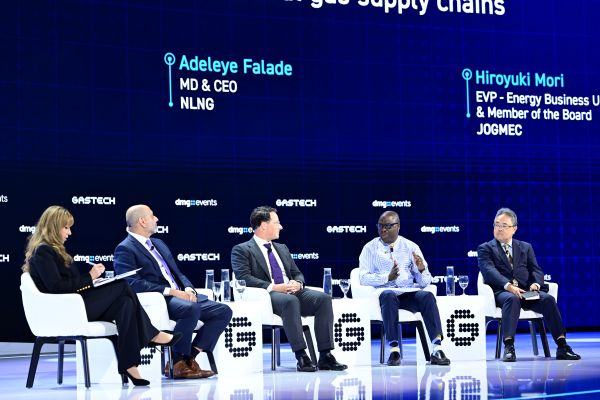
Adeleye Falade, NLNG’s Managing Director and Chief Executive Officer, presented the case at the Gastech 2026 Exhibition and Conference in Bangkok. He spoke during a panel on aligning methane action across natural-gas supply chains, alongside Zubin Bamji of the World Bank, Niels Dijksman of Brunei LNG and Hiroyuki Mori of JOGMEC. Energy economist Dr Carole Nakhle of Crystol Energy moderated the session.
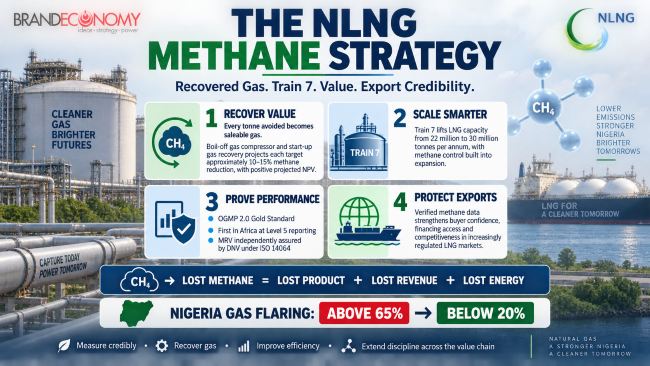
Falade’s central point was that methane is a saleable molecule before it becomes an emissions statistic. Gas that escapes cannot reach customers, support energy access or earn foreign exchange. “Every tonne emitted is lost product, lost revenue and lost energy,” he said. The argument moves methane control from the sustainability budget into capital allocation and plant performance.
 Recovered gas becomes business value
 Recovered gas becomes business value
NLNG cited a new boil-off gas compressor and a start-up gas recovery project as evidence that abatement can produce a financial return. Each is expected to cut methane by approximately 10 to 15 per cent and carries a positive projected net present value, indicating that anticipated lifetime benefits exceed estimated costs.
That logic is supported by wider industry economics. The International Energy Agency estimates that existing technology could abate about 70 per cent of fossil-fuel methane emissions and that roughly 30 per cent could be eliminated at no net cost because recovered fuel is worth more than the intervention. Oil-and-gas methane reduction could make nearly 100 billion cubic metres of gas available annually.
For investors, however, a projected NPV is a thesis rather than a result. NLNG can strengthen the case by publishing capital cost, measurement baselines, recovered volumes, payback periods and independently verified post-commissioning reductions. Those figures would show how much environmental performance is becoming cash flow, higher utilisation and avoided downtime.
Train 7 puts the strategy to scale
Falade said methane controls are being built into Train 7, the expansion designed to raise NLNG’s production capacity from 22 million to 30 million tonnes per annum. Engineering recovery into the project from the outset should cost less than retrofitting leak controls later and could improve reliability across the expanded plant.
Train 7 also raises the standard of proof. Methane intensity can fall while absolute emissions increase as output rises. NLNG should therefore report both measures, with routine flaring, venting, major leak events and recovered-gas volumes. That scorecard would reveal whether larger capacity is creating more value with a smaller emissions burden.
At national level, Falade credited NLNG’s conversion of gas that might otherwise have been flared with helping Nigeria reduce its flaring rate from above 65 per cent to below 20 per cent. The underlying development opportunity remains substantial: recovered gas can support exports, industrial feedstock and domestic energy. Capturing it consistently will require dependable gathering infrastructure, contracts, regulation and payment discipline.
Export credibility rests on trusted data
 Export credibility rests on trusted data
NLNG says measurement guides its investment choices. Its system combines site-wide optical gas imaging, a structured leak-detection and repair programme, phased continuous monitoring and real-time dashboards across its Bonny plant and vessels. DNV independently assures its measurement, reporting and verification system under ISO 14064.
The company holds Gold Standard recognition under the United Nations Environment Programme’s Oil and Gas Methane Partnership 2.0 and says it was the first African operator to attain Level 5 reporting. Level 5 reconciles source-level estimates with site-level measurements, offering the framework’s highest data quality. It strengthens confidence in the inventory, although it does not by itself prove that emissions are low.
This distinction now carries commercial weight. European Union import requirements place measurement and verification at the centre of gas trade. From 2027, importers must demonstrate equivalent standards or Level 5 reconciliation plus verification for relevant oil-and-gas contracts. Methane-intensity reporting follows in 2028, with a threshold scheduled from 2030. Emissions evidence is becoming part of the LNG product specification.
NLNG’s Scope 3 Advocacy Plan extends this discipline upstream. The company says it obtains verified data from feed-gas producers, engages suppliers and contractors on reductions and includes environmental criteria in procurement. This is essential because a significant part of an LNG cargo’s methane footprint can arise before gas reaches the liquefaction plant.
Market implications
Methane performance is beginning to differentiate LNG cargoes that look chemically identical. Buyers can favour suppliers with verifiable low-intensity gas, while lenders and insurers can use the same evidence when pricing operational and transition risk. Shared measurement rules would reduce duplication, constrain selective reporting and improve comparability across exporting jurisdictions.
Brand implications
For NLNG, credible methane performance can strengthen a brand built around reliability and international operating discipline. It also challenges the idea that African producers require diluted standards. That reputational advantage will last only if NLNG publishes comparable trends, explains setbacks and holds feed-gas suppliers to the same expectations it applies at Bonny.
Investor relevance
Investors should track methane intensity, absolute emissions, recovered-gas value and capital efficiency. They should also test whether verified data improves financing terms, protects access to demanding buyers or reduces unplanned downtime. If those benefits become visible in cash flow, asset availability and contract quality, methane control will serve as evidence of capable management.
BRANDECONOMY Insight
NLNG’s methane strategy is most compelling when its four elements are read together. Recovery protects a valuable product. Train 7 provides the scale at which better design can multiply the gains. Measurement converts claims into credible evidence. Export credibility turns that evidence into commercial resilience.
The next step is proof at scale. NLNG should publish a performance series showing what was detected, what was repaired, how much gas and value were recovered, and how Train 7 affects both absolute emissions and intensity. Falade aligned this work with Nigeria’s net-zero 2060 and zero routine flaring 2030 goals while insisting that energy access and affordability must advance with emissions reduction. Verified results will determine whether methane leadership becomes a durable competitive advantage.