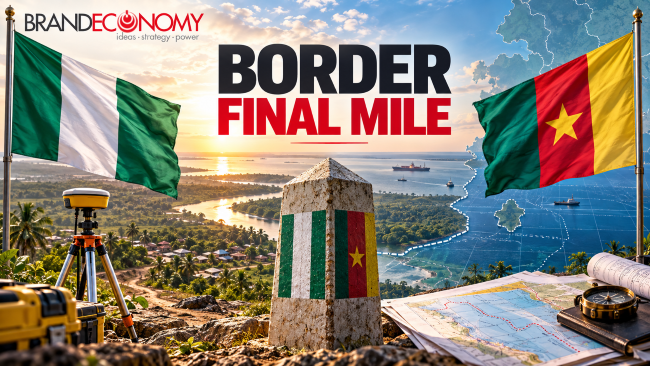
 Nearly 24 years after the International Court of Justice delivered its judgment on the Cameroon-Nigeria land and maritime boundary dispute, the two countries are approaching the completion of one of Africa’s most consequential post-colonial border demarcation exercises.
A Border Story Bigger Than Pillars


Mr Adamu Adaji, Director-General of Nigeria’s National Boundary Commission, told the News Agency of Nigeria in Abuja that the remaining physical demarcation is concentrated around the Adamawa sector, where more than 260 boundary pillars are being emplaced to make the boundary visible on the ground.
According to him, the work could be completed within two or three months, with the expectation that the Nigeria-Cameroon international boundary demarcation may be concluded before the end of the year. Once that happens, the focus will shift from defining the border to managing its human, economic and security consequences.
This is not a routine cartographic update. It is the final mile of a diplomatic, legal and community-sensitive process that began after the ICJ judgment of October 10, 2002. The case is remembered in Nigeria mostly through the emotional prism of Bakassi, but its full implications stretch from the Lake Chad Basin through border communities in Nigeria’s eastern flank to the Gulf of Guinea.
The Long Shadow of the Nigeria-Cameroon Border ICJ Judgment
The 2002 ICJ judgment resolved the land and maritime boundary dispute between Nigeria and Cameroon, awarding sovereignty over the Bakassi Peninsula to Cameroon and delineating the boundary between both countries.
For Nigeria, Bakassi became a symbol of loss, grievance and the painful limits of post-colonial territorial inheritance. For international law, it became a major African case study in how states can submit a volatile territorial dispute to judicial settlement rather than prolonged armed confrontation.
Adaji noted that Nigeria’s boundary with Cameroon stretches about 2,100 kilometres, making it Nigeria’s longest international land boundary. By comparison, Nigeria shares about 770 kilometres with Benin and about 1,500 kilometres with Niger.
This means the Cameroon frontier is not a marginal line; it is a strategic corridor touching security, trade, migration, ethnic relations, customs enforcement, agriculture, maritime access and regional diplomacy.
Diplomacy After Dispute
Implementation began in 2002 after Nigeria and Cameroon agreed, under United Nations auspices, to give effect to the judgment. The two countries established the Nigeria-Cameroon Mixed Commission, chaired by the United Nations, to resolve outstanding issues and guide implementation.
That framework became the diplomatic bridge between legal finality and political reality. Court judgments can declare sovereignty, but border implementation requires maps, coordinates, field teams, security guarantees, community engagement, engineering works, presidential diplomacy and patience.
The Greentree Agreement on Bakassi, signed in 2006, became a defining moment in that process by setting the terms for Nigeria’s withdrawal and transfer of authority. However painful the outcome was for many Nigerians, the wider significance was that both countries avoided a full-scale war over a resource-sensitive territory and gradually built a mechanism for compliance.
Koja, Turu and the Human Geography of Sovereignty
One of the most important parts of Adaji’s account is the recognition that boundaries do not run across empty space. They cut through human settlements, farmlands, rivers, markets, language groups, kinship networks, grazing routes and ancestral memory.
Adaji said disagreements that caused some sectors to be skipped had been resolved through interventions by the presidents of both countries. The resolution allowed Nigeria and Cameroon to consider affected populations and adjust boundary lines in a spirit of give-and-take.
He cited Koja as a major Nigerian settlement affected by the boundary alignment, explaining that the ICJ-defined boundary initially placed about 90 per cent of the community in Cameroon. Through understanding between the two countries, Koja was retained in Nigeria, while concessions were made elsewhere. He also cited Turu, where Cameroonians are predominant, as an area treated as a concession to Cameroon.
That example is crucial. It shows that sustainable border management cannot be built on geometry alone. A technically accurate line that divides a living community without sensitivity can produce resentment, identity anxiety, economic disruption and long-term security risk.
From Demarcation to Border Governance
Adaji said the next phase would focus on management, including the needs of people adversely affected by the boundary. According to him, the NBC has assessed the needs of affected populations and is working with the United Nations to improve their conditions.
This is where the story moves from international law to development economics. Border communities are often treated as peripheral, yet they are frontline communities in national security, trade integration and neighbourly diplomacy.
If they are neglected, they can become vulnerable to smuggling networks, irregular migration routes, extremist influence, illicit arms flows, informal taxation and identity-based grievances.
If they are supported, they can become platforms for legal trade, agricultural value chains, cultural exchange, community intelligence, transport services, border markets and regional integration.
The Security Question
The Nigeria-Cameroon boundary sits within one of Africa’s most security-sensitive regions. Parts of the wider corridor connect to the Lake Chad Basin, where insurgency, displacement, arms trafficking and humanitarian fragility have affected Nigeria, Cameroon, Chad and Niger.
The challenge for Nigeria is to ensure that demarcation strengthens legitimate control without disrupting legitimate movement. Adaji captured this reality when he noted that people cannot simply be prevented from moving because the communities are often the same. In some places, a short movement places a person in another country. Some houses or farmlands may even straddle the boundary.
This is why cross-border cooperation is not a diplomatic luxury. It is a security necessity. Intelligence sharing, local committees, documented movement, joint understanding of community relationships and cooperation against smuggling or irregular migration will matter as much as boundary pillars.
Trade, Markets and the Corridor Economy
For businesses and investors, the Nigeria-Cameroon border demarcation provides something markets value deeply: clarity. Unclear borders create administrative uncertainty, customs confusion, policing ambiguity, land tenure risk and investment hesitation. Clear borders do not automatically create prosperity, but they reduce one layer of sovereign risk.
The Nigeria-Cameroon corridor has potential across agriculture, livestock, fisheries, timber, logistics, retail trade, small manufacturing, transport services, border markets, warehousing and formal export channels.
But that potential will remain underdeveloped unless demarcation is followed by investment in roads, border facilities, digital customs systems, security cooperation, health posts, schools, water supply and market infrastructure.
Nigeria’s broader continental trade ambition under the African Continental Free Trade Area will also depend on how it manages borders like this. Regional trade does not happen in policy speeches. It happens at roads, posts, markets, farms, ports and communities where goods and people move.
Maritime Boundaries and the Gulf of Guinea
Adaji also disclosed that Nigeria shares maritime boundaries in the Gulf of Guinea with Equatorial Guinea, Cameroon, Ghana and Benin. He said Nigeria’s maritime boundary with Cameroon has been resolved, about three nautical miles remain to be resolved with Equatorial Guinea, about eight nautical miles remain under negotiation with Ghana, while the maritime boundary with Benin is defined by treaty.
This maritime dimension is central to Nigeria’s strategic economy. Maritime boundaries are not marked by visible pillars; they are established by coordinates and maps. Yet they shape naval operations, shipping, fisheries management, offshore energy, maritime security, insurance risk, port competitiveness and the policing of illegal activity at sea.
For Nigeria, clarity in the Gulf of Guinea is not merely a legal matter. It affects oil and gas, blue economy planning, shipping routes, coastal surveillance and investor confidence in offshore assets.
Brand Nigeria and the Power of Peaceful Compliance
There is a brand dimension to this story that Nigeria should not ignore. The Bakassi outcome was domestically painful and politically controversial, but Nigeria’s eventual compliance helped preserve its diplomatic standing as a country willing to respect international law even when the judgment did not favour its preferred position.
For Brand Nigeria, that matters. Countries build reputational capital not only through economic growth, culture and population size, but through the way they manage disputes, honour agreements and protect vulnerable communities after difficult decisions.
The opportunity now is to convert compliance into leadership. Nigeria can use the completion of the Cameroon demarcation process to demonstrate a more mature model of border governance: lawful, humane, security-conscious, development-oriented and regionally cooperative.
But that brand value will be weakened if affected communities remain neglected. The test is not only whether pillars are planted. It is whether people living along the line see schools, clinics, roads, water, livelihoods, safety, identity protection and fair treatment.
Market Implications
A clearly demarcated boundary can reduce uncertainty for trade, customs administration, logistics, agribusiness and border markets. But value will depend on roads, border facilities, digital customs, security cooperation and support for communities that live along the frontier.
Brand Implications
Nigeria’s handling of the post-ICJ process can strengthen its reputation as a country that respects international law while protecting border communities. The brand opportunity lies in converting a painful Bakassi memory into a mature story of peace, order and regional leadership.
Investor Relevance
For investors, the near-completion of demarcation should be read as part of a broader risk map. Border clarity can support infrastructure planning, agribusiness, logistics, energy, telecoms, trade finance, insurance and regional commerce. It can also reduce uncertainty for projects close to the frontier.
However, demarcation alone does not eliminate risk. Investors will still watch insecurity, customs efficiency, road quality, policy consistency, community relations, land administration and cross-border enforcement. The opportunity is strongest where government converts legal clarity into corridor development.
If Nigeria and Cameroon can move from boundary definition to joint border prosperity, the corridor could attract investment in formal markets, cold-chain logistics, agro-processing, transport fleets, rural connectivity, warehousing, hospitality, border trade infrastructure and security technology.
The near-completion of the Nigeria-Cameroon boundary demarcation is a quiet but historic moment. It closes one chapter in a dispute that tested Nigeria’s diplomacy, Cameroon’s legal claims, the authority of the ICJ and the patience of border communities.
But the more important chapter begins after the last pillar is placed. Nigeria must now shift from boundary consciousness to corridor intelligence. The question is no longer only where Nigeria ends and Cameroon begins. The question is how both countries can make the border safer, more humane, more commercially useful and more developmentally productive.
The lesson of Bakassi is that territory is never just territory. It is identity, memory, livelihood, strategy, law, oil, sea access, diplomacy and emotion. If Nigeria treats the demarcation as a legal closure only, it will miss the larger opportunity. If it treats it as the beginning of a border-development compact, it can turn a painful history into a regional model.
For Nigeria, the Nigeria-Cameroon Border frontier challenge is now a governance challenge: protect the people, formalise legitimate movement, fight illicit flows, invest in communities, complete maritime clarity and convert border certainty into economic value. That is how a disputed line becomes a development corridor. That is how a loss remembered through Bakassi can still produce a legacy of peace, order and strategic maturity.