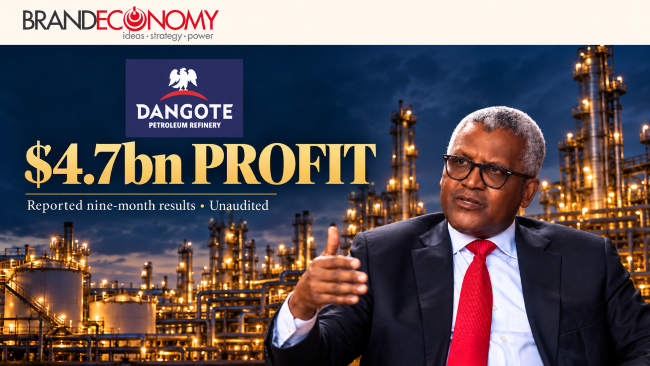
 Dangote Petroleum Refinery and Petrochemicals has given prospective shareholders a stronger commercial story to examine. Its reported $4.73 billion profit for the first nine months of 2026 suggests that the investment assembled around Africa’s refining ambitions is beginning to demonstrate earning power.
The question facing investors is how much of that Dangote Refinery profit earning power can endure, and what price reasonably reflects the risks attached to it.




According to company figures reported by THISDAY and Reuters, revenue reached $22.48 billion in the nine months ended September 30, compared with $9.19 billion a year earlier. The corresponding 2025 period produced a $117.2 million loss.
Released on October 13, the unaudited results arrive while the company is seeking wider public ownership through its initial public offering. They deserve careful attention because an industrial asset’s importance to Nigeria and its attractiveness at a particular share price require different assessments.
 A commercial breakthrough with a cyclical dimension
 A commercial breakthrough with a cyclical dimension
Managing Director and Chief Executive Officer David Bird attributed the improvement to higher throughput, greater operational reliability and stronger refining margins. He described the performance as evidence that the business was advancing from commissioning and production ramp-up towards sustained commercial operations.
Bird also linked the results to the Dangote Refinery IPO and Vision 2030 growth strategy, which encompasses capacity expansion, a broader product portfolio and stronger distribution across Africa.
The financial improvement is considerable.
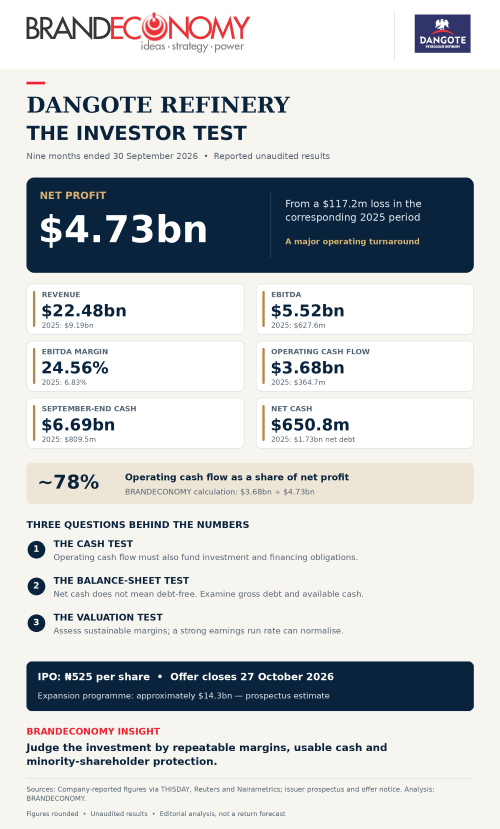
| Metric | January–September 2025 | January–September 2026 |
| Revenue | $9.19bn | $22.48bn |
| EBITDA | $627.6m | $5.52bn |
| EBITDA margin | 6.83% | 24.56% |
| Net profit/(loss) | ($117.2m) | $4.73bn |
| Operating cash flow | $364.7m | $3.68bn |
| September-end cash balance | $809.5m | $6.69bn |
| Net financial position | $1.73bn net debt | $650.8m net cash |
Source: Company-reported figures carried by THISDAY, Reuters and Nairametrics. The 2026 results are unaudited; figures are rounded. EBITDA excludes interest, tax, depreciation and amortisation.
The Dangote Refinery profit growth alone would not establish stronger economics. Refiners can sell more expensive products while paying correspondingly more for crude. The increase in EBITDA margin suggests that Dangote retained significantly more operating value from its sales.
Understanding that improvement requires separating operational progress from market conditions. Higher utilisation can distribute fixed costs across more output, while reliable logistics and a useful product mix can support competitive advantage.
Refining margins also fluctuate. They reflect the relationship between product prices, crude costs and processing expenses, rather than the oil price alone.
Reuters reported that supply disruptions associated with the Iran war supported demand for Dangote’s products, including jet-fuel sales into Western Europe. Such opportunities can reward capable operators without remaining equally profitable indefinitely.
The Dangote Refinery investment case therefore needs evidence that the refinery can perform when exceptional supply pressures ease. Throughput, downtime, product yields and margins across successive reporting periods will be more informative than capacity announcements alone.
The earnings must survive the cash test
The reported $3.68 billion operating cash flow is approximately 78% of net profit, according to BRANDECONOMY’s calculation.
That represents substantial cash generation, although profit recognised in the accounts exceeds cash produced by operations. The difference warrants examination rather than an automatic adverse conclusion.
Receivables, inventories, supplier-payment schedules, taxes and other timing movements can affect conversion. Investors need to establish whether these movements reflect commercial activity and whether earnings consistently turn into usable cash.
There is a further distinction between operating cash flow and cash available to shareholders. Maintenance and expansion expenditure must also be funded, alongside financing obligations.
A growing refinery can consequently report strong profits while retaining much of its cash for investment. Dividend expectations should reflect that competing demand.
The analysis here combines published coverage of the unaudited results with the available prospectus. Complete standalone September statements and detailed notes were not located, so specific explanations for the working-capital, tax or exceptional-item movements cannot be independently established.
That information would strengthen assessment of how much of the profit can recur.
A stronger balance sheet still carries obligations
The move from net debt to net cash improves the financial position. It does not establish that borrowings have disappeared.
Net cash measures the balance after specified cash holdings are offset against debt. A company can therefore have more cash than borrowings while still carrying loans and repayments.
If the reported $6.69 billion cash balance is the amount offset in the stated net-cash calculation, the figures imply gross borrowings of approximately $6.04 billion. This is an inference conditional on consistent definitions.
The relevant questions concern debt maturities, interest costs, currency exposure and the availability of cash. Restricted balances or money earmarked for expansion cannot be treated as freely distributable wealth.
Investors should also distinguish improved liquidity from the ability to fund every stage of a major growth programme without additional financing.
What the offer price assumes
The company’s October 12 extension notice confirms an offer of 4.1 billion shares at ₦525 each. Following Securities and Exchange Commission approval, the application period now closes on October 27.
Aliko Dangote has said demand exceeded the original fundraising ambition, stressing wider African participation in ownership. That interest demonstrates the brand’s ability to mobilise attention; valuation still requires an assessment of future returns.
The prospectus states indicative post-listing equity capitalisation of approximately ₦65.22 trillion.
Using an illustrative exchange rate of ₦1,330 per dollar converts that valuation to about $49 billion. Annualising the nine-month profit mechanically produces approximately $6.31 billion, implying a price-to-earnings multiple near 7.8 times.
This calculation is a scenario, not a profit forecast or current exchange-rate quotation. It assumes the base offer capital structure and that the nine-month earnings pace continues.
At the same illustrative equity value, annual profit of $4 billion would imply roughly 12.3 times earnings. At $3 billion, the multiple would rise to approximately 16.3 times.
These scenarios demonstrate why apparently modest multiples can become less compelling when cyclical earnings normalise. The central task is estimating sustainable profitability rather than selecting the most flattering annualised number.
Peer comparisons must similarly account for differences in refining exposure, leverage and capital requirements. A diversified oil major combines businesses whose earnings patterns may differ materially from those of a standalone refinery.
Expansion creates value only when returns justify it
The prospectus estimates the expansion programme at approximately $14.3 billion, with IPO proceeds meeting part of its phased funding requirements.
Greater capacity could strengthen the refinery’s commercial reach. It also introduces construction costs, financing decisions and commissioning risks before the additional assets generate returns.
The shareholder test is whether the incremental earnings reward the capital committed. Producing more barrels is useful only when the economics support the investment.
Governance also matters. The prospectus identifies related-party dealings and arrangements for their oversight. Transactions within the Dangote group may support efficiencies, but minority investors need transparent pricing, settlement terms and accountability for decisions affecting their company.
Published analyst research provides another perspective. CardinalStone’s initiation report set a twelve-month target price of ₦688.09 using discounted cash flow and valuation multiples.
Its assessment depends on assumptions about margins, expansion and financing. CardinalStone Partners is also among the IPO’s joint issuing houses; the report discloses relevant interests and states that analysts form their views independently.
That context belongs alongside the valuation opinion. A target price is an estimate to assess, rather than a promised outcome.
Nigeria’s industrial gain and the brand obligation
For Nigeria, dependable local refining can support fuel availability and opportunities in logistics, engineering and maintenance. Assessing the foreign-exchange benefit requires accounting for imported crude, equipment and external financing alongside export receipts.
Consumers may also experience different outcomes from shareholders. Strong refinery profits can coexist with high pump prices because feedstock, distribution and market conditions influence retail costs.
For the Dangote brand, wider ownership raises expectations of consistent disclosure and fair treatment of investors. Its industrial reputation provides an advantage; its conduct as a publicly owned business will determine how that confidence develops.
BRANDECONOMY Insight
The Dangote Refinery earnings announcement strengthens the evidence that Dangote Refinery can operate as a profitable industrial enterprise. It also raises the standard of information shareholders should expect.
The enduring investment proposition rests on repeatable margins, dependable cash generation and expansion that rewards the capital employed.
Nigeria’s market benefits when a major enterprise attracts participation through transparent performance and defensible valuation. Investors benefit when enthusiasm is supported by an understanding of what they own, what they paid and how they will share in the value created.