

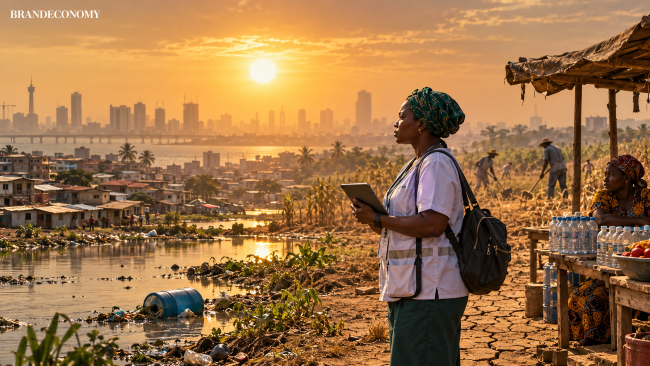
 Nigeria’s intensifying heat is no longer merely a question of physical discomfort. It is emerging as a public-health emergency, a labour-productivity constraint and a growing source of pressure on household incomes, food systems and already stretched healthcare infrastructure.as the El Niño phenomenon unravels.
Public-health physicians have warned that the strengthening El Niño weather pattern could expose more Nigerians to dehydration, heat exhaustion, heatstroke, infectious diseases and malnutrition—particularly where high temperatures interact with flooding, unsafe water, poverty and weak public services.


The concern has become more urgent following the World Meteorological Organization’s assessment that the current El Niño could become exceptionally strong, peak towards the end of 2026 and continue influencing weather conditions into 2027. WMO forecasts indicate that the phenomenon is highly likely to persist through February 2027. wmo.int
El Niño begins with unusual warming in the central and eastern tropical Pacific Ocean, but its consequences travel far beyond that region. It can alter rainfall, atmospheric circulation and temperature patterns, producing drought in some locations, flooding in others and greater heat stress across large areas.
Its Nigerian impact will not be uniform. El Niño changes the probability of particular weather conditions; it does not automatically explain every heatwave, flood or disease outbreak. Local geography, drainage, urbanisation, sanitation, poverty and the quality of public infrastructure determine how a climatic disturbance becomes a human emergency.
Nigeria’s forecast has changed
The Nigerian Meteorological Agency’s Seasonal Climate Prediction, released in Abuja on February 10, anticipated generally warmer temperatures, variable rainfall, prolonged dry spells and a severe August break in some areas.
That original outlook was developed around a projected weak La Niña and subsequently neutral El Niño–Southern Oscillation conditions. By August, however, NiMet’s updated assessment confirmed the emergence of a strong El Niño expected to influence weather patterns during the second half of 2026. nimet.gov.ng
This evolution demonstrates why an annual forecast cannot be treated as a static document. Climate intelligence must be continuously updated and translated into operational warnings for hospitals, schools, farms, markets, transport operators and employers.
At an August 12 webinar, the World Health Organization identified heat-related illness, waterborne and vector-borne infections, malnutrition and disruption to essential health services among the leading risks associated with El Niño. who.int
When heat becomes a medical emergency
Dr Yetunde Odusolu, a consultant public-health physician at Ikorodu General Hospital in Lagos, said prolonged exposure to excessive heat could cause dehydration, exhaustion and potentially fatal heatstroke. It could also worsen cardiovascular illness and place additional strain on the kidneys.
Infants, young children, older people, pregnant women and people living with chronic medical conditions face particularly elevated risks. Outdoor workers—including farmers, construction workers, sanitation personnel, commercial transport operators and market traders—are also heavily exposed.
Heatstroke should not be mistaken for ordinary tiredness. Confusion, collapse, altered consciousness and extremely high body temperature require immediate medical attention. Safe cooling should begin while emergency assistance is being arranged.
Odusolu advised Nigerians to drink sufficient safe water, wear light clothing, improve ventilation and reduce strenuous outdoor activity during the hottest parts of the day.
But personal precautions alone cannot address a systemic threat. Many low-income Nigerians work outdoors because their livelihoods leave them no alternative. Millions also live or work in poorly ventilated buildings without reliable electricity, affordable cooling or uninterrupted access to potable water.
Employers, she argued, must provide drinking water, shade and scheduled rest periods for exposed workers.
The economic case is compelling. WHO and WMO research indicates that worker productivity can decline as temperatures exceed comfortable working thresholds, while heat exposure increases the likelihood of dehydration, kidney dysfunction and neurological complications. who.int
For businesses, this can mean slower production, more workplace accidents, higher absenteeism and rising health and insurance expenses.
Floodwater, unsafe water and disease
Heat is only one part of the risk.
Dr Naomi Dongo, Medical Officer and Director of Advocacy at Cancer Advocacy Nigeria, said altered rainfall patterns could produce both extended dry periods and destructive flooding. Each creates different but connected health consequences.
Flooding can push sewage, refuse and faecal matter into wells, boreholes, waterways and food-distribution environments. Water shortages can similarly force households to rely on unregulated vendors and unsafe sources.
The warning comes against an already dangerous regional disease background. UNICEF reported in August that Nigeria had recorded more than 50,000 cumulative cholera cases and 338 deaths between January and the end of July 2026—the largest reported outbreak in West and Central Africa at the time. Flooding, displacement and contaminated water were identified as significant transmission risks. unicef.org
Dongo said climate shocks tend to punish people with the least capacity to protect themselves. A middle-income household may respond to heat with air-conditioning, stored water and private healthcare. A low-income household may face the same conditions in an overcrowded room, without power, savings, insurance or nearby medical support.
That is why climate vulnerability is also an inequality problem.
Food production and malnutrition
Prolonged dry spells can reduce crop yields, weaken livestock productivity and raise irrigation expenses. Flooding can destroy farmland, cut transport routes and increase post-harvest losses.
The result may be higher food prices at precisely the moment when heat and disease are increasing households’ need for safe water, healthcare and nutritious food.
Dr Lilian Ochayi, Public Relations Officer of the Association of Public Health Physicians of Nigeria’s Lagos Chapter, warned that children and pregnant women face particular danger when climatic shocks reduce food availability and household purchasing power.
The risk extends beyond outright crop failure. World Bank analysis shows that partial crop losses in Nigeria have risen significantly in recent years, driven by climatic stress, environmental shocks and insecurity. Research covering Nigeria and other West African countries also suggests that extreme heat can cause farmers to reduce productive investments while spending more on defensive inputs such as pesticides. blogs.worldbank.org
For investors in agriculture, food processing, logistics and retail, El Niño therefore represents more than a weather story. It creates potential volatility in commodity supplies, transport costs, energy demand and consumer purchasing behaviour.
Government must move from forecasts to protection
The three physicians called for stronger early-warning systems, disease surveillance, flood preparedness, safe-water provision, nutrition programmes and better-equipped health facilities.
For Lagos, Odusolu highlighted drainage maintenance, heat-health alerts and improved preparedness across medical facilities. These are especially important in a densely populated commercial centre where poor drainage, traffic congestion, overcrowding and unreliable water and electricity can amplify health risks.
A credible national response should include:
- Heat alerts translated into simple, location-specific public guidance.
- Extended surveillance for cholera, malaria and acute watery diarrhoea.
- Water-quality testing in flood-prone and underserved communities.
- Heat protocols for schools, markets, construction sites and farms.
- Strategic stocks of oral rehydration materials, essential medicines and water-treatment supplies.
- Nutrition support for children, pregnant women and displaced households.
- Local-language public communication that distinguishes warning signs from routine discomfort.
- Transparent reporting of hospital admissions, disease outbreaks and emergency-response capacity.
Market, investor and brand implications
Heat and climate disruption are increasingly material business risks. Employers may face reduced productivity, disrupted operations and greater obligations to protect workers. Insurers will need more accurate climate-risk pricing, while healthcare providers, water companies, cooling-technology businesses and renewable-energy firms could see stronger demand.
Consumer-facing companies should also recognise the reputational dimension. A business that keeps employees working in unsafe heat, sells water of uncertain quality or exploits shortages through unreasonable pricing risks significant brand damage.
Conversely, companies that provide cooling stations, drinking water, flexible work schedules, emergency support and honest public information can convert climate responsibility into measurable stakeholder trust.
Investors should scrutinise whether businesses have heat-response plans, resilient supply chains, backup energy, adequate insurance and credible environmental, social and governance controls. Climate preparedness is rapidly becoming an indicator of management quality.
BRANDECONOMY Insight
Nigeria’s greatest El Niño vulnerability may not be the weather phenomenon itself. It is the gap between possessing forecasts and acting on them.
NiMet can predict warmer temperatures. WHO can identify medical risks. Physicians can advise people to drink water and avoid strenuous activity. Yet those warnings achieve little where safe water is unavailable, electricity is unreliable, drainage is blocked and workers cannot afford to stop working.
This is where climate policy must become economic policy.
Heat affects the factory floor, the construction site, the farm, the marketplace and the classroom. Flooding affects logistics, food prices, insurance claims and business continuity. Malnutrition weakens human capital. Disease outbreaks drain household savings and public budgets.
Nigeria therefore needs a climate-health compact connecting meteorological intelligence with public health, labour regulation, agriculture, water, urban planning and social protection.
The real measure of preparedness will not be how early the country predicted the danger. It will be how many illnesses, deaths, business disruptions and livelihood losses it prevented.