

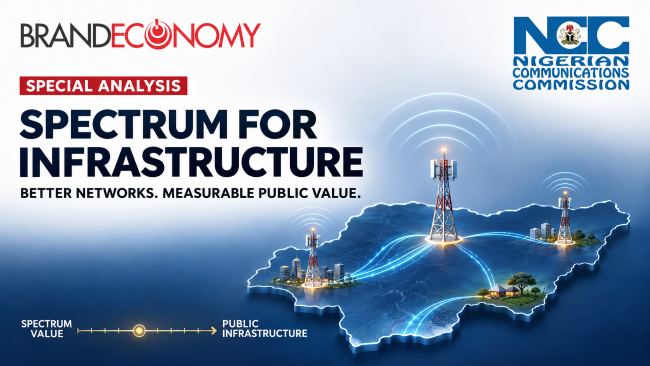
 The NCC wants to exchange spectrum-related incentives for measurable network investment. Nigeria needs the infrastructure, but every concession must buy additional, independently verified public value. This is why the Spectrum Incentives could be the ultimate game-changer.
By BRANDECONOMY Editorial Intelligence Desk




A familiar Nigerian frustration
Picture a small retailer in Lagos at the end of a busy day. A customer has made a bank transfer, but the confirmation page keeps spinning. The customer shows a debit alert. The retailer has received nothing. Both wait, refresh their phones and shift awkwardly between networks while the queue grows.
It is an ordinary scene with an extraordinary economic cost. Across Nigeria, unstable connectivity interrupts payments, online classes, remote work, hospital systems, logistics and entertainment. Each failed session looks small, but together they weaken productivity, consumer confidence and the credibility of the digital economy.
This is the lived reality behind the Nigerian Communications Commission’s proposed Incentive-Based Spectrum Investment Framework, or IBSIF. The consultation, dated 12 November 2026 and signed by the NCC’s Executive Vice Chairman and Chief Executive Officer, Dr Aminu Maida, closes on 30 November. It asks whether spectrum-related incentives can be tied to additional, independently verifiable investment in fibre, towers, radio capacity, power and network modernisation.
The proposal is timely. It is also delicate. Spectrum is a scarce national asset. A discount, extended tenure, favourable payment arrangement or other regulatory concession transfers economic value. Nigeria should make that trade only when the public receives more reliable service, wider access and stronger competition in return.
Demand has outrun the old network model
The pressure on Nigerian networks is no longer theoretical. Monthly mobile-data consumption rose from about 518,000 terabytes in January 2023 to 1.66 million terabytes in July 2026 – more than tripling in three and a half years. The NCC estimated 5G population coverage at only about 13 per cent in April 2026.
These figures reveal two infrastructure gaps. Some communities remain unserved, with little or no meaningful broadband. Others are underserved: a signal exists, but congestion, weak backhaul or unreliable power makes the connection too unstable for dependable use. A crowded commercial district can be underserved even when several networks advertise coverage there.
The case for investment is therefore strong. Yet the case for incentives must still be proven. Operators naturally invest where traffic and revenue justify expansion. The NCC’s challenge is to identify the places and capacity problems that will not be solved quickly enough through normal commercial spending.
The test is additionality
IBSIF will succeed or fail on one word: additionality. Any infrastructure purchased with a spectrum incentive must go beyond existing licence obligations, approved capital programmes and investments an operator would make anyway.
Without a verified baseline, a company could repackage an already planned urban upgrade as the price of a valuable concession. Its economics would improve, but Nigeria would gain little that was not already coming.
The NCC should therefore establish each applicant’s existing commitments, coverage and capacity maps, capital budget, spectrum holdings and rollout timetable before valuing an incentive. Independent engineers and financial auditors should test that baseline. Commitments should identify communities, transport corridors or congestion zones, not disappear into a national investment figure.
Valuation also matters. In the 2021 auction of the 3.5GHz band, MTN Nigeria and Mafab Communications each paid $273.6 million for a 100MHz lot. That does not mean every future spectrum decision must maximise immediate cash revenue. Government can rationally exchange some near-term proceeds for infrastructure with greater long-term economic value. But the value surrendered must be published and compared with the risk-adjusted value of the result promised.
Nigerians should not pay twice
The public-interest test is sharper because the NCC approved tariff adjustments of up to 50 per cent in 2025 after operators argued that inflation, energy costs and foreign-exchange pressure were weakening investment capacity. Consumers accepted higher prices with an expectation of more sustainable networks and better service.
Investment is occurring. MTN Nigeria reported capital expenditure of about N1.19 trillion in the first nine months of 2026. The sector remains capital-intensive, and network traffic continues to grow. The question is not whether operators spend money. It is whether a new incentive will change what they build, where they build it and how quickly Nigerians feel the difference.
Before awarding any benefit, the NCC should disclose what followed the tariff adjustment, which gaps remain commercially unattractive and what extra result the new concession will purchase. Otherwise, consumers could pay once through higher tariffs and again through public spectrum value, while still returning to the spinning payment screen.
Competition must not become collateral damage
The largest operators have the balance sheets and financing access to make the biggest investment promises. If IBSIF rewards size alone, it could hand dominant companies a cheaper path to more spectrum and widen the disadvantage faced by smaller rivals.
The final rules should include spectrum caps, use-it-or-lose-it provisions and fair pathways for regional operators or consortia. Publicly supported fibre, towers or rural backhaul should carry transparent open-access obligations so other licensed providers can buy capacity on non-discriminatory terms.
Geography is equally important. Incentives should not subsidise expansion in locations that are already commercially attractive. They should target unserved communities, priority economic corridors and areas where congestion imposes a measurable productivity cost.
Verification must reach the customer
Invoices and photographs of new base stations prove that money was spent; they do not prove that service improved. Verification must connect expenditure to network performance and user experience.
Independent assessors should confirm site coordinates, equipment, active spectrum, fibre routes and power systems. Measurements should then test coverage, peak-hour capacity, speed, latency, availability and service restoration. The NCC should publish a dashboard showing the value of each incentive, the locations covered, delivery milestones and verified outcomes, while protecting genuinely sensitive commercial information.
Benefits of the Spectrum Incentives should vest only as milestones are achieved. Performance bonds, suspension clauses and proportionate clawbacks should protect the public when delivery fails. Repeated non-performance should influence future spectrum eligibility.
France offers a useful lesson. Under its New Deal for Mobile, coverage commitments were embedded in licences, progress indicators were published and the regulator retained enforcement powers. Nigeria’s geography, income levels and institutional capacity are different, but the principle travels well: incentives work best as enforceable performance contracts, not goodwill agreements. The International Telecommunication Union similarly favours targeted, time-limited incentives, standard reporting and independent verification.
Market brand and investor implications
A credible framework could stimulate demand across the digital-infrastructure value chain. Tower companies, fibre providers, energy-service firms, equipment vendors, civil contractors and network-optimisation specialists could gain new business. Better connectivity would also expand the addressable market for fintech, e-commerce, digital health, media, cloud services and technology-enabled exports.
For investors, however, the consultation is a signal rather than an investable outcome. The structure, eligibility rules and value of possible incentives remain undecided. Investors should watch the valuation method, incremental capital commitments, geographic obligations, open-access rules, milestones and enforcement. These details will determine whether value flows across the infrastructure ecosystem or is captured mainly by incumbent operators.
For telecom brands, IBSIF presents an opportunity to turn capital expenditure into visible evidence of reliability and national contribution. But the strongest claim will not be the size of an announced investment. It will be the improvement customers can measure after deployment.
The NCC faces the greater brand test. It must be seen as an impartial custodian of a public asset, not a negotiator of opaque concessions. Publishing award criteria, valuations, commitments and results would distinguish investment-oriented regulation from regulatory favour.
Seven safeguards Nigeria should insist on
- A published valuation method. Every concession should have a disclosed public cost.
- An independently verified baseline. Existing obligations and normal commercial spending must be excluded.
- Precise geographic and service targets. Commitments should name communities, corridors or capacity zones and define expected outcomes.
- Milestone-based incentives. Benefits should be earned through verified delivery rather than granted on promises.
- Competition and open-access rules. The framework must prevent spectrum hoarding and allow smaller providers to benefit from supported infrastructure.
- A public performance dashboard. Nigerians should be able to compare promised investment with completed infrastructure and service improvements.
- Clawbacks and periodic evaluation. Government must recover value after unjustified failure and test whether the policy actually changed investment behaviour.
BRANDECONOMY Insight
The NCC has identified the correct policy tension. Nigeria needs far more network investment, yet spectrum retains fiscal, competitive and strategic value. The choice is not simply between collecting revenue and building infrastructure. The Spectrum Incentives objective is to maximise total public value.
The strongest IBSIF would operate like a performance contract: government prices the concession; operators commit only incremental investment; independent experts verify delivery and customer outcomes; the public sees the scorecard; and failure carries a financial consequence.
The weakest version would publicise large investment figures, conceal the value of incentives and rely on evidence supplied by beneficiaries. That would create impressive headlines without proving that the policy changed anything.
Return, finally, to the retailer waiting for a transfer confirmation. She does not experience spectrum policy as a licence condition or discounted fee. She experiences it as the difference between completing a sale and losing one. That is the standard the NCC should apply.
Better networks are a legitimate return for spectrum incentives. Promises are not. Nigeria should approve the bargain only when every concession purchases infrastructure the country can locate, performance it can measure and obligations it can enforce.