


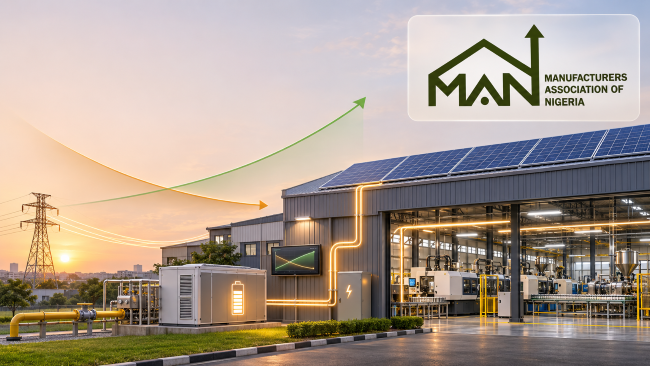
 Nigeria’s manufacturers are moving to build a more coordinated alternative to the country’s expensive and unreliable electricity system, with a new programme designed to help factories finance rooftop solar, battery storage, captive gas plants and intelligent energy-management infrastructure.
The Manufacturers Association of Nigeria unveiled the Industrial Energy Cost Reduction and Adoption Programme on Tuesday at the 2026 Manufacturers Energy Security and Energy Efficiency Summit in Lagos.




The initiative signals a transition from years of advocacy over electricity shortages to a more commercially structured response—one that aggregates manufacturers’ energy requirements and connects viable projects with long-term finance, technical expertise and private capital.
MAN President Dr Ifeanyi Okoye said the programme would help manufacturers access affordable, reliable and sustainable power through financing arrangements better suited to energy infrastructure.
The summit was organised by the Manufacturers Power Development Company Limited in collaboration with Germany’s international development agency, GIZ, and the Nigerian Energy Support Programme.
Okoye said the programme would promote factory rooftop solar systems, battery energy storage, captive natural-gas solutions and smart energy-management networks. These technologies could help companies reduce their exposure to grid instability, volatile diesel costs and production interruptions.
He estimated that manufacturers committed about 40 per cent of their profits to resolving energy challenges. High electricity tariffs, unreliable public supply and continued dependence on fossil-fuel generators, he argued, were weakening industrial competitiveness.
That burden has become one of the most consequential barriers to Nigeria’s ambition to build a productive, export-capable economy.
Energy is not simply another factory expense. It affects machine utilisation, product quality, delivery schedules, inventory management and the ability of manufacturers to price goods competitively. When electricity fails during a production cycle, the resulting loss may extend beyond fuel costs to damaged materials, missed orders and reduced customer confidence.
Why conventional bank finance cannot solve the problem
Okoye said manufacturers could not fund modern energy infrastructure with short-term commercial bank loans carrying high interest rates.
This is central to the programme’s financing proposition.
Solar installations, battery systems and captive power plants require substantial initial expenditure, but their economic benefits are recovered over several years. Financing such assets with short-tenor loans creates a mismatch: repayments become due long before energy savings generate sufficient cash flow.
MAN therefore intends to facilitate access to longer-term funding, climate-finance facilities, green investment and asset-financing models. The objective is to allow factories to adopt energy infrastructure without sacrificing the working capital required for raw materials, wages, maintenance and expansion.
“Today, we are moving beyond advocacy into implementation,” Okoye said, describing the initiative as one intended to return control of electricity costs and supply to manufacturers.
The approach could shift industrial energy investment from individual, improvised purchases of diesel generators towards professionally designed systems supported by measurable savings and contractual performance standards.
Manufacturers are funding a second power system
Chairman of the MPDCL board, John Aluya, said energy accounted for more than 40 per cent of manufacturers’ operating expenditure. This, he noted, had compelled factories to invest heavily in alternative generation, reducing margins and weakening their competitiveness.
Although the figures concerning profits and operating expenditure represent different measurements, they point to the same structural problem: Nigerian manufacturers are paying for electricity twice.
They pay tariffs and related charges to participate in the public electricity market, then finance generators, diesel storage, gas supply, solar panels, maintenance teams and other backup infrastructure to keep their factories running.
Dr Adaora Chukwudozie, Regional Chairman of MAN’s Anambra, Ebonyi and Enugu branch, put the estimated cost of manufacturers’ alternative power generation at ₦1.11 trillion in 2024. She said the figure rose to approximately ₦1.35 trillion in 2025.
In effect, industry is financing a parallel electricity network without receiving the economies of scale, regulatory coordination or network benefits associated with a properly functioning public system.
The opportunity cost is significant. Money committed to energy self-generation cannot simultaneously purchase new machinery, deepen inventories, employ additional workers or develop new products.
For businesses competing against imports produced in countries with cheaper and more stable electricity, the disadvantage is particularly severe. Domestic manufacturers must either absorb the energy premium, reduce product quality, accept lower margins or transfer part of the cost to consumers already under pressure.
South-East pilot offers a test case
Chukwudozie highlighted a proposed pilot project in the South-East built around a 1.5-megawatt energy solution. The project is expected to deliver savings exceeding 50 per cent.
Its financing structure would allow the participating manufacturer to use the infrastructure without providing all the initial capital. The arrangement is intended to preserve working capital while spreading the cost of the energy assets over time.
The project would also deploy smart meters, remote-monitoring equipment and energy dashboards to track consumption, generation, system performance and actual savings.
These measurement tools are critical. Energy projects often look compelling in presentations but become less attractive when generation assumptions, equipment downtime, foreign-exchange exposure and maintenance costs are properly tested.
A credible pilot must therefore establish an independently verifiable baseline: what the factory previously spent, how many hours of electricity it received, what fuel it consumed and what production losses it suffered. Only then can projected savings be compared with actual operating results.
Chukwudozie said the model would be extended across MAN’s branches, allowing manufacturers to combine their requirements, attract investors and secure economies of scale.
Aggregation could lower procurement costs, improve manufacturers’ negotiating power and create portfolios large enough to attract institutional capital. It could also help financiers diversify risk across multiple factories rather than depend on the performance of one borrower.
However, the contracts must clearly allocate responsibility for equipment maintenance, fuel supply, system failure, insurance, currency movements and early termination.
Government promises industrial energy corridors
Responding to manufacturers’ concerns, Minister of Power Joseph Tegbe said the Federal Government was directing investment towards infrastructure gaps, improved electricity supply and greater sector sustainability.
He acknowledged that unreliable power increased manufacturers’ cost of capital, diverted working capital into diesel, disrupted production schedules and prevented companies from using machinery efficiently.
Tegbe outlined a four-part government roadmap covering grid standardisation, sector liquidity and sustainability, asset optimisation and electricity-infrastructure expansion.
The ministry is also conducting a technical audit intended to identify infrastructure gaps and ensure that investment decisions are based on actual system requirements.
Lagos has been selected as the first major energy corridor under the initiative because of its substantial share of national electricity demand. Similar corridors are planned for other industrial and commercial centres.
Industrial corridors can deliver more value than scattered interventions if generation, transmission, distribution and demand are planned together. But prioritising commercially valuable consumers must not become a substitute for broader electricity-sector reform.
The government is also seeking to improve gas supply to power plants, expand renewable-energy deployment and optimise existing generation and transmission assets.
For investors, these commitments will become credible when they are accompanied by clear project pipelines, defined funding sources, enforceable contracts and published implementation milestones.
NERC offers route to monetise surplus power
The Nigerian Electricity Regulatory Commission said it was working with distribution companies to prioritise reliable supply to industrial customers and promote industrial electricity corridors.
NERC Chairman Dr Musiliu Oseni, represented by the commission’s Director of Economic Regulation, Agba Terab, said the regulator was encouraging network investment, including battery-supported storage.
Oseni also highlighted NERC’s net-billing framework, which would allow qualifying renewable-energy customers to export surplus electricity to distribution networks and receive credits under transparent regulatory arrangements.
For factories, this could materially improve the economics of renewable energy. A solar installation designed to meet daytime production demand may sometimes produce more electricity than the factory consumes. Without an export arrangement, that surplus energy could be wasted.
Net billing converts part of the excess generation into financial value, potentially shortening the investment payback period and making projects more attractive to lenders and green-finance providers.
Execution will nevertheless depend on appropriate metering, network capacity, payment discipline and transparent pricing. Manufacturers will require confidence that credits are calculated correctly and recognised promptly.
Oseni said regulatory certainty and transparent compensation mechanisms were essential to mobilising private investment. He called for greater collaboration among manufacturers, electricity distributors, banks, technology providers and development partners.
Market, brand and investor implications
For technology companies and energy developers, MAN’s programme could create a substantial pipeline covering solar systems, batteries, gas plants, smart meters, energy software and maintenance services.
Banks, pension funds and development-finance institutions could also gain access to industrial assets backed by measurable energy savings and long-term demand. Yet financiers must assess the manufacturers’ credit quality, technology performance, tariff assumptions and exposure to imported equipment.
For manufacturers, reliable power offers more than lower costs. It can strengthen product consistency, delivery performance and brand credibility. A company that repeatedly misses orders because of electricity failure eventually suffers a customer-trust problem.
The programme also creates a reputational obligation for MAN and participating partners. Savings projections must be realistic, procurement transparent and technology recommendations independent. Factories should not be pushed into poorly structured contracts simply because the projects carry a green label.
BRANDECONOMY Insight
Nigeria’s manufacturing-energy crisis is now a competitiveness emergency. When factories commit more than ₦1 trillion annually to alternative power, the country is effectively imposing an invisible industrial tax on production, employment and consumer prices.
MAN’s initiative is promising because it recognises that manufacturers need more than new technology—they need finance structured around the economic life of energy assets.
But private factory-level solutions cannot permanently compensate for a dysfunctional national grid. They can protect production and demonstrate scalable models, but public reform must still address sector debt, gas constraints, transmission weaknesses, distribution losses and payment discipline.
The decisive test is not how many agreements are announced. It is whether factories receive cheaper and more reliable electricity, preserve working capital, increase output and become more competitive.
If MAN can convert aggregated demand into investible projects with verifiable savings, the programme could become one of Nigeria’s most important industrial interventions. It would not merely keep machines running; it could begin restoring the economics of making things in Nigeria.