

FirstBank Targets Gen Z with 24-Hour Digital Banking Centre at UniAbuja

 FirstBank is taking its branch-transformation strategy deeper into Nigeria’s university ecosystem with the launch of a self-service digital experience centre at Yakubu Gowon University, Abuja, formerly known as the University of Abuja.
The bank says the facility could serve at least 40,000 customers within the university community, positioning the campus as a major testing ground for how young Nigerians will interact with financial institutions in an increasingly branch-light banking environment.




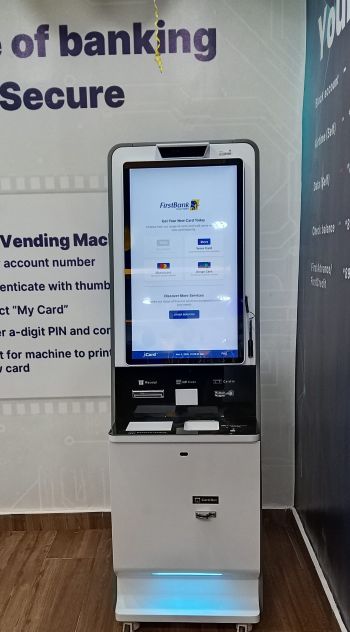
Commissioned on Tuesday in Gwagwalada, Federal Capital Territory, the FirstBank digital experience centre is designed to provide round-the-clock access to services traditionally associated with a conventional banking hall.
FirstBank Chief Executive Officer Olusegun Alebiosu said customers could use the centre to withdraw cash, replace lost or damaged debit cards, check account balances, request statements, transfer funds and update personal information such as telephone numbers and email addresses.
The proposition is straightforward: bring essential banking services closer to students and employees while reducing their dependence on branch personnel and fixed operating hours.
For FirstBank, however, the strategic objective goes beyond convenience. The centre represents a customer-acquisition platform targeted at a digitally native population that will shape the future of retail banking.
Alebiosu said the bank was particularly interested in bringing Generation Z consumers onto its digital platforms. In his assessment, the banking industry could operate with significantly fewer traditional branches over the next 20 years because younger customers already manage much of their lives through mobile devices.
That outlook reflects the structural transition taking place across financial services. Banks are investing less in expansive physical branch networks and more in mobile applications, agent banking, automated service centres, data analytics and cybersecurity.
The campus experience centre sits between a conventional branch and a fully remote digital bank. It offers the familiarity and visibility of a physical location without relying on the staffing model, paperwork and operating restrictions of a standard banking hall.
 Biometrics at the centre of the experience
 Biometrics at the centre of the experience
FirstBank says it has incorporated facial and fingerprint-recognition systems into the facility to protect transactions and personal information.
Fingerprint verification will be required for sensitive activities such as changing passwords, telephone numbers and email addresses. These controls are intended to prevent unauthorised changes that could allow criminals to take over an account or intercept transaction alerts and authentication codes.
The security architecture is commercially important. Digital banking adoption depends not only on convenience but also on confidence. A self-service centre that makes transactions faster but exposes customers to identity theft or account compromise would weaken rather than strengthen the bank’s brand.
Biometric authentication can provide an additional layer of protection, but it also raises questions about privacy, data storage, consent and recovery procedures. Unlike a password, biometric information cannot simply be replaced after a breach.
FirstBank will therefore be judged by more than the sophistication of the equipment. Customers will need clear information about how their biometric data is captured, processed, retained and protected. The centre must also provide reliable support when facial or fingerprint verification fails.
This is particularly important in a university environment, where first-time account holders may be less familiar with fraud risks, social engineering and the consequences of sharing personal banking credentials.
The race for lifetime customers
Nigeria’s universities have become strategically valuable markets for banks and fintech companies. Students may begin with relatively small account balances, but they represent potentially valuable lifetime relationships.
Today’s undergraduate could become tomorrow’s salaried professional, entrepreneur, mortgage applicant, investor or corporate decision-maker. A bank that establishes trust early can build a relationship extending across several financial products and life stages.
The attraction is therefore not the immediate deposit value of one student account. It is the potential lifetime value of thousands of young customers.
FirstBank’s advantage lies in combining a long-established institutional brand with modern digital infrastructure. The challenge is to ensure that the physical experience matches the promise of seamless banking. Broken machines, failed biometric authentication, cash shortages or delayed complaint resolution would quickly damage adoption.
Young consumers are also less tolerant of poor user experience. Their competitive reference points are not limited to other banks; they compare financial applications with e-commerce platforms, streaming services and social-media products built around speed, simplicity and personalisation.
FirstBank must consequently make the centre intuitive, reliable and accessible. It should also use the facility as a financial-literacy platform, helping students understand digital security, savings, credit, investment and responsible borrowing.
A campus laboratory for branch transformation
Alebiosu said the bank had introduced similar digital experiences in several branches and planned to extend the model to more universities.
That expansion should be guided by measurable evidence. The target of 40,000 customers is ambitious, but registrations alone will not demonstrate success. More relevant indicators include the number of active users, transactions completed without staff assistance, customer waiting times, service availability, fraud incidents and complaint-resolution rates.
The university also has an important role. Vice-Chancellor Professor Hakeem Fawehinmi described the facility as a one-stop centre that would give students and staff access to international-standard banking services while supporting the broader learning experience.
Fawehinmi said the bank and university had established mechanisms for continuous surveillance and protection of the centre.
That partnership could extend beyond physical security. The university could collaborate with FirstBank on financial education, fintech research, cybersecurity awareness, entrepreneurship support and internship opportunities. Such initiatives would transform the centre from a transaction point into an institutional platform for developing financially capable graduates.
Market and investor implications
For investors, the centre illustrates how established banks are attempting to reduce service costs while defending market share against fintech competitors and digital-only banks.
If the model increases digital migration and reduces routine branch traffic, it could improve operating efficiency. However, the financial case depends on utilisation, maintenance costs, fraud prevention and the ability to convert acquired users into active, profitable customers.
The project also carries reputational significance. FirstBank’s longevity gives it considerable heritage equity, but younger customers will judge the institution on present-day performance rather than history. The digital centre provides an opportunity to reposition the brand as both established and technologically relevant.
BRANDECONOMY Insight
FirstBank is not merely installing banking machines on a university campus; it is contesting for the future ownership of young Nigerians’ financial relationships with the launch of the UniAbuja FirstBank digital experience centre among others.
The strategic opportunity is substantial, but the real test begins after commissioning. Success will depend on whether the facility works reliably at midnight, protects biometric information, resolves failures quickly and offers a genuinely easier experience than existing alternatives.
If FirstBank can convert the centre’s 40,000-customer ambition into sustained usage and long-term trust, the Yakubu Gowon University project could become a useful model for the next generation of Nigerian banking. If it becomes another impressive facility undermined by downtime and weak support, Generation Z will migrate elsewhere with a few taps on a screen.