

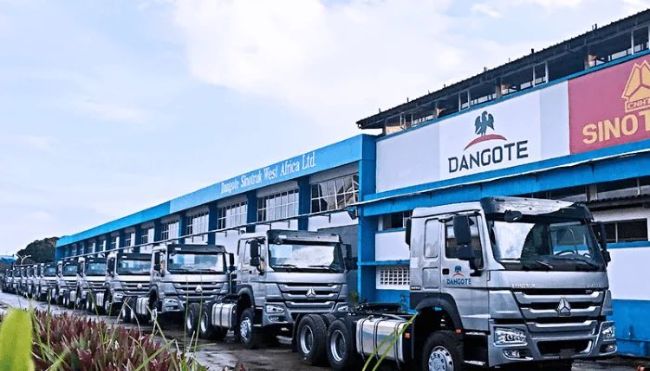
 Dangote Sinotruk West Africa Limited has unveiled its first locally assembled electric commercial trucks in Lagos, adding battery power to a vehicle range that already includes compressed natural gas models. The rollout broadens the Nigerian joint venture’s industrial ambitions and gives fleet operators a practical question to answer. On which routes can an electric truck earn its keep?
The rollout gives Nigerian fleet operators a locally assembled electric option. Its commercial prospects will depend on what it costs to move a tonne of cargo, how reliably trucks can recharge and how quickly they can return to service after a fault.




Speaking at the Sunday rollout, Dangote Group Vice-President Devakumar Edwin said the joint venture was set up to build a competitive commercial vehicle business, deepen local assembly and create jobs. Its range has grown from heavy-duty trucks to include tippers, light trucks, pickups and buses. Electric trucks extend that portfolio, giving the company another way to serve customers whose routes, payloads and refuelling needs vary widely.
Edwin said electric trucks could lower operating costs and eliminate tailpipe emissions on suitable routes. He identified electricity prices, vehicle use and access to charging as factors that would determine adoption. The company has set up an after-sales team and plans to support customers with charging facilities and technical expertise, working with commercial partners and government stakeholders.
The strongest case may be on routes that end at the depot
A fleet that runs a predictable daily route and returns to base can plan charging around loading, unloading or overnight parking. An operator serving irregular, long-distance routes has a harder calculation. An unscheduled stop to recharge consumes time that could otherwise be spent carrying freight. Unreliable depot power can also leave a truck parked when it should be earning revenue.
The purchase decision therefore goes beyond comparing diesel prices with electricity tariffs. Operators have to factor in the cost of installing and powering chargers, finance costs, payload, battery life and the number of hours each truck is available for work. In Nigeria, the source of charging power matters too. Heavy reliance on diesel generators could erode both the operating savings and the wider emissions benefit. Dangote Sinotruk’s existing CNG range gives fleet buyers another option to evaluate against diesel and electric power on the same routes.
For lenders and fleet lessors, the investment case will become clearer once operators can show how the trucks perform under load. Service records, battery warranties and evidence of battery condition at resale would help financiers assess downtime and residual value with greater confidence.
From assembling trucks to building industrial capability
Sinotruk Group President Liu Wei described the vehicle as Africa’s first locally assembled new-energy truck. He said the partnership began in 2013, was formalised as a joint venture in 2014 and assembled its first heavy-duty truck in 2017. A commercial vehicle welding and eco-coating paint line began operating in 2024. According to Liu, the venture has assembled more than 8,000 vehicles locally over the past decade.
Liu said the company plans to upgrade its production lines, expand capacity and broaden its offering across heavy-duty trucks, light trucks, pickups, trailers and vehicle body-building. He also pledged more training for Nigerian engineers and technicians, including practical placements in China. Edwin said the longer-term ambition was to make Dangote Sinotruk a leading West African manufacturing business, with more local value added through skills development and technology transfer.
The industrial opportunity will depend on how much work Nigerian teams and suppliers can take on as volumes grow. Welding and body-building can deepen the domestic supplier base. Building the capacity to diagnose electrical faults, service batteries and repair power systems would also keep more of the value generated over each truck’s working life in Nigeria.
Lagos and Ikeja want the investment to build local skills
Lagos State Commissioner for Transportation Oluwaseun Osiyemi, represented by Lagos Bus Services Managing Director Olasunkanmi Ojowuro, said local assembly could lower long-term transport costs, reduce emissions and build skills that support Nigeria’s automotive and battery industries.
The Ologba of Ogba Kingdom, Oba Latif Egbeyemi, urged Dangote Sinotruk to prioritise local content and professional training while investing in youth empowerment, environmental protection and engagement with the host community. He also called for reliable electricity, charging infrastructure, suitable standards and incentives for local manufacturing.
Ikeja Local Government Chairman Akeem Dauda said the rollout reinforced Ikeja’s position as a centre for industry and enterprise. He pointed to opportunities for jobs, skills development and technology transfer, and pledged the council’s support through infrastructure improvements and partnerships that benefit residents.
BRANDECONOMY Insight
Dangote Sinotruk’s strongest sales argument will be a customer placing a second order. The first trucks can demonstrate that the venture can assemble them in Lagos. Repeat orders will show whether customers can keep them working profitably.
That makes after-sales support part of the product. A stocked parts depot, trained technicians and clear repair timelines can make the difference between a missed delivery and a truck back on the road. For the Dangote and Sinotruk brands, the most persuasive proof would be route-level results showing cost per tonne-kilometre, charging downtime and vehicle availability. If those numbers hold up under everyday operating conditions, the venture will have a stronger case for scaling production and selling into neighbouring markets.