

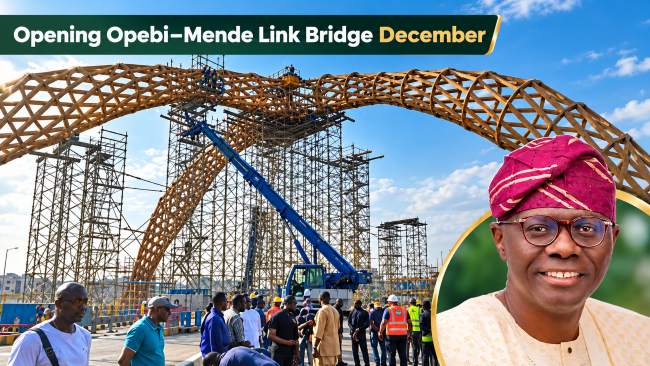
 Lagos State Governor Babajide Sanwo-Olu has set December 2026 as the latest completion date for the Opebi–Mende Link Bridge, placing the long-awaited transport corridor under renewed scrutiny after it missed a September delivery target.
Sanwo-Olu announced the revised timeline during an inspection of the project, saying his visit was intended to establish the causes of the delay and determine whether the remaining work could be completed safely before the end of the year.




The governor said the project was about 80 per cent complete, with three of its four major steel components finished and installation of the final section underway. He projected that the corridor would open to traffic before Christmas.
The new commitment matters because the bridge has acquired a complicated delivery history. Conceived in January 2022, it was initially expected to be completed in the second quarter of 2024. That target moved to the end of 2024, followed by September 2026.
It was also formally inaugurated in April 2026, although the route remained inaccessible to motorists months afterwards. That gap between commissioning and actual public use has made the December promise more than a construction deadline—it is now a test of infrastructure credibility. Tinubu
Engineering through difficult terrain
The Opebi–Mende Link Bridge project covers an approximately 4.5-kilometre transport corridor connecting Opebi with Mende, Maryland, Ojota and Ikorodu Road. It includes a 530-metre bridge, a second bridge of about 110 metres, approach roads, underpasses and U-turn facilities.
Its engineering complexity is substantial. The alignment crosses difficult swamp terrain with soft peat extending to depths of about 20 metres, requiring large bored piles reaching approximately 40 metres below ground. julius-berger.com
Sanwo-Olu said the landmark steel structure incorporates more than 300 tonnes of steel and rises to about 25 metres. The state’s latest description says its interwoven design draws inspiration from traditional cane craft associated with the area, combining transport functionality with cultural symbolism.
LED lighting in Lagos colours, landscaping, repainting and environmental finishing are expected to complete the site’s transformation into both a mobility asset and an urban landmark.
Yet architectural ambition cannot substitute for operational readiness. Welding integrity, load testing, drainage, lighting, road markings, pedestrian protection and traffic management must be completed before the bridge is opened. A December deadline should not encourage shortcuts on a structure expected to carry heavy daily traffic for decades.
The productivity test
The Opebi–Mende Link Bridge economic value lies in its potential to provide another connection between the Ikeja commercial district and the Ojota–Maryland–Ikorodu Road axis.
If well managed, it could shorten journeys, reduce fuel consumption and improve delivery predictability for businesses operating around Opebi, Allen Avenue, Toyin Street, Mobolaji Bank Anthony Way, Maryland and Mende. Those gains would translate into lower vehicle-operating costs and fewer productive hours lost in traffic.
However, the bridge may redistribute congestion rather than eliminate it. Without effective junction management, traffic control, public-transport integration and enforcement against roadside obstruction, bottlenecks could simply migrate to its entry and exit points.
Lagos should therefore judge success through measurable outcomes: travel-time reductions, traffic volumes, accident rates, public-transport efficiency and the condition of adjoining roads.
Market, brand and investor implications
Better connectivity could strengthen retail activity, commercial property demand and land values along the corridor. Businesses previously constrained by poor access may gain a wider customer and labour market.
For contractors and infrastructure investors, however, repeated timetable changes raise questions about project planning, supervision and public disclosure. The government should publish the reasons for the delays, the updated completion programme and any variation in project cost or scope.
The reputational stakes are equally significant. LED lighting and cultural design can enhance the Lagos brand, but residents will ultimately judge the project by accessibility, safety and reliability. A commissioned bridge that remains closed weakens public confidence; an operational bridge that materially improves movement rebuilds it.
BRANDECONOMY Insight
The Opebi–Mende Link Bridge could become one of Lagos’ most consequential urban-mobility interventions—but only when traffic begins to move safely and predictably across it.
December must be treated as a delivery commitment, not another ceremonial date. Lagos should accompany the countdown with transparent milestones, independent safety certification and a post-opening traffic-management plan.
Public infrastructure begins creating economic value when citizens can use it—not when dignitaries cut the ribbon.