

NPA Renews Apapa Decongestion Push as Port-Corridor Problem Defies Permanent Fix

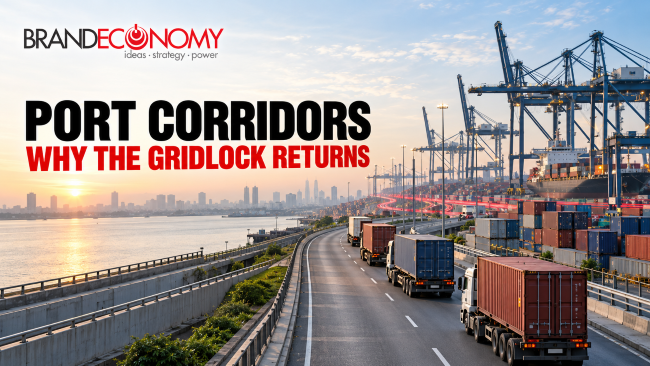 The Nigerian Ports Authority is tightening container evacuation, holding-bay supervision and traffic enforcement around Apapa. But previous clearances at Tin Can Island and Apapa raise a harder question: why does congestion repeatedly return after apparently successful interventions?
The Nigerian Ports Authority has renewed efforts to prevent congestion around the Lagos Port Complex, directing attention to empty-container evacuation, terminal capacity, holding bays and the regulation of truck movements.




Port Manager of the Lagos Port Complex, Mr Adebowale Lawal, said the authority was working with terminal operators, shipping lines, truck owners and security agencies to maintain traffic flow and improve cargo movement through the Apapa corridor.
Lawal, speaking in Lagos on Sunday, said the measures include inspections of shipping companies’ holding bays, closer monitoring of terminal stock levels, movement of import containers to off-dock facilities and stronger enforcement of the electronic truck call-up system.
The interventions are commercially significant. Apapa is not simply a Lagos traffic corridor; it is a critical channel through which imported machinery, industrial inputs, consumer goods and export cargo move.
When that channel becomes congested, businesses incur demurrage and storage charges, trucks complete fewer journeys, factories wait longer for materials and consumers eventually absorb the higher logistics costs.
NPA targets terminal-yard pressure
APM Terminals Apapa has been directed to provide regular information about container volumes within its yard and transfer some import containers to off-dock terminals when necessary.
Moving boxes away from the main terminal could create additional space for cargo handling and reduce the risk of gate restrictions when the yard approaches full capacity.
The NPA is also reassessing the notification process for terminal gate closures. Shipping lines are expected to receive an initial warning five days before a planned closure, another notice three days before the restriction and a final reminder one day in advance.
Advance notice should help operators adjust container releases and prevent trucks from heading towards a terminal that cannot receive them.
However, regular gate closures would still point to a deeper capacity-management problem. The stronger objective should be to prevent terminal yards from becoming saturated, rather than merely giving operators more warning before access is suspended.
Empty containers remain the pressure point
Lawal identified the slow evacuation of empty containers as an important cause of congestion and called on shipping lines to remove them more efficiently.
Once imported goods are discharged, the container must be returned to an approved facility, assigned to an exporter or loaded onto another vessel for repositioning.
Where shipping lines lack adequate evacuation arrangements, truckers can remain stranded with empty boxes. Their vehicles become temporary storage facilities, haulage capacity declines and access roads or nearby communities absorb the overflow.
The NPA’s inspection of holding bays is therefore necessary. But the exercise must determine more than whether an operator has supplied an address for licensing purposes.
The authority should verify the capacity, accessibility, operating condition and utilisation of every approved facility. A holding bay that exists only on paper—or cannot accommodate the traffic generated by its shipping line—offers little protection against congestion.
Egede and earlier port managers have cleared the corridors before
The latest intervention is not the first time determined port management has restored order to the Lagos port environment.
Mr Sylvester Egede, during his tenure as Port Manager at Tin Can Island Port in 2024, led an operation that cleared the Tin Can corridor and restored more orderly access to the port.
The management of the Apapa Port also achieved a comparable clearance of its corridor only a few years earlier.
Those interventions demonstrated that congestion is not beyond the reach of public authority. When port managers, traffic agencies, security personnel and operators act with urgency, illegally parked trucks can be removed, access roads reclaimed and scheduled movement restored.
The troubling lesson is that the results have repeatedly proved difficult to sustain.
If corridors can be cleared but congestion keeps returning, the central problem is no longer the government’s ability to conduct an operation. It is the absence of a system strong enough to preserve the gains after the task forces, patrols and public attention recede.
Why does a permanent solution remain elusive?
Several structural weaknesses explain why Apapa and Tin Can Island appear vulnerable to recurring disorder.
Enforcement remains intervention-driven
Port-corridor management often becomes most intense after congestion has already deteriorated into a public crisis.
Trucks are removed, checkpoints dismantled and officials deployed. Traffic improves, but enforcement can weaken once the immediate emergency passes.
A lasting solution requires routine operating discipline that functions every day, not periodic rescue operations.
Too much cargo still depends on roads
A large proportion of cargo leaving Lagos ports relies on trucks.
Rail and barge services have expanded, but they have not yet displaced enough road traffic to eliminate pressure on the corridors. Any breakdown in terminal scheduling, truck parks or access control can therefore produce immediate congestion.
Nigeria needs a genuinely multimodal evacuation system in which railways and inland waterways carry meaningful volumes on predictable schedules.
Empty-container logistics remain fragmented
The authority regulates port operations, terminal companies manage yard space, shipping lines control containers and vessel allocations, while truckers move boxes between locations.
Each participant can blame another when empties accumulate.
Permanent reform requires enforceable responsibility. Shipping lines should have defined evacuation thresholds, vessel plans and functional holding capacity proportionate to the volume of containers they introduce into the country.
Electronic scheduling can be undermined physically
An electronic call-up platform can sequence truck movements, but it cannot prevent congestion if inaccurate capacity information enters the system or unauthorised vehicles bypass the process.
The platform should integrate terminal-yard position, holding-bay availability and road capacity. A truck should not receive clearance when its destination cannot accommodate it.
Too many agencies operate within the corridor
NPA, the police, LASTMA, FRSC and other security or regulatory bodies perform legitimate functions around the ports.
But overlapping enforcement can create confusion, inconsistent instructions and opportunities for unofficial checkpoints. A unified command structure is essential so that truckers are subject to one transparent access procedure rather than multiple layers of discretionary control.
Commercial behaviour can defeat public regulation
Consignees may delay cargo collection, shipping lines may postpone empty-container evacuation, truckers may seek unscheduled jobs and terminal operators may continue accepting volumes that strain yard capacity.
The solution must therefore combine sanctions with commercial incentives. Operators that clear cargo and evacuate equipment quickly should benefit, while those that use terminals as long-term storage should bear an escalating cost.
Round-the-clock monitoring continues
Lawal said the NPA was maintaining a 24-hour presence on port access roads, monitoring import and export truck movements and strengthening patrols with the Marine Police.
Terminal operators are also being pressed to comply with environmental standards and maintain cleaner, more disciplined operations.
Consignees and truck owners were urged to respect electronic call-up approvals and holding-bay regulations.
These measures may preserve the current traffic improvement, but the NPA should ensure that enforcement does not merely relocate congestion from the main corridor to truck parks, side streets or neighbouring communities.
Truck owners recognise current improvements
National Secretary-General of the Association of Maritime Truck Owners, Mr Muhammed-Sani Balla, commended the traffic-management teams for maintaining order and enforcing the operating procedures governing electronic truck access.
He said Apapa and Tin Can Island corridors had experienced relief from gridlock and credited the progress to coordinated action.
Balla also acknowledged the NPA management led by Dr Abubakar Dantsoho, as well as port managers, traffic officials, security personnel, the Nigeria Police Force, Lagos State Traffic Management Authority and Federal Road Safety Corps.
He urged operators to protect the gains by matching truck releases with terminal handling capacity, particularly during the ember months when year-end import activity can increase pressure on the ports.
His warning deserves attention. Releasing more vehicles than a terminal can process does not accelerate cargo evacuation; it simply transfers the queue to the road.
Market and investor implications
Sustained improvement at Apapa would reduce logistics uncertainty for manufacturers, retailers, exporters, shipping companies and financial institutions.
Factories would receive raw materials more predictably, while exporters would face a lower risk of missing vessel schedules. Faster truck turnaround would improve fleet utilisation and could moderate haulage charges.
Investors should nevertheless distinguish between temporary traffic relief and structural port reform.
The stronger evidence would be declining cargo dwell time, fewer gate closures, faster empty-container evacuation, increased rail and barge volumes and lower costs for moving containers between the port and inland destinations.
These indicators would also influence investment in off-dock terminals, bonded warehouses, truck parks, cargo-tracking platforms, rail freight and inland water transportation.
Brand implications
The NPA’s institutional reputation is inseparable from the public experience of Apapa.
Each successful clearance strengthens confidence temporarily. Each recurrence of congestion raises doubts about institutional memory, enforcement consistency and the durability of reform.
The authority can strengthen trust by publishing a monthly port-corridor performance dashboard covering truck turnaround, yard occupancy, empty-container volumes, gate closures and reported traffic violations.
Shipping lines also face a brand test. Importers and truck owners will judge them by the ease of returning empty containers, not merely by vessel schedules and freight rates.
For terminal operators, credibility will depend on transparent capacity communication and efficient cargo release. Logistics companies must similarly treat compliance with electronic scheduling as part of their service promise.
BRANDECONOMY Insight
Nigeria must replace corridor-clearing operations with a permanent port-flow system
The achievements recorded by Sylvester Egede at Tin Can Island and by the Apapa Port management a few years earlier prove that determined leadership can clear the corridors.
But they also expose the central weakness of Nigeria’s port-reform model: success is too often attached to an individual manager, a special task force or a moment of institutional urgency.
A port corridor should not remain clear because a particular official is exceptionally vigilant. It should remain clear because the operating system makes disorder difficult to create and easy to detect.
NPA must move from recurring decongestion campaigns to a permanent port-flow architecture built around shared real-time data, automatic capacity controls and clearly assigned responsibility.
Terminal occupancy, holding-bay availability, truck approvals and empty-container evacuation should be visible on one integrated platform. When space falls below a defined threshold, new truck releases should slow automatically. When a shipping line exceeds an agreed stock of empty containers, its evacuation plan should become immediately enforceable.
Success must also be measured publicly.
Clear roads matter, but cargo velocity matters more. The decisive indicators are how quickly a container leaves the terminal, how many trips a truck completes, how often gates close and how much businesses spend moving goods.
Until those measurements become the basis of port governance, Nigeria may continue celebrating the clearance of corridors that should never have been allowed to collapse into disorder.