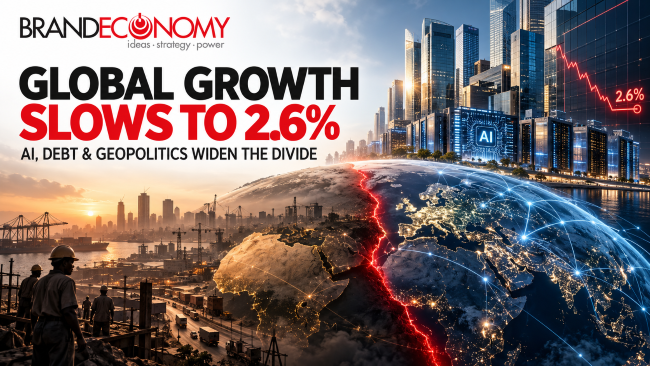
 Developing economies are still expanding faster than advanced markets, but their growth is weakening just as access to affordable finance, advanced technology and industrial opportunity becomes more unequal. For Nigeria and the rest of Africa, the warning is clear: population, commodities and market size will not automatically translate into prosperity.
The global economy is entering a slower and more politically fragmented phase in which the countries with the greatest development needs may have the weakest capacity to protect themselves.




UN Trade and Development, UNCTAD, projects world economic growth at 2.6 per cent in 2026, down from 2.9 per cent in 2025. The forecast is contained in its flagship Trade and Development Report 2026: The Geoeconomics of Development, presented in Geneva on October 9.
Developing economies are expected to grow by 4 per cent, a marked deceleration from the 4.7 per cent expansion recorded in 2025. The aggregate figure also conceals widening differences among regions, with a limited number of Asian economies continuing to advance while income convergence has stalled across much of the developing world. UN Trade and Development (UNCTAD)
The report is more than another downward revision to global gross domestic product. It describes an international economy in which trade, technology, energy, investment and finance are increasingly being deployed as instruments of national security and geopolitical influence.
That shift matters because many of the development routes previously used by emerging economies are becoming more difficult to follow.
Industrialisation once depended on attracting investment, importing technology, joining international production networks and gradually moving into more sophisticated manufacturing. Today, export controls, investment screening, technology restrictions, industrial subsidies and strategic competition are making entry into high-value sectors more difficult.
The result is a world economy that may continue growing while leaving large parts of the developing world structurally behind.
Trade is growing but its rewards are concentrating
One of the report’s most important findings is the divergence between global output and international trade.
Trade in goods and services is forecast to expand by approximately 4 per cent in constant prices during 2026, even as global economic growth slows. Global trade had already reached a record value of about $35 trillion in 2025.
Ordinarily, stronger trade growth would suggest wider opportunity. But the composition and ownership of that growth tell a more complicated story.
Artificial intelligence-related products have become a major driver of merchandise trade. Yet the companies, countries and workers benefiting from the expansion are highly concentrated.
UNCTAD’s examination of an advanced AI server rack found that after-tax profits represented 68 per cent of the value added traced through the product, while workers received less than 15 per cent.
Asia is expected to contribute 59 per cent of global economic growth in 2026, supported by projected expansion of 7.3 per cent in India, 5.2 per cent in Indonesia and 4.5 per cent in China. vimeo.com
These figures reveal the new hierarchy of globalisation. The competitive advantage is no longer simply access to inexpensive labour or natural resources. It increasingly rests on control of intellectual property, computing infrastructure, semiconductor supply chains, energy systems, finance and market platforms.
A country may assemble products, supply minerals or provide low-cost digital labour without capturing a proportionate share of the resulting value.
That is the inequality at the centre of the UNCTAD warning: participating in the global economy does not guarantee meaningful economic upgrading.
Geopolitics is rewriting the rules of development
The report’s title—The Geoeconomics of Development—captures a fundamental change in international commerce.
Governments are increasingly using tariffs, export controls, financial sanctions, industrial incentives and investment restrictions to pursue geopolitical and security objectives. Economic efficiency is no longer the sole consideration shaping supply chains.
Semiconductors, artificial intelligence infrastructure, critical minerals, renewable-energy technologies and advanced manufacturing are being treated as strategic assets.
For developing countries, the danger is that the ladder of industrial upgrading could be pulled further out of reach. Countries that do not control important technologies may face restrictions on access, while those without large fiscal resources cannot match the subsidies offered by richer governments.
The problem is not merely technological exclusion. It is the possibility that manufacturing, research, data, finance and high-value services become even more concentrated within a small number of economies and multinational corporations.
This could leave commodity-dependent countries exporting raw materials into value chains whose most profitable segments remain elsewhere.
The energy shock adds another layer of pressure
The weakening economic outlook is unfolding against geopolitical tensions and higher energy costs.
According to UNCTAD, disruption associated with conflict in the Middle East drove Brent crude from around $70 to more than $110 per barrel within weeks. Higher petroleum prices spread through transportation, electricity, agriculture, manufacturing and international shipping.
Oil-exporting countries may initially receive additional foreign-exchange and fiscal revenue when crude prices rise. But the benefits depend on production volumes, operational stability, contract structures and the capacity to manage the proceeds.
For countries such as Nigeria, the net effect is more complicated.
Higher crude prices can improve export receipts, but they can also increase the market price of refined petroleum products, raise transportation costs and worsen inflation. Businesses dependent on imported machinery, chemicals, logistics and dollar-denominated services face additional pressure.
The policy lesson is that producing crude oil is not the same as achieving energy security. Resilience depends on refining capacity, reliable electricity, efficient gas infrastructure, renewable-energy investment and the ability to move goods without excessive logistics costs.
Development finance is retreating when it is needed most
Poorer economies also face a more difficult financial environment.
Official development assistance is projected to decline by almost 7 per cent in 2026, marking a third consecutive annual fall. UNCTAD indicates that aid could shrink to approximately 0.23 per cent of donor countries’ combined income—far below the longstanding international target of 0.7 per cent. unctad.org
This contraction comes as developing countries confront costly debt, infrastructure deficits, climate risks, expanding populations and pressure to invest in digital transformation.
Many poorer governments already spend substantial portions of public revenue servicing debt. When concessional funding and development assistance decline, they are pushed towards more expensive commercial borrowing—or forced to postpone investments in education, health, energy and infrastructure.
The financing divide can therefore reproduce the technology divide.
Countries unable to finance broadband networks, power systems, research institutions, modern ports and technical education will struggle to participate in higher-value production. Their limited productive capacity then weakens exports and revenue, making affordable finance even harder to obtain.
It is a self-reinforcing development trap.
What the slowdown means for Nigeria
Nigeria faces the global downturn with both advantages and vulnerabilities.
Its large domestic market, growing digital economy, substantial energy resources, entrepreneurial population and position within the African Continental Free Trade Area provide strategic options. But those advantages will deliver limited results without improvements in power, logistics, access to capital, skills and institutional reliability.
A slower international economy could affect Nigeria through several channels.
First, weaker global demand may reduce opportunities for non-oil exports. Manufacturers and agricultural exporters could face softer prices, more protectionist trade policies and intensified competition.
Second, elevated energy and shipping costs could raise the price of imported inputs. Even businesses serving primarily domestic consumers remain exposed through machinery, packaging, software, chemicals, transport and foreign-currency financing.
Third, declining development assistance could place greater pressure on federal and state budgets, particularly in healthcare, education, humanitarian intervention and climate adaptation.
Fourth, tighter access to international finance could increase the cost of refinancing public and corporate debt. Investors will differentiate more sharply between credible borrowers and those perceived to carry excessive currency, governance or policy risk.
Fifth, the concentration of AI-related value could leave Nigeria as a consumer of imported platforms rather than a producer of valuable technology, intellectual property and computing capacity.
The response cannot be another catalogue of aspirations. Nigeria needs a focused productive-capacity strategy connecting reliable energy, development finance, export infrastructure, technical education and industrial policy.
Banking and financial-market implications
For Nigerian banks, the UNCTAD outlook points to a more demanding credit environment.
Higher energy and import costs could weaken the cash flows of businesses with limited pricing power. Import-dependent manufacturers, transport operators and highly leveraged consumer businesses may require closer credit monitoring.
Banks must also examine the indirect effects of slower growth on household income, loan repayment and demand for discretionary products.
At the same time, the changing global environment creates opportunities for financial institutions that can structure funding for regional trade, renewable energy, logistics, data infrastructure, export manufacturing and supply-chain localisation.
The most strategically positioned banks will move beyond financing imports and short-term commerce. They will help customers build productive assets, improve energy efficiency and reach markets across Africa.
Development-finance institutions also face a larger burden. As foreign aid and affordable external funding decline, institutions such as the Bank of Industry, Development Bank of Nigeria, Nigeria Export-Import Bank and regional multilateral lenders will be expected to mobilise longer-term capital.
The challenge is to expand that role without replacing rigorous investment assessment with politically allocated credit.
For the capital market, the stronger proposition is patient funding for commercially viable infrastructure and industrial platforms. Pension funds, insurers and institutional investors could support such investments where governance, risk allocation and revenue structures are credible.
Investor relevance
The 2.6 per cent global growth forecast does not imply that opportunity has disappeared. It means investors must become more selective about where value will be created and who will retain it.
Businesses with excessive foreign-currency debt, weak pricing power and heavy dependence on imported inputs face greater vulnerability.
By contrast, firms positioned in essential consumer goods, energy efficiency, renewable power, digital infrastructure, regional logistics, telecommunications, export services and local manufacturing may benefit from the drive towards resilience.
Investors should pay particular attention to five questions:
- Can the company protect margins during energy and currency volatility?
- Does it earn foreign exchange or depend heavily on purchasing it?
- Can it replace imported inputs with credible local or regional alternatives?
- Does it own valuable technology, data, distribution or intellectual property?
- Can it expand across African markets without creating unsustainable debt?
The strongest businesses will not necessarily be those insulated from global change. They will be those capable of converting disruption into greater productive capacity and market relevance.
Market implications
Commodity markets will remain sensitive to conflict, shipping disruption and strategic stockpiling. This may support prices for energy and critical minerals while increasing volatility.
Technology markets could continue expanding faster than the wider economy, but value may remain concentrated among infrastructure owners, chipmakers, cloud providers and dominant platforms.
Consumer markets in developing countries will become more value-conscious as inflation and slower income growth constrain spending. Businesses will need to offer affordability without destroying quality or trust.
Regional trade could become more important as companies diversify supply chains and governments seek markets closer to home. This strengthens the strategic case for AfCFTA implementation, cross-border payment systems, harmonised standards and more efficient transport corridors.
However, regional integration cannot succeed through agreements alone. Goods must be capable of crossing borders faster, cheaper and with fewer administrative obstacles.
Brand implications
The global slowdown will test the credibility of corporate promises.
Consumers under financial pressure become less receptive to symbolic positioning that does not improve value, convenience or security. Brands must demonstrate how their products help households manage constrained incomes.
For banks, telecommunications companies, energy providers and digital platforms, trust will increasingly depend on transparent pricing. Unexplained fees, sudden tariff changes and complex product conditions will attract greater resistance.
Brands associated with technology must also confront the question of inclusion. It is no longer sufficient to celebrate artificial intelligence while ignoring whether local businesses, workers and creators share in the economic value it generates.
Companies can strengthen their reputations by investing in local capability: supplier development, technical training, research partnerships, responsible data practices and accessible digital tools.
Localisation must, however, move beyond advertising language. Replacing foreign images with Nigerian models while importing nearly every valuable input does not constitute meaningful economic participation.
The most credible brands will be those that connect commercial growth with productive contribution.
From trade participation to value capture
UNCTAD recommends greater investment in productive industries, more diversified trade structures, acceleration of the energy transition and stronger regional cooperation.
For African countries, this means shifting attention from the volume of exports to the value retained within the continent.
Exporting cocoa without processing, crude oil without dependable energy security or critical minerals without refining and manufacturing leaves economies exposed to commodity cycles and foreign technology dependence.
AfCFTA offers the potential to aggregate demand across fragmented national markets. A larger regional market could support manufacturing at scale, attract investment and create stronger bargaining power.
But the continental agreement must be supported by industrial capability, transport links, efficient customs administration, enforceable contracts and interoperable payments.
Regional integration should not merely facilitate the circulation of imported goods. Its strategic purpose must be to deepen African production.
BRANDECONOMY Insight
A slower world is dangerous—but a low-value position is worse
The central message of the UNCTAD report is not that every developing economy is condemned to stagnation. It is that the global development contest is becoming less forgiving.
Growth of 4 per cent across developing economies may appear respectable beside the projected global rate of 2.6 per cent. But aggregate expansion can conceal falling income per person, weak job creation, growing debt burdens and continued dependence on low-value exports.
The decisive question is not simply how fast an economy grows. It is what the country produces, who owns the productive assets, how much value remains locally and whether the growth expands national capability.
Nigeria should therefore resist interpreting high crude prices, strong telecommunications activity or the rapid adoption of artificial intelligence as proof of structural transformation.
A country can consume sophisticated technology while contributing little to its design or ownership. It can export more commodities while becoming increasingly dependent on imported machinery, finance and intellectual property. It can record higher nominal output while households experience declining purchasing power.
The emerging geoeconomic order rewards countries that combine market scale with productive competence. It punishes those that depend indefinitely on imported technology, external finance and unprocessed commodity exports.
Nigeria’s strategic response must be built around five linked priorities: reliable energy, competitive domestic production, affordable long-term finance, market-relevant skills and deeper African trade.
The country should select a manageable number of sectors in which it can build genuine regional advantage—agro-processing, energy services, pharmaceuticals, digital finance, creative industries, logistics and selected manufacturing among them.
Public policy must then address the entire commercial ecosystem: electricity, transport, regulation, standards, skills, research, procurement and export access.
The object should not be protection from competition. It should be the creation of Nigerian companies capable of surviving competition.
As development assistance contracts and technology becomes more strategically controlled, the cost of policy inconsistency will rise. Countries without a productive agenda will not merely grow more slowly. They may discover that the pathways to industrial advancement have become narrower, more expensive and politically restricted.
UNCTAD’s 2.6 per cent forecast is therefore a warning about far more than global GDP.
It is a warning that the next phase of globalisation may distribute opportunity according to technological power, financial strength and industrial depth.
Nigeria must decide whether it intends to remain primarily a market for the products of that system—or become one of its serious producers.