Nigeria 2027 Elections Face the GOCOP Trust Test After IReV Issues


At GOCOP’s tenth conference in Lagos, electoral officials, security authorities and civic advocates set out their expectations for the 2027 Elections. Restoring confidence will depend on whether Nigerians can independently check the safeguards promised, the results recorded and the decisions taken when disputes arise.
By BRANDECONOMY Reporters




Nigeria approaches its next general election with a question that more sophisticated equipment cannot answer on its own: will citizens have enough reliable evidence to trust the process that determines who governs them?
That question ran through the tenth Annual Conference of the Guild of Corporate Online Publishers, GOCOP, held on October 7–8 at the Radisson Blu Hotel, Ikeja GRA, Lagos. The gathering examined how institutional confidence, public scrutiny and clearly assigned duties could improve the 2027 elections. Its discussions also exposed a persistent weakness: completing an election under the law does not necessarily persuade the electorate that the process deserves its confidence.
For Nigerians managing rising living costs, electoral credibility has immediate relevance. Those elected will decide how public money is spent, which taxes businesses pay and whether communities receive adequate security and essential services. Investors must assess how those decisions will affect operations and future returns.
The conference supplied a substantial agenda for improvement. Whether that agenda produces a better election will depend on implementation that citizens can examine, rather than assurances they are simply expected to accept.
INEC’s commitments face a delivery test
The chairman of the Independent National Electoral Commission, Professor Joash Amupitan, SAN, presented his preparations through the Lagos Resident Electoral Commissioner, Professor Ayobami Salami. According to the timetable cited in the address, presidential and National Assembly voting is scheduled for January 16, 2027, followed by governorship and state assembly elections on February 6.
Amupitan put the registered electorate at approximately 103 million and reported more than 10.6 million registrations over three phases of continuous voter registration. His account also indicated that duplicate removal and final checks remained in progress. The definitive register will therefore matter more than a rounded preliminary total: registration entries cannot all be assumed to represent additional eligible voters.
He identified October 9 as the commencement date for permanent voter card collection. The practical measure of that exercise will be whether designated centres operate as announced and whether eligible voters can actually collect their cards.
A corrected registration record offers little reassurance to someone still unable to obtain the document required to vote. INEC should make collection performance, outstanding complaints and operational locations visible to the public. National totals cannot explain the difficulties at an individual collection centre.
The commission also outlined improvements to the Bimodal Voter Accreditation System, BVAS, and an enhanced electronic Form EC8A, known as eEC8A. Its proposals include digital protection for polling-unit records, cryptographic signatures, stronger cybersecurity and arrangements for public access and auditing.
These announcements describe intended capabilities. Demonstrating that they work across Nigeria requires a further step. Publicly observed trials should recreate weak internet connections, depleted batteries, heavy upload traffic and incorrectly labelled documents. The tests should show how officials detect mistakes and recover from failures while preserving an inspectable record of every action.
Public support for elections exceeds confidence in INEC
Afrobarometer’s survey of 1,600 Nigerian adults, conducted from June 19 to July 17, 2024, illustrates the distance between support for elections and confidence in the institution administering them. Only 16.3 per cent of respondents expressed at least some trust in INEC. Yet 73.8 per cent supported choosing political leaders through elections conducted openly and fairly.
The findings describe attitudes during the 2024 fieldwork period. They cannot be presented as a current opinion poll, nor do they identify the IReV failure as the sole cause of distrust. Their value lies in showing that many Nigerians remain committed to electoral choice despite their doubts about its administration.
INEC consequently has a constituency for credible reform. Winning its confidence will require consistent conduct, particularly when the commission encounters an embarrassing error or a politically sensitive dispute.
The public should be able to learn which locations were affected by a failure, inspect the relevant records and understand how the problem was resolved. Officials responsible for proven wrongdoing should face consequences. These responses will carry more persuasive force than the purchase of equipment or another statement of institutional intent.
The paper fallback needs an accountable procedure
The Electoral Act 2026 supplies the legal framework for result handling. Under Section 60, polling-unit results must be electronically transmitted to the INEC Result Viewing portal, IReV, after the required form has been signed and stamped, with party agents countersigning where available. Where communication failure prevents transmission, the Act provides for the properly completed paper Form EC8A to serve as the primary record for collation and declaration.
The legislation also establishes requirements for checking and reconciling results during collation. For party nominations, it permits direct primaries or consensus arrangements. These legal provisions must be distinguished from further measures proposed to strengthen public confidence.
Preserving an alternative route for genuine network failure is necessary. Communities should not lose their votes because telecommunications infrastructure is inadequate. The concern arises when officials invoke an exception without evidence that others can examine.
Before polling, INEC should explain how an outage will be established, who can authorise reliance on the paper record and how the incident will be documented. The procedure should also set out when delayed publication must take place and how the final resolution will be recorded.
An accountable fallback would protect valid votes while allowing observers and affected parties to check why electronic transmission did not occur as expected.
Secure transmission still requires an accurate source
Voter accreditation, transmission of results and public access to uploaded records address separate parts of the electoral process. BVAS does not perform the same task as IReV, and the digitisation of a result form does not convert paper-ballot voting into electronic voting.
Cryptographic signatures can help establish where a digital file originated and whether it has changed after signing. They cannot establish, by themselves, that the numbers entered on that file accurately represent the ballots counted.
A form containing incorrect figures could pass through a secure transmission system. A blurred scan might upload without delay. Even an accurate polling-unit return could be incorrectly aggregated at a later stage.
The required safeguard is continuity of evidence from the physical count to the signed form, the published image and the eventual total. Auditing only the upload would leave other points of vulnerability insufficiently examined.
Artificial intelligence could assist officials by identifying repeated images, incomplete fields or unusual numerical patterns. Any alert must lead to investigation under a published procedure. An automated assessment should never acquire unchecked authority to invalidate votes.
Technical scrutiny must also respect personal data. Citizens need access to evidence about election results; that requirement does not justify exposing voters’ biometric information.
Agbakoba seeks clarity on election reporting rights
Conference chairman Dr Olisa Agbakoba, SAN, a former president of the Nigerian Bar Association, urged publishers to obtain a judicial interpretation of the press’s freedom to gather and report election information.
His intervention concerned the relationship between constitutional expression rights and the electoral commission’s statutory responsibilities. Section 39 protects expression and the communication and receipt of information, within applicable constitutional limits. Officially returning an election result remains a separate exercise of legal authority.
Publishing a verified polling-unit return, reporting an exit poll and announcing an official winner should therefore be clearly differentiated. An exit poll depends on sampling and research design; its findings cannot be treated as an actual count of ballots.
Agbakoba referred to litigation involving American media access to the White House as an illustration of challenging restrictions through the courts. The comparison supports his argument for legal testing in Nigeria. It does not mean that an American judgment settles the Nigerian constitutional question.
A timely ruling could clarify the responsibilities of publishers, police officers and electoral officials. It would help protect legitimate reporting while reducing confusion about unofficial projections and formal declarations. Accuracy would remain essential throughout: constitutional protection cannot excuse presenting fabricated figures as verified election evidence.

Security promises must withstand nationwide demands
Dr Abayomi Shogunle, Commissioner of Police for Election Planning, Monitoring and Evaluation at Force Headquarters, Abuja, outlined preparations for security coverage of 176,846 polling units. He said the police would assess likely threats and use those findings to determine where personnel and other resources should be deployed.
His account drew on criminological analysis of potential offenders, vulnerable targets and gaps in protection. It also emphasised deterrence, layered deployment and monitoring movement across state boundaries.
Shogunle credited the approach with improved electoral conditions in Anambra and subsequent exercises in Abuja and Ekiti. He said preparations for the general election had already begun. These statements represent the police’s assessment; claims about turnout, absence of violence and sufficient personnel still require corroboration from independent records and observers.
The principal challenge is national scale. A single-state election allows security agencies to concentrate resources. General elections create demands across numerous jurisdictions at the same time. Performance in one setting cannot establish readiness for the other.
Scrutiny should therefore cover operational communications, response times, protection at collation centres and accessible channels for reporting intimidation. It should also examine how complaints against security personnel are investigated.
Journalists, accredited observers and voters need protection as part of the electoral environment. Threat assessment must be based on evidence of potential harm, without treating lawful opposition activity, ethnicity or critical reporting as substitutes for that evidence. A quiet polling area offers little assurance if eligible citizens have been frightened away.

Women’s participation depends on access to nominations
Dr Adaora Onyechere Sydney-Jack, Creative Director of Gender Agenda and founder of WEWE Network Afrique, argued that women’s inclusion must extend beyond public appearances and token opportunities. Access to political power begins with the rules and decisions inside institutions and parties.
She criticised opaque consensus arrangements that can exclude female aspirants before voters have any opportunity to consider them. Her warning was that improved election technology could coexist with party structures that continue to restrict women’s access to the ballot.
Inter-Parliamentary Union records consulted on October 9, 2026 placed women in 15 of 356 occupied House of Representatives seats, equivalent to 4.2 per cent. In the Senate, women held four of 107 occupied seats, or 3.7 per cent. The figures describe the composition recorded for the sitting chambers and should not be used as projections of the next legislature.
Claims about female nominees for 2027 must be checked against the official candidate lists. The 2023 presidential contest included a woman: Princess Chichi Ojei stood for the Allied People’s Movement. Assessments of participation should begin with an accurate account of who previously reached the ballot.
Meaningful reform would examine nomination fees, campaign funding, harassment and access to party decision-making. Consensus selection requires particular scrutiny of how aspirants’ consent is obtained. Proposals for reserved seats should be reported according to their legislative status rather than described as rights already in force.
Sydney-Jack also challenged the suggestion that perceived improvements in an Osun election would automatically establish nationwide confidence. The suspicion she described among citizens demonstrates a trust problem; it does not prove that an undisclosed political bargain occurred.
Persistent barriers to women’s participation reduce the range of candidates available to voters and the experience represented in public decision-making. Greater representation cannot guarantee better policy, but exclusion prevents the electorate from making a fuller choice.
Journalism must apply the same standard to all parties
GOCOP President Danlami Nmodu, mni, emphasised the duty to investigate the claims of incumbent administrations and those seeking to replace them. He also linked safer communities to the ability of Nigerians to earn a living and undertake investment.
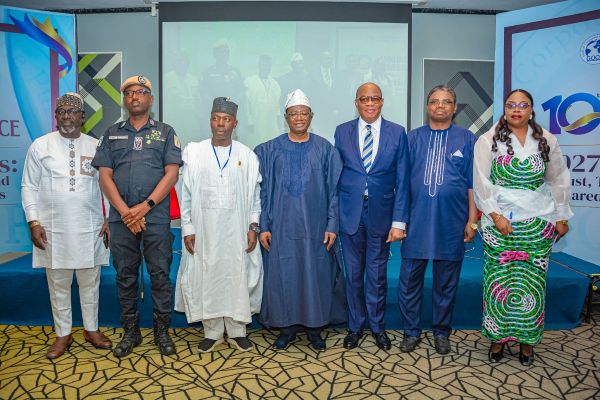
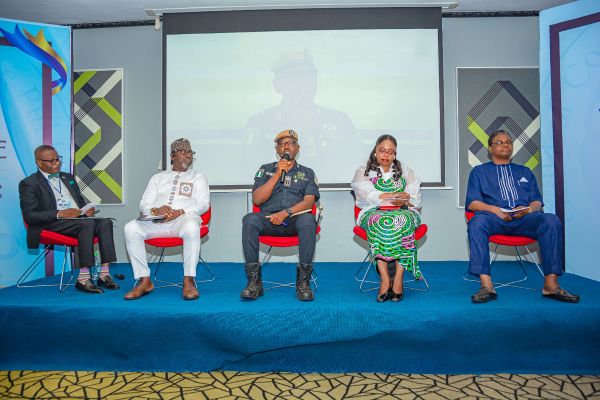
Other participants in the panel were Professor Tayo Popoola, Head of Mass Communication at the University of Lagos, and Lanre Arogundade, Executive Director of the International Press Centre. Ken Ugbechue, publisher of Political Economist, moderated the discussion involving Shogunle and Sydney-Jack.
Imo State Governor Hope Uzodinma, represented by Information Commissioner Declan Emelumba, encouraged factual electoral reporting and outlined his administration’s ambitions for digital development and industrialisation. Assessing such claims requires evidence about spending, delivery and outcomes, using the same standard applied to opposition promises.
Editorial balance rests on consistent verification. It does not oblige publishers to assign equal credibility to a substantiated finding and an unsupported allegation.
Online newsrooms should examine original documents, authenticate images and preserve the evidence behind their stories. When errors occur, corrections should be clearly visible. Manipulated video, synthetic audio and photographs recycled from unrelated events make verification especially consequential during election campaigns.
Cooperation with INEC on voter education and fact-checking may improve public access to useful information. It must preserve publishers’ freedom to investigate the commission itself. Sponsorship and public-sector advertising should likewise confer no protection from legitimate scrutiny.
Electoral confidence affects business decisions
Agbakoba encouraged Nigerians to think of themselves as collective owners of the country, entitled to evaluate those managing its affairs. The analogy makes accountability accessible, provided its limit is understood: democratic influence must never depend on the size of a citizen’s wealth.
His reference to the rising price of essential medicines brought that accountability to household level. Voters will assess leadership through the goods they can afford, the services they can access and the safety of the places where they live and work.
For business, electoral risk operates through practical channels. Disruption can impede deliveries, limit trading hours and threaten staff safety. Extended uncertainty may cause companies to postpone purchasing or expansion. Changes of government can alter taxes and sector rules; disputed transitions make the timing of those changes harder to assess.
These possibilities do not establish that an election will trigger a market collapse. Exchange rates, financing costs and investment decisions also respond to monetary policy, fiscal conditions and international developments. Electoral credibility nevertheless belongs within a serious assessment of the operating environment.
Boards should prepare proportionate arrangements for staff protection, payments, transport and communications. Investors assessing long-term commitments should examine how institutions implement rules as well as what candidates promise in manifestos.
A commercially attractive policy pledge carries less reassurance when the institutional procedures surrounding political power remain difficult to verify.
Institutional and commercial brands face a credibility test
INEC’s reputation will depend heavily on its response to contested evidence. Timely disclosure, consistent explanations and visible remedies give citizens reasons to trust the institution. Promotional messaging cannot supply those reasons on its own.
Political brands will face a related test: candidates who promise transparency must demonstrate it in party selection, financing and their treatment of inconvenient facts.
Companies participating in civic education should ensure that the material serves voters rather than conceals partisan advertising. Brands advocating inclusion should also examine whether their own recruitment, advancement and procurement practices support that commitment.
The reputational opportunity is to make stated values observable in conduct. The risk is that highly visible promises create expectations which institutional behaviour subsequently defeats.
What Nigerians should be able to verify
BRANDECONOMY proposes the following checks for evaluating election readiness and delivery. They are recommendations for public scrutiny, not a claim that every safeguard is already functioning.
| Area | Evidence to examine |
| Results | Readable polling-unit forms, retained originals, documented amendments and agreement with aggregated totals. |
| Technology | Observed testing under difficult conditions, recovery procedures and records of transmission failures. |
| Voter access | A checked final register, operational card-collection centres and a usable complaints process. |
| Security | Readiness for simultaneous national deployment, incident channels and impartial investigation of complaints. |
| Women’s participation | Confirmed candidate data and scrutiny of financial, selection and harassment barriers. |
| Accountability | Prompt access to evidence, transparent remedies and sanctions for established misconduct. |
BRANDECONOMY Insight
IReV must rebuild the confidence lost in 2023
The infamous IReV glitch during the 2023 presidential election left deep disappointment because the portal had become central to expectations of a more transparent contest. Nigerians anticipated an opportunity to check polling-unit records while the election was unfolding. The failure at that decisive stage weakened confidence in the assurances surrounding the technology.
INEC later attributed the presidential upload problem to a technical configuration issue and maintained that the difficulty did not invalidate the election’s credibility. Separately, the European Union Election Observation Mission documented publication delays, a substantial number of records still unavailable when the presidential result was declared, and uploaded forms that could not be read clearly.
Those findings warrant serious scrutiny of transparency and administration. They do not independently establish that another candidate won. Responsible analysis must preserve that distinction while insisting on a clear explanation of how comparable failures will be prevented and addressed in 2027.
Equally damaging would be a system in which patently defaced result sheets are published and then accepted as authentic simply because they appear on an official portal. Uploading a document establishes its availability for inspection. It does not establish the accuracy of its figures or resolve unexplained alterations.
An official repository should retain problematic records as evidence and make their status clear. Where numbers are unreadable, changes lack explanation or polling-unit identifiers conflict, the record requires prompt examination through a lawful procedure.
Any replacement or correction should remain connected to the original, with an accessible explanation of the change. Quietly overwriting a compromised image would deprive citizens and affected parties of information needed to understand what happened.
A handwritten amendment is not automatically fraudulent, and an immaculate form is not automatically truthful. Verification must assess the original return alongside available agents’ copies, accreditation records and other admissible evidence. Presentation alone cannot determine validity.
Nor should a technical flag become a shortcut for cancelling a community’s votes. Disputed entries require lawful reconciliation, participation by affected parties where appropriate and a record showing how the decision was reached. Deliberate falsification, once established, should attract consequences regardless of the beneficiary’s political affiliation.
Restoring trust requires INEC to account for the complete history of a contested result: what was first recorded, why it was questioned and how the discrepancy was resolved. Nigerians deserve an evidence trail that remains available when officials, parties or supporters would prefer the questions to disappear.
Credibility will be decided after the conference
GOCOP’s Lagos gathering set out responsibilities that can now be assessed. INEC must provide a process whose records can be checked. Security agencies must protect participation impartially. Parties must make candidature more accessible. Publishers must investigate electoral claims with discipline, and citizens must retain effective avenues for lawful challenge.
These duties differ. Public vigilance cannot repair every administrative failure, just as journalistic reporting cannot replace an authorised electoral return. Shared responsibility works when each participant remains accountable for the powers and tasks assigned to it.
The conference’s lasting value will depend on the procedures published, systems tested and remedies applied before and during voting. For 2027 to earn greater trust, Nigerians must be able to see precisely how the process has improved.