
IMF Warns Rising Transport Costs Are Deepening Nigeria’s Cost-of-Living Crisis
Fiscal Reform Needs a Human Buffer

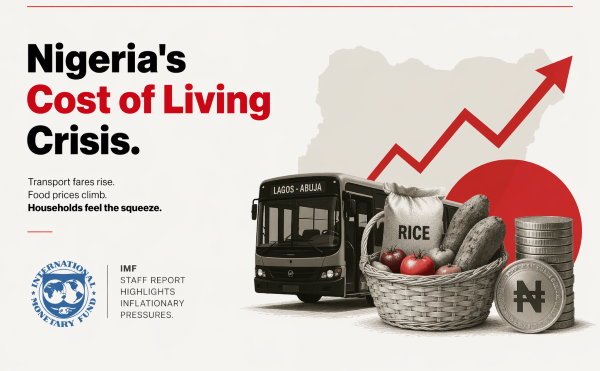 Nigeria’s cost-of-living crisis is being pushed onto a harsher trajectory by one of the economy’s most stubborn pressure points: transport. According to the International Monetary Fund, surging logistics and mobility costs are now feeding directly into food inflation, worsening household hardship at a time when the government’s fiscal room for relief remains limited.
The warning came from Abebe Selassie, Director of the IMF’s African Department, during a media briefing on Sub-Saharan Africa’s regional economic outlook at the IMF/World Bank Spring Meetings in Washington. His message was clear: in Nigeria, transport costs are no longer a secondary inflation variable. They are becoming a central transmission channel through which global and domestic shocks reach the dinner table.


When Transport Costs Become Food Inflation
Inflation, in Nigeria’s case, is not simply a monetary story. It is increasingly a logistics story.
Food remains the most politically sensitive and socially consequential component of the consumer basket. And food prices, as Selassie noted, respond quickly to movement costs. When fuel becomes more expensive, the effect cascades across the supply chain—from farm gate evacuation to wholesale movement, urban distribution and final retail pricing.
That Cost Of Living Crisis chain reaction has been intensified by recent fuel price increases linked to rising global oil prices. The result is a broad inflation pass-through: transport fares climb, distribution costs expand, and essential goods become more expensive in both urban centres and rural communities.
In practical terms, the cost of moving people is now inseparable from the cost of feeding them.
A Supply Chain Shock with Social Consequences
The deeper concern is that the transport crisis is not acting alone.
Higher logistics expenses are intersecting with expensive farm inputs—particularly fertiliser—as well as persistent supply bottlenecks. Together, these factors are raising both production and distribution costs, tightening pressure on already fragile household budgets.
For poorer Nigerians, this is not an abstract macroeconomic trend. It is a daily erosion of purchasing power.
The inflationary burden is especially acute because transport is a universal cost. It affects food, work access, school attendance, healthcare mobility and small business operations. In that sense, rising transport costs function like a regressive tax—hitting the most vulnerable with the greatest intensity.
Limited Relief, Narrow Fiscal Space
The IMF’s position is cautious but not wholly pessimistic.
Selassie acknowledged that recent fiscal and debt reforms are beginning to improve Nigeria’s resilience. Efforts to stabilise public finances, he argued, are creating modest buffers that may help the country absorb some of the shock from external volatility.
But those buffers are thin.
That is why the Fund is urging measured policy responses. Short-term relief may be necessary, but it must not come at the expense of medium-term fiscal stability. In other words, Nigeria faces a familiar dilemma: how to ease immediate hardship without undermining the reform path needed to restore broader macroeconomic credibility.
Debt, Trade and the Broader Reform Equation
The IMF also used the moment to restate a broader principle on debt strategy: the question is not whether borrowing is domestic or external, but whether it remains sustainable relative to repayment capacity.
That emphasis on debt quality, maturity balance and prudence reflects the reality that inflation shocks are harder to manage when public finances are already stretched.
Meanwhile, Amadou Sy, Assistant Director in the IMF’s African Department, widened the lens to continental trade. He argued that while the African Continental Free Trade Area holds major long-term promise, progress remains uneven. Unresolved questions around rules of origin, tariff negotiations, customs efficiency and trade finance continue to limit its ability to support diversification and cushion shocks.
For Nigeria, that matters. A more efficient regional trade framework could reduce some domestic cost pressures over time. But for now, the immediate stress remains internal: moving goods across the country is becoming too expensive for comfort.
BRANDECONOMY Insight
- Transport Is Now an Inflation Engine
Nigeria’s inflation debate has focused heavily on currency, interest rates and food supply. But transport has become a powerful inflation multiplier—linking energy prices to virtually every aspect of household consumption resulting in the Cost Of Living Crisis. - Cost-of-Living Pressures Are Logistical, Not Just Fiscal
Relief measures alone will not solve the problem. Nigeria must address the physical and structural inefficiencies that make movement so expensive—poor roads, fragmented haulage systems, weak rail alternatives and fuel dependency. - Fuel Reform Has Secondary Social Costs
Energy pricing reforms may be economically rational, but their pass-through effects on mobility and food distribution require more deliberate cushioning mechanisms for vulnerable groups. - Fiscal Reform Needs a Human Buffer
Nigeria’s improving fiscal discipline is important, but macroeconomic repair must be matched by social protection that is credible, targeted and scalable. - AfCFTA’s Promise Depends on Domestic Efficiency
Continental trade integration cannot compensate for broken internal logistics. Nigeria must first reduce the cost of moving goods within its own borders if it wants to compete effectively across Africa.