


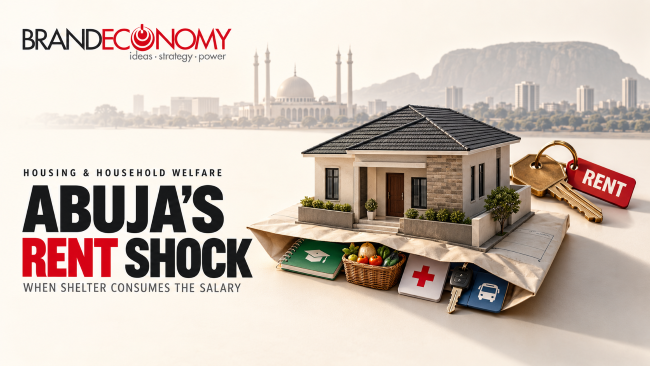
 For many households in Nigeria’s Federal Capital Territory, the most intimidating bill is no longer food, transport or electricity. It is the annual demand from the landlord.
Across Abuja and its rapidly expanding satellite settlements, rents are rising much faster than wages and business income. Families that once managed housing costs through savings, workplace contributions and informal cooperatives now find that an entire year’s earnings may be insufficient to secure a modest apartment.




The crisis is producing consequences that extend well beyond accommodation. Parents are changing their children’s schools. Families are reducing the quality of meals. Workers are parking their vehicles permanently. Small-business owners are diverting trading capital into rent, while others remain in expensive locations because moving farther away would increase transport costs and commuting time.
A News Agency of Nigeria survey conducted across the FCT reveals a housing market that is no longer merely expensive. It is steadily eroding living standards, enterprise resilience and the economic security of salaried households.
The National Bureau of Statistics reported that rent inflation accelerated to approximately 33.8 per cent in July 2026, from 14.79 per cent in June. That national figure is disturbing enough. In parts of Abuja, however, individual tenants are confronting increases of 100 per cent or more.
A Home That Now Costs More Than the Business Can Carry
Mr Olusegun Daniels, a businessman living in Karu, said the annual rent on his two-bedroom bungalow jumped from ₦1.5 million to ₦3.5 million.
The increase is well above 100 per cent. More troublingly, it arrived when his business was already struggling to generate sufficient turnover.
His commercial premises offer no relief. The shop for which he previously paid ₦300,000 now costs ₦450,000 annually.
This means Daniels is being squeezed simultaneously as a household and as an entrepreneur. His residence consumes personal income, while his shop absorbs resources that should replenish inventory, support marketing or finance expansion.
The experience illustrates how housing inflation can become a business constraint. When an entrepreneur diverts working capital into residential and commercial rent, the business becomes less capable of stocking goods, employing workers or withstanding a downturn.
Rent, in this context, does not merely reduce comfort. It destroys productive capacity.
The Cost of Proximity in Wuse
Mr Emeka Okafor faces a different but equally difficult calculation.
The businessman said his one-bedroom apartment in Wuse initially cost ₦1 million. The rent later increased to ₦1.8 million and subsequently reached ₦2 million.
Okafor has considered relocating to a less expensive satellite community. Yet he remains in Wuse because the apartment is close to his place of business.
His predicament captures Abuja’s “proximity premium”—the additional amount residents pay to remain near employment centres, commercial districts and essential services.
Relocating may produce a cheaper rent bill but impose higher transport costs, longer commuting hours and reduced productivity. A worker or entrepreneur who spends several hours travelling between the city centre and a distant settlement pays for housing affordability with time, fuel, physical exhaustion and family life.
Inadequate mass transit and the uneven distribution of employment therefore reinforce rental inflation in central locations.
The issue is not simply that Abuja needs more houses. It needs functional communities where affordable homes are connected to jobs, schools, healthcare, markets, transport and reliable infrastructure.
When Families Remove Food from the Budget
Mrs Evelyn Bode, a civil servant in Kubwa, said two-bedroom apartments that once rented for between ₦600,000 and ₦800,000 now command between ₦1.5 million and ₦2 million, depending on the location and quality of the building.
The rent increase has forced Bode to move her children to less expensive schools and reduce household spending on food.
She said some basic items had disappeared from her children’s meals and that she occasionally went without food to ensure they ate.
Her experience reveals the most dangerous dimension of the housing crisis: rent is beginning to compete directly with nutrition and human-capital development.
When a family changes schools primarily to pay rent, housing inflation affects educational continuity. When parents eliminate protein and other essential foods, it creates health and developmental consequences. When preventive healthcare is postponed, relatively manageable illnesses can become more serious and expensive.
A high-cost housing market can therefore produce poorer health, weaker educational outcomes and reduced labour productivity—even when families technically remain housed.
Rent Has Parked the Family Car
Mr Livinus Anya, another civil servant, said the rent on his Nyanya residence rose from ₦600,000 in February 2025 to ₦1.6 million by December of the same year.
Before the increase, Anya used monthly contributions to accumulate the money required for rent. The new figure has overtaken what his annual contributions and other savings can provide.
He has since parked his vehicle because he cannot simultaneously finance fuel, accommodation, school fees and food.
A new two-bedroom apartment in parts of Nyanya, he said, can now cost between ₦2 million and ₦2.5 million annually.
Parking a car may appear to be an ordinary act of household adjustment. But in an urban area with fragmented public transportation, it can reduce mobility, limit access to employment and lengthen commuting time.
The wider economy also feels the consequences. Every naira transferred from transport, food, education, retail consumption or small-business investment into rent reduces demand elsewhere.
Anya appealed to the Federal Government to fulfil President Bola Tinubu’s Independence Day commitment to reduce the cost of living, arguing that affordable housing for workers would be an appropriate starting point.
The Two-Year Upfront Barrier
Mr Sani Musa, a teacher living in Lugbe, identified another obstacle: some landlords now demand two years’ rent in advance.
Even where the annual rent might appear manageable, requiring 24 months upfront transforms a regular housing expense into an enormous liquidity test.
A tenant may earn enough to pay monthly but remain unable to produce several million naira at once. The result is borrowing, distress sales, dependence on relatives or relocation to a less suitable property.
The practice also exposes a structural failure in Nigeria’s housing-finance system. Salaries are paid monthly, yet rent is commonly demanded annually or biennially. The mismatch favours landlords with scarce assets while penalising tenants whose income arrives gradually.
Musa attributed rising rents to the housing deficit, rural-to-urban migration and the increasing cost of building materials. He called for regulations preventing unreasonable rent increases and stronger enforcement of existing protections.
Apo’s Shrinking Household Economy
In Apo Resettlement, civil servant Abigail Abidolu said the rent on her one-bedroom apartment rose from ₦500,000 to ₦1.2 million.
Her salary has not increased sufficiently to absorb the difference. Workplace training opportunities that previously provided additional income have also been discontinued.
Abidolu has eliminated luxuries, reduced family outings and curtailed visits.
These choices demonstrate how rental inflation weakens the wider consumer economy. Restaurants, retailers, recreation businesses, transport operators and personal-service providers lose spending when families redirect disposable income towards housing.
What looks like higher revenue for property owners may therefore coincide with weaker demand across numerous other sectors.
Why Abuja Rents Keep Rising
Several forces are converging on the FCT housing market.
Construction costs have increased as developers contend with expensive cement, steel, roofing materials, sanitary fittings, diesel, logistics and imported components. High interest rates make project finance costly, while land acquisition, titling delays and infrastructure obligations increase development risk.
Demand is also expanding. Abuja continues to attract civil servants, professionals, diplomats, contractors, entrepreneurs and migrants seeking security and economic opportunity.
Yet supply is poorly matched to the market. Many new developments target high-income buyers or investors, while the greatest shortage exists among households that need functional one-, two- and three-bedroom homes at affordable rents.
There is also a large stock of completed but inaccessible property. Some homes remain vacant because their asking prices bear little relationship to household incomes. Nigeria’s housing problem is therefore partly a shortage of units and partly a shortage of correctly priced, properly located and adequately financed homes.
Regulation Alone Will Not Build Houses
Calls for rent control are understandable. Landlords should not impose arbitrary increases, disregard tenancy agreements or abuse vulnerable tenants.
However, price ceilings introduced without a strategy to expand supply could produce unintended consequences. Developers may withdraw from rental construction, landlords may underinvest in maintenance, and unofficial charges may replace transparent rent.
The stronger policy response should combine tenant protection with supply expansion.
The FCT needs clearer rules on rent increases, enforceable notice periods, accessible dispute-resolution mechanisms and restrictions on excessive advance payments. But it also needs serviced land, faster building approvals, improved title administration, lower-cost construction finance and incentives for institutional rental housing.
Affordable housing must be treated as economic infrastructure rather than occasional political philanthropy.
Market Implications
The rent crisis creates opportunities, but only for investors prepared to design around real household incomes.
Demand is likely to grow for professionally managed build-to-rent housing, smaller energy-efficient apartments, cooperative housing, rent-to-own schemes and developments linked to reliable transport.
Rental-payment platforms may also help tenants convert annual obligations into structured monthly payments. Such products must be carefully regulated to prevent affordability solutions from becoming high-cost consumer debt.
Developers that use local materials, modular construction and standardised designs could achieve cost efficiencies. But affordability cannot be delivered through construction shortcuts that compromise structural integrity, ventilation, drainage or fire safety.
Brand Implications
The housing crisis presents a trust test for developers, landlords, estate agents, employers and government.
Developers that market “affordable housing” at prices beyond the reach of average workers damage the credibility of the term. Estate agents that conceal fees or encourage speculative pricing weaken confidence in the property market.
Landlords may possess the legal right to review rents, but abrupt increases without property improvements can create significant reputational damage—particularly for institutional property owners.
Employers must also recognise housing as a workforce issue. Staff distracted by eviction risks, punishing commutes and annual rent pressure are less financially secure and less productive.
Government’s brand promise on reducing the cost of living will ultimately be judged through everyday expenses. Housing is among the most visible.
Investor Relevance
Investors should look beyond luxury developments and consider the depth of unmet demand in the middle- and lower-income rental market.
The opportunity lies in delivering housing at prices supported by household cash flow, not aspirational valuations.
Important indicators include land and approval costs, building-material prices, infrastructure access, occupancy levels, achievable rents, tenant incomes, transport connectivity and the enforceability of rental contracts.
The most sustainable returns will come from projects that balance affordability with density, quality, energy efficiency and professional management.
BRANDECONOMY Insight
Abuja’s rent crisis is not fundamentally a dispute between greedy landlords and suffering tenants. It is the visible outcome of a city that is attracting people faster than it is producing serviced, well-located and affordable homes.
Rent has become a private tax on household productivity.
It is taking food from dining tables, children from preferred schools, vehicles off the road and working capital out of small businesses. It is shrinking the middle class while weakening the consumer demand upon which companies depend.
Nigeria cannot regulate its way out of a structural housing shortage. Neither can it build its way out through expensive estates disconnected from the incomes and transport realities of ordinary residents.
The answer is a credible housing system: serviced land, transparent titles, efficient approvals, long-term construction finance, institutional rental investment, tenant protection and mass transit connecting affordable communities to employment centres.
A capital city should not force its workers to choose between shelter and nutrition.
Housing policy will have succeeded only when a teacher, civil servant or small-business owner can pay for a decent home without sacrificing food, education, healthcare, mobility and the possibility of building wealth.