

Nigeria at 66: After Stabilisation, Nigeria Should Produce Its Way to Prosperity – Industrialists

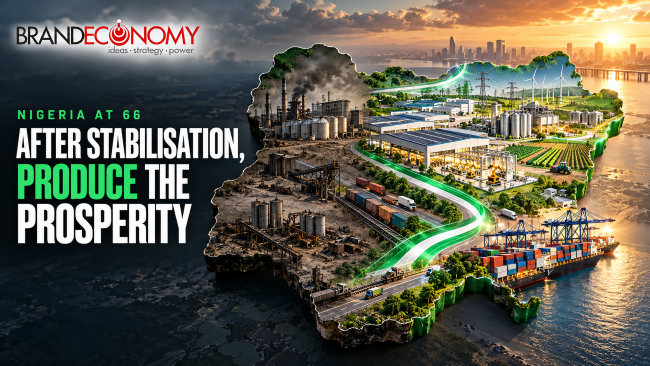 Nigeria’s 66th independence anniversary arrives with a more stable currency, stronger economic growth and moderating inflation—but also with factories still struggling to keep their machines running profitably.
That contradiction is emerging as the defining test of the country’s economic reforms.



Macroeconomic stabilisation has helped reduce some of the extreme uncertainty that previously frustrated investment planning. Yet the cost of electricity, finance, logistics, imported inputs, regulation and taxation continues to constrain the businesses expected to convert stability into production, employment and national wealth.
For industrial stakeholders, Nigeria’s next assignment is therefore unambiguous: after stabilising the economy, the country must produce its way to prosperity.
In separate assessments issued in Lagos, representatives of organised business and the industrial community called on the Federal Government to move beyond celebrating headline economic indicators and prioritise productivity, competitiveness, employment and improved living standards.
Their argument is that the true value of GDP growth and currency stability lies in what they make possible: working factories, affordable goods, viable businesses, better jobs and stronger household purchasing power.
The Factory Owner’s Contradiction
Consider a typical Nigerian manufacturer whose sales are recorded as part of the country’s expanding GDP.
The company may be producing more in nominal terms and paying less for some imported inputs because of improved foreign-exchange stability. But it must still generate much of its electricity, buy diesel, maintain generators, transport goods over difficult roads and finance working capital at interest rates that can erase its operating margin.
Its employees demand higher wages because food, rent, transportation, healthcare and school fees remain expensive. Distributors are reluctant to hold substantial inventory because consumers are increasingly price-sensitive. Suppliers demand faster payment, while large customers negotiate longer credit periods.
On paper, the economy is growing. Inside the factory, the owner is managing a daily battle for survival.
This is the gap Nigeria’s industrial leaders want economic policy to close.
Stabilisation Is a Foundation, Not the Destination
President of the Lagos Chamber of Commerce and Industry, Mr Leye Kupoluyi, acknowledged that the government’s reform programme has produced encouraging signs of macroeconomic stabilisation.
These include stronger real gross domestic product growth, moderating inflation, improved external reserves and greater stability in the foreign-exchange market.
Kupoluyi also described the Central Bank of Nigeria’s reduction of the Monetary Policy Rate to 23 per cent as a welcome indication of growing confidence in the disinflation process.
He nevertheless cautioned that the success of the reforms must ultimately be measured by their effect on welfare, purchasing power, production costs, investment and employment.
This distinction is critical.
Lower inflation does not mean that prices have returned to previous levels. It means prices are rising less rapidly. Families are still paying the accumulated cost of successive increases in food, transport, energy, housing, education and healthcare.
A household that has reduced its consumption of protein, postponed medical treatment or moved its children to a less expensive school may see encouraging inflation statistics without experiencing an actual improvement in living standards.
The same principle applies to businesses. Currency stability improves planning, but it does not automatically make production competitive. GDP growth can signal economic expansion without revealing whether factories are increasing capacity, creating sustainable jobs or earning export revenue.
A More Stable Naira Is Not Yet a Cheaper Factory
Foreign-exchange stability is particularly important for manufacturers that depend on imported machinery, spare parts and raw materials. It reduces uncertainty and makes pricing, procurement and capital budgeting less speculative.
But a stable exchange rate does not necessarily mean that foreign currency has become affordable.
A pharmaceutical manufacturer, for example, may now have greater certainty about the cost of importing active ingredients and production equipment. Yet the company must still recover those costs from consumers whose purchasing power has been substantially weakened.
Similarly, a food processor may obtain packaging materials with less exchange-rate volatility but continue to confront insecurity along agricultural corridors, unpredictable farm supplies, high transport costs and frequent electricity disruptions.
The manufacturer benefits from stability but remains constrained by the total cost of production.
That is why industrialists are demanding a shift from macroeconomic repair to microeconomic competitiveness.
Interest-Rate Cuts Must Reach Productive Businesses
Kupoluyi called for complementary measures to ensure that the reduction in the policy rate translates into more affordable credit, particularly for micro, small and medium-sized enterprises and other productive businesses.
A lower Monetary Policy Rate may improve sentiment, but manufacturers do not borrow at the headline policy rate. They borrow at commercial rates that reflect banks’ funding costs, operating expenses, regulatory conditions and assessment of business risk.
The entrepreneur who needs working capital to buy raw materials may consequently face a lending rate far above the Central Bank’s benchmark.
For a trader with rapid stock turnover, expensive short-term credit may sometimes be manageable. For a manufacturer, the calculation is more difficult.
Manufacturing capital is frequently locked into machinery, inventory and production cycles before revenue is earned. A factory borrowing at a high double-digit rate must generate returns strong enough to repay the loan, absorb infrastructure costs, pay employees and remain price-competitive.
Many businesses cannot achieve that arithmetic.
The result is underinvestment. Equipment is not replaced. Production lines are not expanded. Product innovation is postponed. Staff recruitment is frozen. In more serious cases, factories close or become warehouses for imported products.
Kupoluyi therefore urged the National Credit Guarantee Company to expand access to finance for smaller businesses.
A credible guarantee system could help reduce lenders’ exposure and unlock additional productive credit. Its effectiveness, however, will depend on transparent eligibility requirements, strong governance and measurable lending outcomes—not the number of financing schemes announced.
Manufacturing Must Become the Transmission Belt
Nigeria’s central economic challenge is no longer simply achieving growth. It is developing a transmission mechanism through which growth produces jobs, incomes, industrial capability and stronger local supply chains.
Manufacturing should perform that role.
A single productive factory can generate demand for agricultural commodities, packaging, transportation, maintenance, insurance, financial services, advertising, distribution and retail. Its economic value extends beyond the goods leaving its production line.
Kupoluyi consequently called for a comprehensive industrial competitiveness programme focused on reliable and affordable electricity, long-term finance, predictable trade and tariff policies, local supply-chain development and functional industrial infrastructure.
Nigeria, he said, must produce more domestically, employ more of its citizens and reduce its dependence on imported goods.
That is not an argument for indiscriminate protectionism. It is an argument for building competitive productive capacity.
An industrial policy that merely blocks imports without improving local efficiency can create monopolies, higher consumer prices and complacent producers. Effective industrial policy must instead reward investment, productivity, innovation, quality improvement and export performance.
Nigeria Has Diversified Production More Than Exports
Chief Executive Officer of the Centre for the Promotion of Private Enterprise, Dr Muda Yusuf, offered another important diagnosis: Nigeria has diversified what it produces more than what it exports.
The country has developed significant domestic capacity in telecommunications, banking, cement, fertiliser and refining. Yet its export revenues and foreign-exchange supply remain heavily dependent on hydrocarbons.
This imbalance limits the durability of currency stability.
Nigeria cannot permanently strengthen the naira through monetary management alone. It must earn more foreign exchange by exporting a broader range of competitive goods and services.
Real GDP growth increased from 3.38 per cent in 2024 to 3.87 per cent in 2025, before reaching 4.43 per cent year-on-year in the second quarter of 2026. Headline inflation moderated to 15.39 per cent in August, while the Central Bank reduced the policy rate to 23 per cent in September.
Yusuf acknowledged that these improvements provide a stronger foundation for the economy. But he maintained that the gains have not translated sufficiently into relief for households and businesses.
That concern goes to the quality of growth.
Nigeria can record GDP expansion through sectors that are profitable and capital-intensive without generating enough jobs for its growing population. It can also experience nominal business growth driven by higher prices rather than increased production volumes.
The more revealing questions are whether factories are producing more units, farms are recording higher yields, businesses are employing more workers, exports are increasing and household real incomes are recovering.
Productivity Is Being Lost in Daily Friction
Nigeria’s productivity crisis is not always caused by one dramatic policy failure. It is often the cumulative result of daily operational friction.
A delivery truck delayed for hours on a deteriorated road loses fuel, time and customer confidence. A factory that suspends production during a power failure loses output and may damage temperature-sensitive materials. A business subjected to overlapping levies spends scarce management time negotiating with revenue agents instead of improving products or finding customers.
A small manufacturer may win a major order but lack the working capital to fulfil it. Another may secure financing only after the commercial opportunity has passed. An exporter may produce goods competitively but lose the advantage through port delays and excessive logistics expenses.
Each incident appears small when viewed separately. Together, they suppress national productivity, reduce profits, discourage investment and weaken the capacity to create wealth.
Yusuf therefore urged the government to prioritise power supply, security along farming and commercial corridors, ports and logistics, agricultural productivity, industrial competitiveness and enterprise-oriented skills.
He also argued that industrial support should be tied to investment, efficiency and export performance, with the objective of reducing production costs and increasing the supply of affordable goods and services.
Development Finance Has a Trust Problem
Industrialist Mrs Funlayo Bakare-Okeowo questioned why the reported expansion of the wider economy has not produced corresponding growth among existing manufacturers.
“The GDP is growing, agreed, but why is it not reflected in the manufacturing sector?” she asked.
Her question captures the difference between aggregate economic expansion and industrial deepening.
Bakare-Okeowo said factories were closing while existing manufacturers struggled to expand. She observed that a significant proportion of new factory investment appeared to be coming from foreign investors.
Foreign capital can provide technology, expertise, market access and much-needed investment. But an industrial strategy that attracts new foreign factories while established Nigerian manufacturers weaken will struggle to build broad domestic ownership of productive assets.
Bakare-Okeowo also criticised the difficulty manufacturers face in accessing funding from development finance institutions despite repeated public advertisements encouraging businesses to apply for loans.
She claimed that manufacturers had been unable to obtain such financing for two years, even as the institutions continued to promote their lending programmes.
Her assertion highlights a serious institutional brand problem.
When a development finance institution communicates that funding is available but qualified businesses repeatedly fail to access it, the gap between promise and experience damages credibility. Entrepreneurs incur application costs, prepare documents and disclose business information, only to encounter opaque processes, prolonged delays or rejection without meaningful feedback.
The success of development finance should not be measured by announcements, application volumes or publicity campaigns. It should be assessed through actual disbursements, additional production capacity, jobs supported, export growth and sustainable repayment.
Bakare-Okeowo also questioned whether manufacturers could operate sustainably with commercial loans priced at double-digit interest rates.
Her position is that government must not concentrate solely on attracting new factories. It must enable existing manufacturers to survive, modernise, reinvest and expand.
This matters because existing manufacturers possess assets that cannot be quickly recreated: trained employees, technical knowledge, supplier relationships, distribution networks and accumulated market experience.
When a factory closes, Nigeria loses more than a building. It loses productive memory, skilled jobs, tax revenue, local demand and part of an industrial ecosystem.
From Foreign Investment to Nigerian Wealth Creation
Foreign investment should complement—not substitute for—domestic enterprise.
An economy creates sustainable local wealth when citizens and domestic institutions own productive assets, develop intellectual property, build competitive brands and retain a meaningful share of the value generated across supply chains.
If Nigeria attracts investment mainly by offering access to its large consumer market, it risks remaining a destination where foreign companies sell rather than a production base from which Nigerian and international companies export.
The country’s industrial policy should therefore encourage partnerships that transfer technology, deepen local sourcing, develop Nigerian management capacity and connect domestic suppliers to regional and global markets.
This is how foreign investment becomes a platform for national capability rather than an isolated production enclave.
A Three-Tier Productivity Compact
Yusuf stressed that economic transformation requires coordinated action across the three tiers of government.
The Federal Government controls monetary, trade, security, energy and major transport policies. But businesses operate within states and local government areas, where they encounter access roads, permits, property systems, environmental approvals, local levies and administrative practices.
A federal initiative designed to improve competitiveness can be undermined by poor state infrastructure or arbitrary local charges.
Nigeria consequently needs a national productivity compact.
The Federal Government must preserve macroeconomic stability while addressing electricity, security and national transport systems. States should develop functional industrial clusters, improve subnational logistics and simplify business regulation. Local governments must reduce arbitrary levies and ensure that legitimate taxes are transparent, predictable and fairly administered.
The ultimate evidence of successful reform, Yusuf argued, should be lower transport and production costs, higher farm yields, reliable public services and more productive jobs.
Market Implications
Nigeria’s transition from stabilisation to production will create winners and losers.
Businesses with reliable energy arrangements, strong balance sheets, local input networks and limited dependence on expensive short-term credit will be better positioned to expand.
Highly leveraged companies, import-dependent manufacturers and firms selling discretionary products to financially pressured consumers will remain vulnerable.
A gradual decline in interest rates could improve equity-market sentiment and corporate valuations, but investors should watch actual lending rates rather than assume that a lower MPR automatically represents cheaper business finance.
Companies providing industrial energy, logistics, equipment leasing, payment infrastructure, credit-risk assessment, warehousing and local raw materials could benefit as manufacturers seek alternatives to structural bottlenecks.
Non-oil export performance will also become increasingly important. If Nigeria cannot turn new productive capacity into foreign-exchange earnings, currency stability will remain exposed to movements in oil prices and production.
Brand Implications
The reform programme has a brand-trust challenge.
Government may highlight stronger GDP growth, reduced inflation and a more stable naira. Citizens assess economic performance through food prices, transport fares, electricity supply, salaries, employment and access to credit.
When official optimism runs too far ahead of lived experience, the credibility of economic communication weakens.
Government must therefore present stabilisation honestly: as progress, but not yet prosperity.
Development finance institutions face an equally serious challenge. Their advertising and public promises must be supported by accessible funding, transparent eligibility criteria, reasonable processing times and verifiable disbursement records.
Manufacturers and consumer brands must also respond to diminished purchasing power. Companies that redesign products, pack sizes, payment options and distribution systems around affordability will be better positioned to retain consumers without destroying brand equity.
The temptation to reduce quality while maintaining price accessibility could prove costly. In a fragile market, brands that quietly compromise standards may achieve short-term savings but suffer long-term reputational damage.
Investor Relevance
Investors should look beyond headline GDP growth and monitor the indicators that reveal whether Nigeria is becoming more productive:
- Manufacturing capacity utilisation and factory closures
- Commercial lending rates and real-sector credit growth
- Electricity reliability and self-generation costs
- Port clearance times and inland transport expenses
- Development-finance disbursements to productive businesses
- Growth in manufactured and agricultural exports
- Employment creation in productive sectors
- Consumer volumes adjusted for inflation
- Consistency in trade, tariff and tax policies
- The depth of local sourcing across major industries
Nigeria’s population creates enormous market potential. But population size alone does not guarantee purchasing power, profitability or investment returns.
The most valuable investment opportunities may be found in companies that remove constraints to production—particularly energy, logistics, industrial technology, local inputs, equipment finance, credit infrastructure and export facilitation.
BRANDECONOMY Insight
Nigeria’s economic managers have begun the difficult process of rebuilding stability. The next phase will be even more demanding: converting stability into productive national capability.
A stable naira that does not support competitive factories will remain vulnerable. GDP growth that does not generate productive employment will struggle to command public confidence. Lower inflation that leaves essential goods unaffordable will not feel like recovery. A reduced policy rate that fails to lower the cost of productive credit will remain largely symbolic to manufacturers.
Nigeria cannot consume its way to sustainable prosperity. Nor can it import its way to economic sovereignty.
It must produce more of what it consumes, add value to what it grows and extracts, build brands that can compete beyond its borders, and retain a greater share of the wealth created by its market.
At 66, the country’s decisive economic challenge is no longer merely to stabilise the system. It is to build an economy in which enterprise can produce competitively, workers can earn productively and capital can generate broadly shared wealth.
Stabilisation has created an opportunity. Production must now convert that opportunity into prosperity.