AfDB, UNDP, Google and Partners Move to Close Africa’s Public-Sector AI Skills Gap

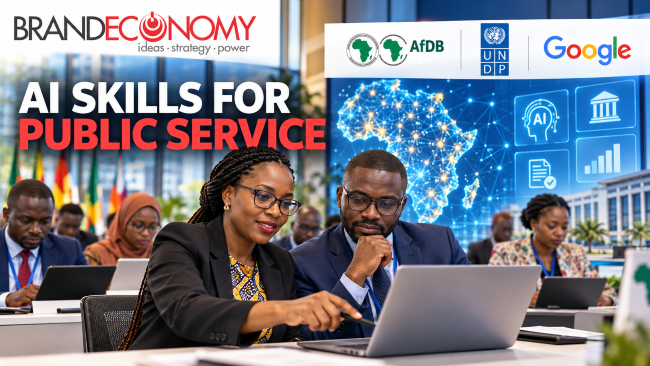 The free training programme for African public servants could become an important test of whether governments can move from AI enthusiasm to productivity, trusted governance and smarter public delivery.
A Public-Sector AI Push




The African Development Bank, the UNDP AI Hub for Sustainable Development, Google and Apolitical have launched a free artificial intelligence training programme for African public servants, in a move that speaks directly to one of the continent’s most urgent digital-development questions: can African governments build the skills required to govern, procure and deploy AI responsibly?
The programme, announced in an AfDB statement in Abuja, was launched on the sidelines of the 81st session of the United Nations General Assembly. It is designed to strengthen the understanding and use of artificial intelligence among public officials across AfDB regional member countries.
Under Apolitical’s Government AI Campus initiative, participants will access courses covering AI fundamentals, leadership and smarter procurement with AI. The courses are expected to address opportunities, risks and strategies for using AI, while helping governments build trust, encourage innovation cultures and improve procurement processes.
The training content was developed by Stanford University Online and SDA Bocconi School of Management, while Google and Apolitical provide the learning platform.
Why Government AI Literacy Matters
For Africa, this intervention is timely. The AI conversation on the continent has often focused on startups, private-sector productivity, automation, content creation and digital platforms. Yet the public sector remains central to whether AI becomes a development multiplier or another imported technology wave that widens institutional gaps.
Governments regulate markets, design public services, procure technology, manage data, issue identity systems, supervise infrastructure and shape national development priorities. If public officials do not understand AI’s possibilities and risks, governments may procure badly, regulate blindly, outsource too much judgment or fail to protect citizens from misuse.
This is why AI literacy within government is no longer optional. It is becoming a core capability for public administration. Officials do not all need to become machine-learning engineers, but they need enough literacy to ask the right questions, understand vendor claims, identify risks, protect public data, evaluate bias, and link technology choices to development outcomes.
The Productivity Argument
Ousmane Fall, AfDB Director for Industrial and Trade Development, said AI is changing the way work is done and could deliver significant productivity gains if users understand how to apply it effectively. He noted that understanding AI within government has been neglected and that the partnership would help address that gap.
According to Fall, the training is the first step in implementing recommendations from an AfDB report on AI productivity gains and inclusive economic transformation. The report projects that inclusive AI deployment could add up to one trillion dollars to Africa’s gross domestic product by 2035.
That projection is striking, but the keyword is “inclusive.” AI gains will not automatically reach African economies simply because tools exist. They will depend on skills, governance, infrastructure, trust, data systems, energy reliability, policy coherence and the ability of institutions to absorb technology intelligently.
Fall said the report identified skills and trusted governance among five key enablers needed for Africa to realise AI’s potential. This places the training programme within a broader productivity architecture, rather than a narrow course offering for African public servants.
Governance, Trust and Procurement
One of the strongest aspects of the programme is its focus on procurement. Public procurement is where many digital-transformation ambitions succeed or fail. Poorly designed procurement can lock governments into unsuitable platforms, opaque vendor relationships, overpriced systems or technologies that do not fit local needs.
AI raises the stakes further. Governments must understand issues such as data ownership, model transparency, bias, cybersecurity, accountability, privacy, interoperability and long-term maintenance. Without these capabilities, public institutions may buy tools they cannot supervise, audit or sustain.
A better-trained public service can improve the quality of AI adoption in education, health, agriculture, transport, tax administration, customs, social protection, identity management and public finance. It can also help governments distinguish between real AI capability and fashionable branding.
This matters for trust. Citizens will not embrace AI-enabled public services if they suspect surveillance, exclusion, poor data handling or unfair automated decisions. AI adoption in government must therefore be anchored on explainability, accountability and citizen protection.
The UNDP and G7 Link
Keyzom Massally, Director of the AI Hub for Sustainable Development and UNDP Head of Digital and AI Programmes, said governments across Africa need timely support as the AI landscape continues to evolve. She said such support was necessary to strengthen the institutional and technical foundations required for meaningful participation in the AI economy.
The AI Hub for Sustainable Development is a G7-endorsed initiative co-led by UNDP and Italy’s Ministry of Enterprises and Made in Italy. It aligns with Italy’s Mattei Plan for Africa, while AfDB is a founding member of its Executive Steering Group.
That institutional architecture is important. AI is now part of global development diplomacy. Countries and institutions that shape AI standards, skills pipelines, data governance and public-sector capacity may influence the next phase of economic competitiveness.
Africa cannot afford to be merely a consumer market for imported AI systems. It must build the public competence to negotiate, regulate, adapt and deploy AI on its own development terms.
Market, Brand and Investor Implications
For the market, the programme could support a stronger ecosystem for responsible AI adoption. Better-trained public officials can improve procurement standards, reduce implementation waste and create clearer demand for credible technology providers.
For African governments, this is also a brand issue. Countries that demonstrate competent, transparent and citizen-centred AI governance will be better positioned to attract digital investment, development finance and public-private partnerships. Investor confidence rises when public institutions understand the technologies they are approving, buying or regulating.
For technology firms, the implication is equally clear: the public sector will increasingly demand solutions that are explainable, secure, auditable and development-relevant. Vendor storytelling will not be enough. Governments with stronger AI literacy will ask tougher questions.
For development partners, the programme shows that capacity-building may be just as important as infrastructure financing. Africa’s AI future will not be determined only by data centres, broadband and cloud access. It will also be shaped by the competence of the officials who make policy, sign contracts and manage public systems.
BRANDECONOMY Insight
The AfDB-UNDP-Google-Apolitical initiative is significant because it targets the layer of AI adoption that often receives too little attention: the public servant. Africa does not only need AI entrepreneurs; it needs AI-literate regulators, procurement officers, policymakers, programme managers and institutional leaders.
The continent’s AI opportunity will rise or fall on execution. If governments lack the skills to understand, procure and govern AI, the technology could deepen dependency, waste public funds and weaken trust. If they build capability, AI can improve productivity, service delivery, planning, accountability and inclusive growth.
The promise of one trillion dollars in potential GDP gains by 2035 should not be treated as a slogan. It should be treated as a challenge. Africa will not capture that value by enthusiasm alone. It will need skills, infrastructure, trusted governance, local innovation and public institutions capable of asking intelligent questions before signing digital contracts.
This African public servants training programme is therefore more than a free course. It is an early test of whether African governments are ready to move from AI fascination to AI competence.