


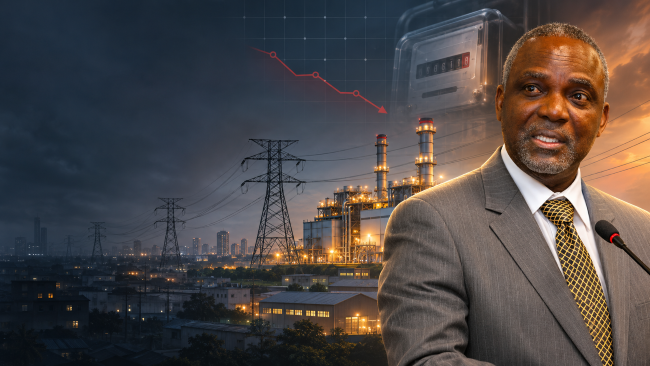
Nigeria’s 2013 power-sector privatisation was designed to replace state inefficiency with private capital, commercial discipline and better electricity supply. Thirteen years later, businesses are still running generators, consumers remain frustrated by unreliable service and the government continues to finance a market supposedly transferred to private investors. Barth Nnaji explains what went wrong.
Former Minister of Power and Chairman of Geometric Power, Professor Barth Nnaji, believes the outcome can be traced to three foundational failures: politically constrained tariffs, abuses in the privatisation process and investors who entered a long-term infrastructure business expecting quick returns.




Nnaji delivered the assessment at the third Lagos Country Club Business Forum in Lagos, held under the theme, “Energy Costs and Business Survival.”
His diagnosis reopens a consequential question: did Nigeria’s electricity privatisation fail because private ownership was inherently unsuitable—or because the country transferred assets without creating the conditions necessary for a functional electricity market?
A commercial promise government could not sustain
Nnaji identified the failure to maintain cost-reflective electricity tariffs as one of the major weaknesses confronting distribution companies.
Before the privatisation exercise, prospective investors were reportedly assured that tariffs would progressively reflect the actual cost of generating, transmitting and distributing electricity. That assurance was central to the financial models used in valuing the assets.
Nnaji recalled that electricity tariffs stood at approximately ₦6 per kilowatt-hour before June 2012. During his tenure, the rate was increased to about ₦22 per kilowatt-hour after engagements with traditional rulers, public officials and other stakeholders.
The adjustment was considered necessary to attract investment while protecting low-income and rural consumers whose electricity use was comparatively limited.
However, the politics of electricity pricing soon collided with the economics of the market. Governments were reluctant to approve tariffs capable of covering rapidly rising industry costs, particularly during periods of inflation, currency depreciation and public hardship.
This produced a structural contradiction. DisCos were expected to invest in networks, install meters, reduce losses and improve supply, but their revenues were constrained by regulated prices and weak collections.
Government attempted to fill the resulting gap through subsidies and financial interventions. Instead of creating an independent private electricity market, Nigeria developed a hybrid system in which assets were privately controlled but the state continued to absorb substantial financial risk.
Privatisation without adequate investor discipline
Nnaji also blamed irregularities in the sale of the former Power Holding Company of Nigeria’s assets and the appetite of some investors for rapid profits.
Electricity distribution is an infrastructure business requiring patient capital. Network rehabilitation, transformer upgrades, metering and technology deployment can consume substantial funding long before returns emerge. Nnaji estimated that some electricity investments could require seven to 10 years to break even.
Yet several buyers financed acquisitions heavily with bank loans, leaving limited capital for the operational improvements promised after takeover.
This created a damaging cycle. Investors needed immediate cash flows to service acquisition debt, but the networks required additional investment before they could generate stronger revenues. Weak service reduced consumer willingness to pay, while poor collections further limited the money available for improvement.
The banking sector consequently became deeply exposed to power assets whose commercial performance fell below expectations.
Nnaji cited industry estimates placing accumulated power-sector obligations above ₦7 trillion. He argued that repeated government interventions prevented the crisis from spreading more severely into banks that funded the original acquisitions.
The warning is significant: the privatisation did not merely transfer operational risk to investors. It also migrated part of the sector’s weakness into bank balance sheets and public finances.
Nigeria never created a fully private electricity market
Describing the exercise simply as a failed privatisation risks overlooking a deeper problem. Nigeria did not privatise the entire electricity value chain or establish a fully competitive market.
Generation and distribution assets were transferred to private operators, but transmission remained under government control. Electricity tariffs remained regulated. The bulk trader retained a central role in purchasing power, while gas constraints, transmission bottlenecks, weak metering and poor payment discipline continued to affect the chain.
A generation company may produce electricity that the transmission network cannot evacuate. A DisCo may receive insufficient energy while lacking the commercial incentive or capital to improve its network. Consumers may resist paying higher tariffs when supply remains unreliable.
Every participant can therefore blame another part of the system—while the customer receives inadequate electricity.
The lesson is that ownership reform cannot substitute for market design. Selling assets without resolving pricing, transmission, fuel supply, collections, governance and enforcement merely changes the identity of the operator without repairing the system.
Cost-reflective tariffs remain politically difficult
The economic argument for cost-reflective tariffs is strong: no electricity market can attract sustained private investment if service is sold below its efficient cost.
The social argument is equally compelling. Millions of households and small businesses cannot absorb large electricity-price increases without corresponding improvements in reliability and income.
Nigeria’s reform challenge is therefore not simply to raise tariffs. It is to connect payment with service.
Consumers paying premium rates should receive clearly defined hours of supply, accurate billing and enforceable compensation when service obligations are not met. Low-income households should receive transparent, targeted support instead of broad subsidies that benefit consumers according to usage rather than vulnerability.
Subsidies hidden inside market shortfalls create debt without necessarily protecting the poorest. A credible electricity market requires tariffs that support investment alongside social protection that is properly funded and narrowly targeted.
The cost of failure has shifted to businesses
The consequences of the sector’s weaknesses are most visible in corporate operating costs.
Ifeoma Ukabiala, Senior Energy Executive and Managing Partner of JDR Energy Limited, said Nigerian manufacturers spent approximately ₦1.35 trillion on alternative electricity in 2025. Businesses routinely switch to diesel, gas, solar installations and other captive-power solutions whenever grid supply fails.
This self-generation burden operates like an unofficial tax on production.
Money that could finance factory expansion, product development, technology, wages and exports is diverted into generating electricity. Large companies may spread the cost across higher volumes, but smaller businesses often cannot.
The result is higher consumer prices, weaker industrial competitiveness and lower returns on Nigerian investments. It also makes locally manufactured products less competitive against imports from markets where electricity is more reliable and affordable.
Ukabiala also highlighted Nigeria’s energy paradox: the country holds proven gas reserves estimated at about 215 trillion cubic feet, yet electricity shortages persist and many households continue to rely on firewood for cooking.
The problem, therefore, is not simply energy availability. It is the failure to convert resources into accessible, dependable and commercially sustainable energy services.
What Geometric Power represents
Nnaji positioned Geometric Power’s approach as an alternative model centred on reliable electricity for productive users, including factories, hospitals, laboratories, schools and markets.
The company’s philosophy, he said, reflects stakeholder capitalism—the idea that businesses should create value for communities and customers alongside returns for shareholders.
This approach is particularly relevant to electricity. Power infrastructure creates economic value far beyond the revenues collected from customers. Reliable supply allows factories to operate longer, hospitals to preserve medicines, schools to deploy technology and businesses to employ more people.
Electricity investors must be commercially disciplined, but they must also understand the developmental responsibility attached to an essential public service.
Market and investor implications
Nigeria’s power deficit remains both a constraint and a vast investment opportunity.
State electricity markets enabled by the Electricity Act could create more decentralised investment pathways. Industrial clusters, embedded generation, mini-grids, renewable energy, gas-to-power projects and bilateral supply contracts may offer more commercially workable models than waiting for the national grid to solve every problem.
However, investors will require credible regulation, enforceable contracts, payment security, access to foreign exchange and tariffs capable of supporting long-term capital.
The government must also resist rescuing poorly structured investments indefinitely. Support should address systemic market failures, not permanently shield owners from the consequences of inadequate capitalisation or weak management.
For DisCos, brand trust will increasingly depend on service evidence: metering speed, billing accuracy, outage communication, complaint resolution and hours of supply. Customers are unlikely to accept higher tariffs where service remains opaque and accountability is absent.
BRANDECONOMY Insight
Nigeria’s power privatisation did not fail because private-sector participation was necessarily the wrong idea. It failed because ownership changed faster than the underlying market.
Assets were transferred without sufficient investor discipline, tariffs became entangled in politics, transmission remained constrained, gas and payment risks persisted, and government continued to carry liabilities that privatisation was expected to reduce.
Nnaji’s criticism of investors seeking quick returns is valid. Electricity is patient-capital infrastructure. But commercial patience cannot compensate indefinitely for broken regulation, unbankable tariffs and a fragmented value chain.
The next reform phase should not be another dramatic asset sale or blanket financial rescue. It should focus on measurable performance: electricity delivered, outages reduced, meters installed, collections improved, losses curtailed and businesses freed from dependence on generators.
Privatisation succeeds only when customers receive better service, investors earn sustainable returns and government intervention declines. By those measures, Nigeria’s electricity experiment remains unfinished.