

 Former African Development Bank Group President Dr Akinwumi Adesina has offered to support Nigeria’s economic development in any capacity, positioning his decade of multilateral leadership as a potential national asset as the country seeks growth beyond macroeconomic stabilisation.
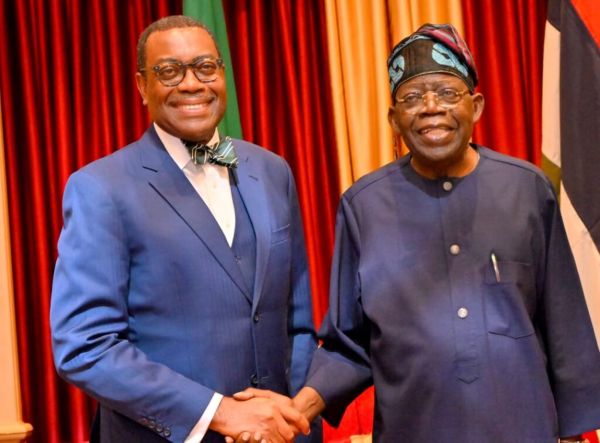
Adesina made the offer after meeting President Bola Tinubu at the Presidential Villa in Abuja on Tuesday. The former AfDB chief said the visit allowed him to formally brief the President on his 10-year stewardship of Africa’s premier development-finance institution and the scale of its intervention in Nigeria.




Although his remarks may inevitably generate speculation about a possible government appointment, Adesina was emphatic that he was neither seeking employment nor lobbying for office. He framed his offer as a patriotic obligation to deploy his knowledge, relationships and experience in support of Nigeria.
No appointment or specific assignment was announced after the meeting.
The State House confirmed that Tinubu received Akinwumi Adesina in Abuja on October 27, 2026. The State House, Abuja
AfDB’s $7bn Nigeria intervention
Adesina said the AfDB provided approximately $7 billion in financing to Nigeria between 2015 and 2025, representing about 63 per cent of the institution’s cumulative $11.1 billion financing to the country since it began operations here in 1971.
The figures underline Nigeria’s strategic importance to the bank as both a major shareholder and one of its largest clients. They also reflect the depth of the country’s infrastructure and development-financing needs across energy, agriculture, transport, water, sanitation, financial services and human capital.
Under Adesina, the AfDB’s “High 5” priorities centred on lighting and powering Africa, feeding the continent, industrialisation, regional integration and improving living standards. The bank says those programmes affected hundreds of millions of people across Africa, while its capital base rose substantially during his tenure. afdb.org
Nigeria’s larger challenge, however, is not simply attracting development loans. It is converting financing commitments into completed, commercially productive assets. Delayed procurement, counterpart-funding shortages, weak project preparation, currency exposure and inconsistent implementation have frequently limited the impact of otherwise important development interventions.
Adesina’s potential value to Nigeria may therefore lie less in ceremonial advisory work and more in helping the country build bankable projects, mobilise blended finance and establish stronger delivery systems.
Endorsement with an important qualification
The former AfDB president commended the Tinubu administration’s removal of the petrol subsidy and consolidation of foreign-exchange windows, describing both measures as difficult but necessary.
Akinwumi Adesina identified improved foreign-exchange availability, renewed portfolio-investor interest, easing inflation and more favourable sovereign assessments as indications that the reforms were beginning to deliver results.
His endorsement carries institutional weight. Adesina has operated at the intersection of government, global capital, agriculture, infrastructure and development finance. Yet his assessment also contained an important qualification: macroeconomic stabilisation is only the beginning.
Declining inflation does not mean that prices have fallen. It means that the pace of price increases has moderated. For households whose incomes have not recovered from successive increases in food, energy, transport and housing costs, improvement in headline indicators can remain disconnected from lived experience.
Similarly, portfolio inflows may strengthen market liquidity and support the naira, but they are more reversible than long-term foreign direct investment. Nigeria will require investments that build factories, improve power supply, strengthen logistics, modernise agriculture and create sustainable employment.
This is the transition Adesina highlighted: from reform and stabilisation to structural transformation, growth and broadly shared prosperity.
From financial reform to productive capacity
Nigeria’s reform story will ultimately be judged by what happens to productive capacity.
The government has made major changes to subsidy administration, foreign-exchange pricing, taxation, monetary policy and public revenue. These measures may repair distorted incentives, but they cannot independently deliver industrial competitiveness.
Businesses still face expensive credit, unreliable electricity, high logistics costs, security risks and weak consumer demand. Manufacturers must often finance infrastructure that should ordinarily be supplied through functional public systems. Small businesses remain particularly vulnerable because they have limited ability to absorb shocks or borrow at prevailing commercial rates.
The next phase must therefore connect improved fiscal and monetary conditions to affordable long-term capital for agriculture, manufacturing, infrastructure, technology and export-oriented enterprises.
Adesina’s experience is relevant here. As Nigeria’s agriculture minister from 2011 to 2015, he promoted technology-driven input distribution and private-sector participation in agricultural value chains. At the AfDB, he operated at a larger scale, mobilising sovereign, private and blended capital for development.
That combination of domestic policy experience and international financial credibility could support Nigeria’s effort to move from consuming development capital to building projects capable of attracting it competitively.
Investor and market implications
For investors, the meeting sends a modest but potentially useful signal that the Tinubu administration remains open to internationally experienced Nigerian technocrats.
Adesina’s relationships with multilateral institutions, sovereign investors, philanthropic capital, agricultural businesses and infrastructure financiers could help strengthen Nigeria’s investment narrative. However, international stature alone will not overcome weak domestic execution.
Investors will continue to assess policy consistency, currency stability, contract enforcement, regulatory predictability and the government’s ability to protect capital. Nigeria must also demonstrate that its project pipeline is supported by credible feasibility studies, land access, permits, revenue models and transparent procurement.
From a national-brand perspective, Akinwumi Adesina represents a powerful Nigerian export: technically accomplished, globally connected and associated with large-scale development finance. Deploying such expertise effectively could strengthen the country’s reputation for mobilising its diaspora and international talent.
Reducing his contribution to partisan politics or appointment speculation would diminish that value.
BRANDECONOMY Insight
Adesina’s return should not become another conversation about who gets the next government position. The more consequential question is whether Nigeria can institutionalise his knowledge.
The country needs a high-level mechanism for converting reforms into investible programmes—particularly in agriculture, power, transport, digital infrastructure and industrial development. Such a platform should bring together government, development-finance institutions, private investors and project sponsors around measurable transactions rather than speeches.
Tinubu’s reforms may have improved important macroeconomic indicators, but citizens will judge them by employment, purchasing power, food affordability and access to essential services. Investors will judge them by returns, policy predictability and the quality of project execution.
Akinwumi Adesina’s offer gives the administration access to experience accumulated across two terms at the AfDB. The real test is whether that experience is converted into stronger institutions, bankable projects and development outcomes—or absorbed into Nigeria’s familiar politics of personalities.