NSE, Greenville LNG Partner to Accelerate CNG Adoption in Nigeria

 The partnership announced in Kano places engineers at the centre of Nigeria’s transition-fuel conversation, where affordability, safety, infrastructure and investor confidence will determine whether CNG becomes a mass-market transport solution.
Engineering Meets Energy Transition




The Nigerian Society of Engineers, Kano Branch, is partnering with Greenville LNG to promote the adoption of Compressed Natural Gas across Nigeria, in a move that places engineers at the heart of the country’s search for cheaper, cleaner and more sustainable mobility.
The collaboration was unveiled in Kano during the branch’s Annual Memorial Lecture in honour of the late Salihi Illiasu, a seasoned engineer, and the induction of 40 new corporate members. The event brought together engineers, professionals and stakeholders to examine how CNG can respond to Nigeria’s transport-cost pressure, environmental concerns and energy-transition needs.
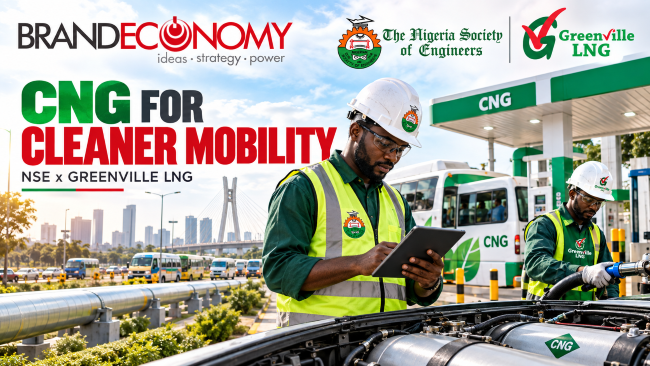
The lecture was themed “Compressed Natural Gas as Transition Fuel: Engineering Insight, Economics and Environmental Impact.” Its practical focus was captured in the presentation topic: “CNG for Transportation: Engineering Solutions for Cleaner and Affordable Mobility.”
For Nigeria, the theme is not academic. Transport costs have become a major pressure point for households, commuters, transport operators and businesses. Any fuel alternative that can reduce cost, improve supply options and lower emissions deserves serious attention. But CNG adoption will not succeed by enthusiasm alone. It requires engineering discipline, infrastructure rollout, safety assurance, financing, consumer trust and policy consistency.
CNG as an Affordability Question
Chairman of NSE Kano Branch, Alhaji Lawan Umar, said the theme was relevant to Nigeria’s current economic and environmental realities. He described CNG as a practical alternative to conventional transport fuels, noting that its adoption could help address rising transport costs while supporting environmental sustainability.
Umar said CNG speaks directly to the engineering responsibility to design for affordability and sustainability while taking account of the lifestyle and economic conditions of Nigerians. His point is important because energy transition in Nigeria cannot be framed only as a climate question. It must also be framed as a cost-of-living question.
For millions of Nigerians, mobility is productivity. When transport costs rise, workers spend more to reach their workplaces, traders spend more to move goods, farmers face higher market-access costs, and businesses pass logistics expenses into final prices. A cheaper transport fuel can therefore have wider economic implications beyond the filling station.
CNG’s appeal lies in the possibility of providing a lower-cost fuel option for commercial buses, taxis, logistics vehicles, haulage fleets and eventually private motorists. But the transition must be practical. Vehicle conversion must be safe. Stations must be accessible. Pricing must remain competitive. Spare parts and maintenance skills must be available. Without these, adoption will remain patchy.
The Infrastructure Test
The keynote speaker, Nurudeen Salahudeen, said Greenville LNG is working toward establishing 70 CNG stations across Nigeria by 2027. The planned expansion is aimed at improving access to CNG and supporting the development of cleaner and more affordable fuel alternatives for the transport sector.
That ambition goes to the heart of the CNG challenge. Nigeria does not merely need advocacy; it needs infrastructure. A transport operator will not convert a vehicle if refuelling is uncertain. A commuter will not benefit from CNG if transporters cannot access it reliably. Investors will not finance large-scale conversion or fleet transition if the supply network is thin or unpredictable.
CNG adoption is therefore a network business. It requires stations, pipelines or virtual gas supply systems, compression equipment, safety protocols, trained technicians, conversion centres, financing products and strong regulatory supervision. The more reliable the network becomes, the more attractive CNG becomes to fleet operators.
Greenville LNG’s planned 70 stations could help widen confidence if delivered on schedule and linked to real transport corridors. The strategic question is where those stations will be located: high-traffic urban centres, interstate routes, logistics clusters, bus terminals, industrial zones and commercial transport hubs will matter more than symbolic spread.
Why Engineers Matter
The NSE’s involvement is important because CNG adoption is an engineering challenge before it becomes a mass-market behaviour change. Safety is central. Poor conversion practices, weak inspection, substandard cylinders, bad installation and untrained maintenance can damage public trust and create risk.
Engineers have a duty to define standards, support training, guide infrastructure design and help the public understand what safe CNG adoption should look like. If Nigeria gets the engineering wrong, the market could suffer reputational damage. If it gets the engineering right, CNG can become a credible transition fuel.
Umar also paid tribute to the late Salihi Illiasu, describing him as one of the early indigenous engineers whose vision and dedication helped advance the profession in Nigeria. The memorial lecture, therefore, carried a symbolic message: engineering legacy must now translate into practical solutions for national problems.
The induction of 40 new corporate members also matters in that context. Nigeria needs a new generation of engineers who can work across energy, mobility, climate, safety, industrial policy and public communication. CNG adoption will require precisely that cross-disciplinary competence.
Market, Brand and Investor Implications
For the market, the NSE-Greenville collaboration signals growing institutional support for CNG as a transport fuel. If implemented well, it could open opportunities in vehicle conversion, station development, equipment supply, gas logistics, fleet financing, safety certification, maintenance services and transport operations.
For Greenville LNG, the partnership strengthens its positioning as more than a gas supplier. It presents the company as an infrastructure player in Nigeria’s mobility transition. But that positioning will be tested by delivery. Promised stations must become functioning stations. Public trust will depend on availability, pricing, safety and service reliability.
For the engineering profession, the brand opportunity is significant. Engineers can move from technical observers to public problem-solvers. By championing safe and affordable CNG adoption, NSE can strengthen its relevance in national economic life.
For investors, CNG offers a potentially attractive transition-fuel opportunity, but the risks are real. Infrastructure capital requirements, policy shifts, gas supply logistics, conversion affordability, safety regulation and consumer adoption must be carefully assessed. The opportunity is strongest where CNG deployment is linked to high-volume fleet users and predictable transport corridors.
BRANDECONOMY Insight
Nigeria’s CNG conversation must now move from promise to execution. The case for CNG is strong: it can lower transport costs, reduce emissions, diversify fuel options and support gas utilisation. But the market will only scale if the system around it works.
That system includes refuelling stations, safe conversions, trained technicians, financing for transporters, public education, credible standards and dependable gas supply. CNG is not just a fuel; it is an ecosystem.
The NSE-Greenville partnership is therefore important because it brings technical credibility to a market that needs trust. Nigerians will adopt CNG when it is safe, available, affordable and convenient. Investors will back it when policy is stable, demand is visible and infrastructure economics are clear.
The big lesson is this: Nigeria cannot engineer an energy transition by slogans. It must design one. If engineers, investors, policymakers and operators align, CNG could become one of the most practical bridges between today’s transport-cost crisis and tomorrow’s cleaner mobility economy.