Nigeria Moves to Forensic Engineering as 321 Building-Collapse Deaths Expose Safety Crisis

 Nigeria’s long-running crisis of building collapse and infrastructure failure has entered a more consequential phase with the inauguration of a new national initiative designed to strengthen the investigation of engineering failures and improve accountability across the built environment.
A New Response to an Old National Failure



The initiative, known as the Certified Forensic Engineering Failure Investigator certification programme, was inaugurated in Abuja as a specialist response to the country’s troubling record of preventable structural failures, deaths, injuries and economic losses.
It is being promoted by the Chartered Institute of Forensics and Certified Fraud Investigators of Nigeria in partnership with the Council for the Regulation of Engineering in Nigeria and the Nigeria Building and Road Research Institute.
At the induction of the inaugural cohort of CEFFI professionals, Dr Iliyasu Gashinbaki, President and Chairman of the Governing Council of CIFCFIN, framed the programme as a direct answer to findings that should unsettle every regulator, developer, insurer, financier, architect, engineer, town planner and property buyer in Nigeria.
The Grim Arithmetic of Collapse
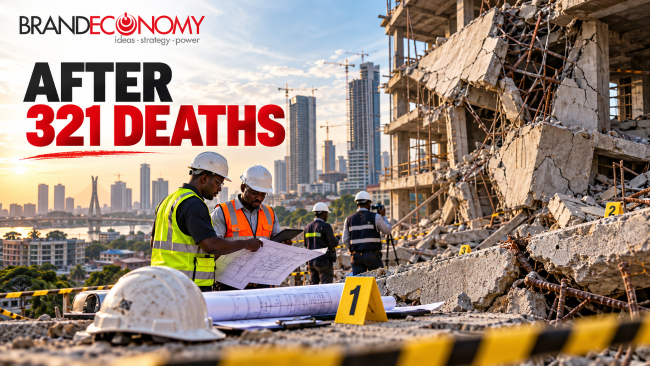
According to Gashinbaki, a 2026 engineering study identified 111 validated building-collapse incidents across Nigeria between 2015 and 2025. Those incidents resulted in 321 deaths and 344 injuries, an average of about 32 deaths and 34 injuries annually within the study’s dataset.
The fire-loss numbers cited by Gashinbaki are equally sobering. A recent analysis of documented fire-related incidents between 2022 and 2025 estimated that at least N4.6 trillion worth of goods, property and business assets had been destroyed.
For a country seeking long-term capital in housing, logistics, manufacturing, energy, retail, hospitality, transport and urban regeneration, these figures raise a fundamental market question: how bankable is an environment where buildings can fail, fires can consume assets, and technical accountability can disappear into the fog of blame-shifting?
From Mourning to Evidence
Gashinbaki said the scale of the problem shows why Nigeria must move from reactive responses to evidence-based investigation and accountability. Too often, the country’s familiar pattern after a collapse is predictable: emergency rescue, official visits, public outrage, temporary arrests, preliminary statements, committee announcements and eventual silence.
What is frequently missing is a credible technical chain of evidence strong enough to determine causation, identify culpability, improve standards and support enforcement.
Why Forensic Engineering Matters
The CEFFI initiative seeks to professionalise the process of finding out why a structure, system or infrastructure asset failed. Was the design defective? Were the drawings altered? Were substandard materials used? Was the soil investigation ignored? Were approvals obtained without compliance? Was there illegal conversion of use? Did regulators fail to act?
These are not questions for speculation. They require disciplined investigation, technical competence and an evidentiary process that can stand up to regulatory, legal, insurance and commercial scrutiny.
COREN’s Capacity Question
COREN President, Prof. Sadiq Abubakar, described the collaboration as a significant milestone in addressing longstanding gaps in the investigation of engineering failures, particularly within construction and the built environment.
Nigeria does not lack professionals on paper. It has engineers, architects, builders, quantity surveyors, estate surveyors, urban planners, safety officers and regulators. The deeper challenge of building collapse is coordination, enforcement, ethical discipline and institutional consequence.
The Urban Planning Dimension
From a town-planning perspective, engineering failure is also an urban management failure. Buildings collapse within ecosystems: approvals, zoning, density, drainage, soil conditions, traffic access, fire-service response, emergency evacuation, power systems and public utilities.
A structure designed for one use may be converted to another. A residential building may become a school, warehouse, factory, church, hotel or event centre without adequate technical reassessment. The failure may begin long before the visible crack.
Market, Brand and Investor Implications
For developers, contractors and consultants, safety is no longer just a professional obligation; it is a brand asset. In a trust-deficit market, buyers, tenants, lenders and institutional investors increasingly need assurance that projects are not only attractive but technically credible.
For insurers, better investigation of engineering and fire losses can improve underwriting, claims assessment, risk pricing and fraud detection. For banks and investors, forensic engineering capacity can support stronger project finance discipline by interrogating technical risk, professional responsibility, approval status, contractor competence and compliance history.
Beyond Buildings
Abubakar also noted that forensic engineering investigations should extend beyond construction to mining, oil and gas, telecommunications, transportation, aviation and aerospace. Nigeria’s infrastructure future will depend on bridges, roads, pipelines, towers, terminals, refineries, power systems, rail networks, ports, data centres and industrial facilities.
Still, the success of CEFFI will depend on execution. The certification must be rigorous, not ceremonial. Its graduates must be technically competent, legally aware and ethically insulated from influence.
BRANDECONOMY Insight
Nigeria’s building collapse crisis is ultimately a trust crisis built in concrete, steel, paper approvals and institutional silence. The CEFFI programme is a welcome step, but its true value will be measured by whether forensic findings lead to enforceable consequences.
After 321 recorded deaths and hundreds of injuries in validated collapse incidents, the country can no longer afford a culture where failure is mourned but not interrogated. The built environment needs a new chain of responsibility: design with integrity, build with discipline, regulate with courage, insure with intelligence, investigate with evidence and punish with fairness.
That is the real promise of forensic engineering. It turns collapse from a passing headline into a test of national seriousness. For developers, regulators, insurers, banks and investors, the message is clear: safety is no longer a technical footnote. It is now a market signal, a brand asset and a measure of institutional credibility.