
Afreximbank’s $500m ATDC Facility Puts Africa’s Trade Distribution Problem in Focus

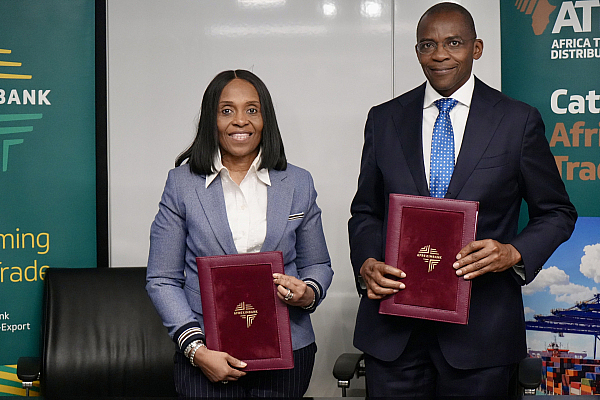 Afreximbank and the Africa Trading and Distribution Company (ATDC) have signed a $500 million Global Credit Facility to finance the purchase, movement and distribution of African goods. The agreement targets an obstacle that tariff reform alone cannot remove: producers need working capital, reliable buyers and functioning routes to market before the promise of continental trade becomes commercial reality.
The credit line can finance goods from purchase to delivery. Its larger test is whether African producers gain dependable routes to processors, manufacturers and consumers across borders.





The facility will give ATDC trade-finance capacity for eligible transactions across African markets and, where relevant, global markets. According to a statement issued on Monday by Afreximbank’s Communications and Events Manager, Vincent Musumba, it can cover purchasing and aggregation, transport, warehousing, logistics and distribution at different points in the trading cycle. The announcement describes available financing capacity; it does not establish that $500 million has already been disbursed or specify the pricing, tenor and drawdown schedule.
That distinction matters. A credit line can support many shipments if it is deployed prudently and capital returns as buyers pay. Its impact will be measured in completed, profitable transactions, not the headline value of the agreement. The more consequential ambition is to develop repeatable trade corridors and dependable sourcing and distribution networks rather than finance isolated deals.
The missing middle of African commerce
Africa’s producers frequently encounter a gap between making a product and selling it across a border. Small and medium suppliers may struggle to assemble consistent volumes or meet a buyer’s quality specifications. Processors need predictable supplies of raw materials. Manufacturers need storage, transport and distributors that can deliver on schedule. Even a competitively priced product can lose its advantage through delays, fragmented shipments and uncertain payment.
ATDC’s proposed role is to connect those links. By aggregating supply and financing inventory and movement, it could lower the cost of coordinating many sellers and buyers. It could also help processors obtain inputs locally and bring more African manufactured and value-added products to regional shelves. Greater import substitution, however, should be a commercial outcome where local supply meets standards and delivered prices—not an assumption attached to the source of finance.
The company begins with local operations in Egypt, Nigeria, Malawi and Zimbabwe. That footprint spans distinct production bases and trading routes, but the statement did not announce country allocations or identify the first products to receive financing. The practical questions are which goods have confirmed demand, which corridors can handle them reliably, and how ATDC will price the full journey from collection to final delivery.
A busy corridor is not necessarily an industrial success. If it mainly carries unprocessed goods outward and finished products back, higher volumes may leave the structure of trade largely intact. The facility’s development value would be stronger where reliable inputs support African processing, packaging and manufacturing before goods move to another market. That requires buyers willing to commit to recurring orders, suppliers able to meet specifications and a distribution operator prepared to measure value added as carefully as shipment volume.
What technology must make visible
A modern distribution platform also needs trustworthy information. To scale beyond individual relationships, ATDC will need accurate stock records, supplier and buyer verification, shipment tracking, quality documentation and a clear view of payment obligations. These are operating requirements and potential technology investment opportunities, not digital systems promised in the announcement.
Better market intelligence could reveal where African raw materials are scarce despite available supply elsewhere on the continent, or where a manufacturer’s output has unmet regional demand. Shared transaction data can help lenders assess inventory, counterparties and repayment. Yet data only improves trade when participants can use it across warehouses, carriers, customs processes and payment systems. Fragmented records merely move uncertainty from the roadside to the screen.
For the African Continental Free Trade Area (AfCFTA), this is an important test of execution. Lower barriers create an opening; commercially sound logistics and verified compliance make that opening usable. Origin rules, product standards, customs procedures and foreign-exchange exposure remain relevant to every corridor. Financing can bridge the time between purchase and sale, but it cannot erase a non-compliant shipment or a route that repeatedly misses delivery windows.
Market, brand and investor implications
Kanayo Awani, Afreximbank’s Executive Vice President for Intra-African Trade and Export Development, said the agreement is intended to strengthen the architecture needed for the AfCFTA, improve the movement of Made-in-Africa goods, deepen regional value chains and support manufactured exports. ATDC Chief Executive Officer Stewart Makura emphasised the need to connect producers, processors, manufacturers and markets, saying the financing would help aggregate supplies, mobilise working capital and move goods more efficiently.
For Nigerian producers, the opportunity is access to organised cross-border demand for suitable commodities, industrial inputs and finished goods. The opportunity is conditional: firms must meet specifications consistently, fulfil orders and compete on landed cost. Logistics providers, warehouse operators, testing services and trade technology firms may find work where corridors develop, although the facility creates no automatic contract for any participant.
Brands also stand to gain or lose at the point of delivery. A Made-in-Africa label carries greater value when buyers receive authentic goods in consistent condition and on time. Poor handling, uneven quality or opaque sourcing can damage the reputation of an entire product category. Traceability, packaging and dependable after-sales distribution should therefore be treated as commercial infrastructure, alongside vehicles and warehouses.
Investors will watch utilisation, inventory turnover, payment collection, losses, corridor-level margins and the share of trade involving processed or manufactured goods. They will also want clarity on ATDC’s governance, related-party exposure, currency risk and concentration by buyer or commodity. Those measures would show whether the facility is creating durable regional value chains or simply enlarging the financing available for existing commodity flows.
BRANDECONOMY Insight
The $500 million agreement addresses a real gap between African production and African markets. Its strongest result would be a repeatable system in which finance, trusted information and physical distribution reinforce one another: producers sell more predictably, processors secure inputs and buyers receive goods at a competitive delivered price. The benchmark should be completed trade with more African value added, not the size of the credit line. AfCFTA becomes meaningful when a producer can sell across a border again next month, with the same confidence as this month.