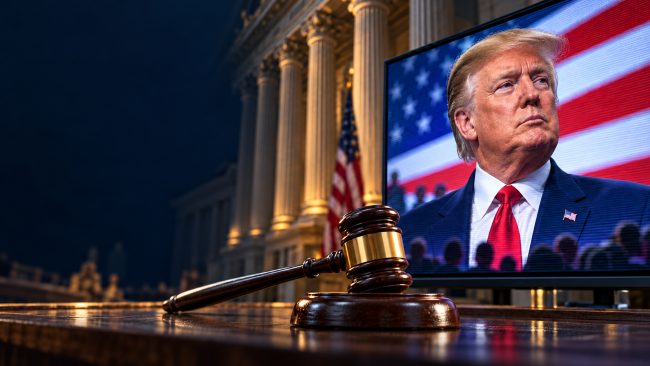
 The temporary order against taxpayer-funded Trump ads puts public spending, political promotion and the credibility of government communication under scrutiny as Washington approaches the November 3 elections.
A federal judge in New York has temporarily stopped the Trump administration from using public money for television advertisements promoting President Donald Trump, intensifying a dispute over whether government communication budgets were being used to advance partisan interests ahead of America’s midterm elections.




US District Judge Jennifer Rochon, sitting in Manhattan, issued the order on Sunday, October 11, following a challenge led by watchdog organisation Common Cause. The plaintiffs contend that the taxpayer-funded Trump ads, which began appearing in late September, served Republican electoral interests rather than a legitimate public information purpose.
The intervention raises an issue that extends beyond American politics: when governments purchase public attention, how can taxpayers establish whether they are financing useful information or the political image of those in office?
For advertising businesses, public institutions and investors assessing governance quality, the distinction carries practical consequences. It determines the legitimacy of expenditure, the security of commercial contracts and the credibility of the institution behind the message.
An interim order with commercial consequences
Rochon’s order suspends a purchase agreement involving US Customs and Border Protection and Lepugh, Inc., trading as LMD Agency, Inc. It also freezes the Office of Management and Budget’s $20 million allocation for the disputed advertising campaign.
The court barred the use of Department of Homeland Security funds for the challenged advertisements, directed the cancellation of remaining placements and prohibited new or expanded agreements covering them. The restrictions extend to contractors acting with the government, and the administration must report its compliance.
The order lasts 14 days unless extended. Rochon found that the applicants seeking immediate relief were likely to succeed on the merits and would suffer irreparable harm without intervention. That is a preliminary assessment supporting emergency relief, rather than a final judgment resolving every claim. storage.courtlistener.com
Its commercial significance is immediate: an advertising campaign can be interrupted at the level of funding, contractual payments and media placement, even after production and distribution have begun.
Why the election calendar matters
The plaintiffs include Common Cause, Service Employees International Union Local 32BJ, its Empire State political action committee and Robert Hunter, a candidate for the Alabama State House. Their case challenges the use of public resources for advertisements they characterise as partisan political promotion. Common Cause
Timing is central to the dispute. Advertising that improves an incumbent president’s public image shortly before voting may also benefit candidates associated with his party, even where it does not explicitly ask viewers to elect them. Whether the challenged expenditure is lawful remains a question for the proceedings; the plaintiffs’ allegation should not be confused with a completed judicial determination.
The coalition had sought intervention before Friday’s deadline to prevent further exposure during weekend broadcasts, including football games and Saturday Night Live. Those placements matter because they can deliver broad audiences outside the narrower constituency that routinely follows political news.
Democratic Party officials have separately challenged the advertisements in federal court in Washington, adding another legal front to the controversy.
An announced withdrawal did not end the dispute
The administration had already indicated in a Saturday court filing that it intended to stop the taxpayer-funded campaign before Rochon issued her order.
That proposed withdrawal did not prevent judicial intervention. The court found that the request for immediate relief remained live and imposed enforceable restrictions on spending and distribution.
Trump had earlier defended the advertisements as favourable promotion of the United States while announcing that taxpayers would no longer finance them. The White House said future costs would be covered through a Trump-aligned political funding organisation, described by Reuters as MAGA PAC; Associated Press reporting identifies the proposed payer as MAGA Inc. AP News
The White House also indicated that the political organisation would not reimburse the public expenditure already incurred. The advertisements carried a disclosure identifying the US government as their payer, while the Justice Department had not immediately responded to Reuters’ request for comment on the order.
Common Cause President and CEO Virginia Kase Solomón said the organisation would continue pressing for accountability and safeguards against the use of taxpayer funds for presidential propaganda, regardless of party. Reuters
The shift in proposed funding therefore addresses future expenditure without settling the argument over money already spent.
Public information needs a demonstrable public purpose
Governments have legitimate reasons to advertise. They may need to explain a tax deadline, communicate a health warning, publicise access to benefits or tell citizens how a new policy affects them.
The governance problem arises when the public benefit becomes difficult to distinguish from the personal or electoral benefit enjoyed by officeholders.
A useful editorial test is whether a campaign gives citizens information they can act on, whether its claims can be checked and whether its spending is proportionate to the public objective. A further question is whether the campaign would retain its essential value if the leader’s image and praise were removed.
These tests do not replace the law. They help explain why a government payment disclaimer, by itself, cannot establish that an advertisement serves an appropriate public purpose.
Disclosure tells the audience who paid. Accountability requires an explanation of why they paid, under what authority and for whose benefit.
Market implications for agencies and media owners
For the advertising industry, the case illustrates how public sector revenue can carry risks that sit outside the usual measures of campaign performance.
An agency may deliver the agreed creative work and secure the planned airtime, yet still face disrupted payments or cancelled placements when the funding authority is challenged. Media owners may need to unwind bookings, while contractors must establish which obligations survive an injunction.
The court order does not establish the eventual losses or liabilities of any particular business. It does, however, show why government advertising contracts require careful attention to spending authority, cancellation terms and responsibility for costs already incurred.
That scrutiny is commercially relevant even when a campaign attracts strong audience numbers. Reach cannot cure a defective funding basis, and an apparently prestigious public sector account can become a source of reputational exposure.
For commercial brands buying space around politically contentious content, the related concern is audience perception. Placement decisions can associate a business with a disputed message without any deliberate endorsement, making context an important part of media planning.
Brand implications for government credibility
The central brand asset at stake is institutional credibility.
Public communication works best when citizens believe that the institution is providing dependable information in service of a recognised public need. If audiences begin treating official messages as extensions of a politician’s publicity operation, future announcements may meet greater scepticism.
That risk extends beyond the campaign being challenged. A controversy over promotional spending can weaken confidence in unrelated messages about public safety, economic policy or service delivery.
From a brand strategy perspective, the administration’s defence and the plaintiffs’ challenge represent competing interpretations of the same communication: patriotic promotion on one side, publicly financed partisan advantage on the other.
Resolving that tension requires more than a persuasive slogan. It requires evidence of public purpose, defensible expenditure and oversight that citizens can trust.
Investor relevance and the lesson for Nigeria
This advertising dispute alone does not establish a change in US market valuations or justify a conclusion about sovereign financial risk. Its relevance to investors is more specific: it reveals how oversight can interrupt government expenditure and affect businesses contracted to deliver it.
Investors assessing agencies, media businesses and other public sector suppliers should examine the quality of receivables, the authority behind major contracts and exposure to politically sensitive work. Revenue secured through a government agreement still needs to be assessed for collectability and continuity.
For Nigeria, the case offers a governance question rather than a directly transferable legal ruling. Public communication should help citizens understand policies and services, while expenditure should be capable of surviving scrutiny beyond the administration that authorised it.
Clear campaign objectives, transparent procurement and independent review can strengthen both public accountability and the commercial standing of agencies serving government clients. The relevant measure of success is the public outcome achieved, alongside the cost of achieving it.
BRANDECONOMY Insight
The deeper issue in this taxpayer-funded Trump ads controversy is ownership of public attention. When citizens fund a communication campaign, its purpose should be explainable in terms of their needs, even when the message concerns an elected leader’s policies.
Rochon’s intervention demonstrates the practical importance of oversight: a disputed campaign can be stopped while its legal basis is examined. Yet the announced move to political funding leaves a separate accountability question about expenditure already incurred. Ending a contested practice and accounting for its cost are distinct responsibilities.
For governments, the strongest reputation strategy is credible performance supported by accurate communication. For agencies, commercial judgment must include the legitimacy of the brief and the resilience of the contract. For citizens, meaningful transparency requires an account of the purpose, authority and outcome of public spending as has been the case in the taxpayer-funded Trump ads controversy.
A campaign may purchase visibility quickly. The trust that makes that visibility valuable depends on whether the public can defend the expenditure after the advertisement has ended.