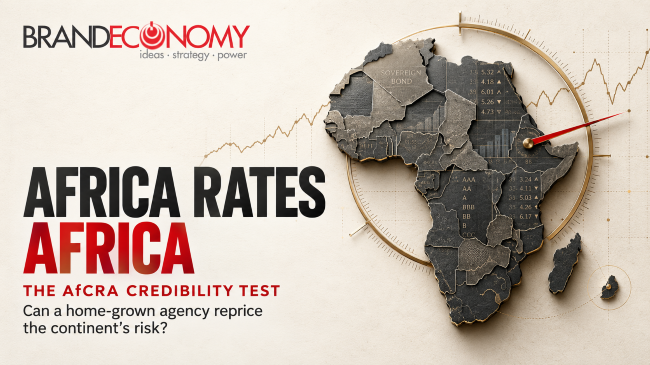
 The African Union is set to inaugurate the Africa Credit Rating Agency, AfCRA, in Port Louis, Mauritius, on Wednesday, October 7, marking a potentially consequential intervention in how African sovereigns, financial institutions and companies are assessed by global capital.
The ceremony represents the culmination of almost a decade of political advocacy. African leaders endorsed the idea in 2018, while subsequent AU decisions established the framework for a privately led, self-financing and commercially sustainable ratings institution.




AfCRA is not being presented merely as an African answer to Moody’s Ratings, S&P Global Ratings and Fitch Ratings—the three firms that dominate the international credit-rating industry. Its more important proposition is to supply an additional credit opinion built on African data, institutional knowledge and a closer reading of the continent’s economic structures.
That distinction matters.
A rating agency gains influence not from the location of its headquarters or the nationality of its promoters, but from the confidence investors place in its methods, governance and willingness to publish uncomfortable conclusions. AfCRA may have been conceived as a response to frustration with the existing order, but it will succeed only if markets consider its judgements rigorous rather than politically convenient.
The cost of Africa’s credibility deficit
Credit ratings influence the interest governments and companies pay when raising debt. They also affect investment mandates, bank capital requirements, portfolio allocations and the eligibility of securities for institutional investors.
For Africa, those consequences are particularly severe. The AU estimates that the continent’s annual external-debt service increased from $61 billion in 2010 to $163 billion in 2024. In several countries, interest obligations now compete directly with—or exceed—public expenditure on healthcare, education and other development priorities.
This is the real economic context behind AfCRA’s arrival. Every additional percentage point paid on sovereign debt represents resources that cannot be invested in electricity, transport infrastructure, schools, hospitals or productive enterprise.
African governments have repeatedly argued that international rating methodologies sometimes exaggerate perceived risk, undervalue economic resilience and react too aggressively during conflicts, pandemics and commodity shocks. The major agencies reject that charge, maintaining that they apply globally consistent standards.
The criticism should not be accepted uncritically. A major 2024 investigation into Africa’s debt crisis found no evidence of systematic discrimination in the sovereign ratings assigned by the three dominant international agencies. Weak institutions, poor fiscal discipline, limited economic diversification, inadequate data and opaque debt arrangements remain genuine risk factors across several African markets.
AfCRA, therefore, must resist the temptation to become an institutional vehicle for validating the continent’s grievances. Its strongest contribution would be better measurement—not automatically better ratings.
Filling Africa’s information gap
The new institution intends to rate sovereign borrowers, banks, other financial institutions and private companies. It may also assess non-African entities where commercially appropriate.
One of its most compelling opportunities lies beyond the already-rated sovereigns. The AU says 23 African economies currently have no rating from the major international agencies. Coverage is even thinner among subnational governments, infrastructure projects, banks, medium-sized companies and local-currency debt issuers.
That information deficit restricts investment. Assets that cannot be credibly assessed are frequently treated as too risky, regardless of their underlying quality. Investors either avoid them or demand an additional return to compensate for uncertainty.
AfCRA could help convert some of that uncertainty into measurable risk. Its proximity to African markets may allow it to incorporate information that global models can overlook: informal-sector activity, regional trade relationships, domestic revenue capacity, pension-fund demand, local-currency repayment history and the strategic importance of particular institutions.
This does not mean abandoning internationally comparable standards. Context should improve the quality of a rating, not dilute its discipline.
AfCRA’s greatest commercial opening may consequently be in Africa’s underdeveloped local-currency markets. Deeper coverage of domestic bonds, municipalities, infrastructure vehicles and corporate issuers could help pension funds, insurers and asset managers allocate capital more intelligently.
For Nigeria, this could become especially relevant. The country already attracts extensive sovereign scrutiny, but much of its corporate, infrastructure and subnational credit universe remains insufficiently analysed. More credible ratings could improve price discovery and help distinguish genuinely bankable projects from propositions relying primarily on political access or promotional language.
Independence cannot remain a slogan
The AU says AfCRA will operate independently, supported by shareholder capital and revenue from its services. It has also been structured without government ownership in an attempt to reduce political interference.
However, important questions remained unanswered ahead of the inauguration, including the identities of shareholders, the composition of management, the architecture of the ratings committee and the detailed arrangements for managing conflicts of interest.
These are not administrative footnotes. They will determine whether AfCRA is recognised as a serious market institution.
The traditional issuer-pays business model already creates a structural tension: the organisation being rated often pays for the assessment. AfCRA must show that its commercial ambitions cannot influence its credit opinions. It will need transparent methodologies, defensible governance, published performance records and credible protections for analysts.
It must also demonstrate a willingness to downgrade African governments and companies when the evidence demands it. An agency that issues flattering assessments may win political applause, but it will quickly lose investors.
Credibility will be earned when AfCRA delivers a judgement that displeases an influential shareholder, government or client—and can show that the decision flowed from transparent analysis.
Market implications
AfCRA’s launch introduces competition into a highly concentrated information market. If its ratings gain acceptance from regulators, institutional investors, development-finance institutions and global asset managers, the agency could broaden coverage and reduce dependence on a small number of international providers.
Its presence may also encourage the established agencies to invest more deeply in African research, strengthen their local teams and explain their sovereign assumptions more clearly.
Yet AfCRA cannot reduce borrowing costs by declaration. Bond yields are shaped by inflation, currency risk, fiscal credibility, debt sustainability, political stability and global liquidity. A new rating cannot compensate for weak economic management.
What it can do is improve the information through which those risks are interpreted. Where international investors are pricing uncertainty rather than demonstrated weakness, better data could narrow the premium. Where the fundamentals are poor, AfCRA’s duty should be to say so plainly.
Brand implications
At a continental level, AfCRA is an attempt to reposition Africa from an object of external assessment to a producer of trusted financial intelligence.
That is a significant brand ambition. Africa’s investment narrative has too often swung between exaggerated optimism and undifferentiated pessimism. Both obscure the enormous differences between countries, sectors and issuers.
A credible AfCRA could replace part of that narrative volatility with disciplined differentiation. It could help investors see that “Africa risk” is not a single category and that a well-managed African bank, infrastructure project or company should not automatically inherit every weakness associated with its home sovereign.
But the reputational danger is equally substantial. If AfCRA appears politically captured, methodologically soft or reluctant to publish negative findings, it could reinforce the very doubts it was created to challenge.
Investor Relevance
Investors should initially regard AfCRA as an additional analytical input rather than a substitute for existing ratings, independent research or market pricing.
The indicators that matter most will be the transparency of its methodology, the identity and independence of its owners, the quality of its analysts, regulatory recognition across jurisdictions and the accuracy of its ratings over time.
Its early sovereign and corporate assignments will be closely watched. More important than the grades themselves will be whether AfCRA explains risk with sufficient clarity to change investor understanding.
BRANDECONOMY Insight
AfCRA’s historic importance does not lie in giving Africa more favourable credit scores. It lies in giving the market better reasons to distinguish genuine African risk from lazy assumptions about African risk.
The continent does not need a cheerleader disguised as a ratings institution. It needs an institution capable of telling African governments, companies and investors the truth—with greater local intelligence than its global competitors and no less analytical discipline.
If AfCRA can combine contextual knowledge with institutional independence, it could become part of the financial infrastructure required to deepen African capital markets. If it allows political purpose to overtake professional judgement, it will become another expensive symbol of sovereignty without market power.
Africa has created a new voice in the global ratings industry. Whether international capital listens will depend on the quality—and courage—of what that voice says.