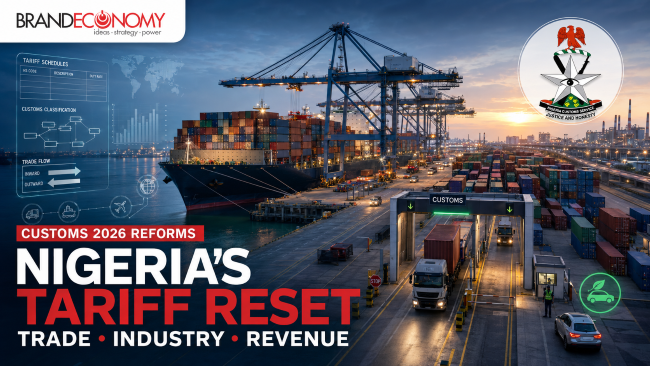
 Nigeria has begun implementing a far-reaching revision of its import, export and excise-duty regime, setting up a critical test of whether tariff policy can simultaneously stimulate production, ease trade, protect local industry and strengthen government revenue. But how far will this Tariff Reforms initiative go?
The Nigeria Customs Service announced the commencement of the 2026 Fiscal Policy Measures and Tariff Amendments approved by President Bola Tinubu.



NCS spokesman Abdullahi Maiwada said in Abuja on Wednesday that the new Tariff Reforms framework was designed to make Nigeria more competitive, facilitate legitimate commerce and improve fiscal administration. It also seeks to bring the country’s tariff system into closer alignment with regional and international trade commitments.
Comptroller-General of Customs Bashir Adeniyi had earlier announced the revised duties while defending the Service’s 2026 budget proposal before lawmakers. He presented the measures as part of the Federal Government’s wider fiscal strategy for stimulating economic activity.
What is changing?
The reforms include a revised Import Adjustment Tax List for the implementation of the ECOWAS Common External Tariff covering 2022 to 2027.
They also introduce a revised National List under the ECOWAS framework, an updated Import Prohibition List, a revised schedule of products liable to excise duty and a new Export Prohibition List.
The package further provides for a Green Tax Surcharge on vehicles with engine capacities above 2,000 cubic centimetres.
Taken together, these instruments determine considerably more than the amount an importer pays at the port. They influence which industries receive protection, which products become cheaper, what businesses can export and the competitiveness of locally manufactured goods.
Earlier details of the fiscal measures indicated lower tariffs for selected foods, passenger vehicles and industrial inputs, while electric vehicles, mass-transit buses and some manufacturing machinery received exemptions. Passenger-vehicle tariffs were reportedly reduced to 40 per cent from 70 per cent, although larger-engine vehicles now face the environmental surcharge.
Tariffs as industrial policy
Tariffs are often discussed primarily as revenue instruments. In practice, they are also tools of industrial policy.
A lower duty on machinery can reduce the cost of establishing or expanding a factory. Reduced tariffs on raw materials may improve production margins, encourage capacity utilisation and strengthen the ability of Nigerian manufacturers to compete with imported finished goods.
The opposite can also occur. Lower duties on products already manufactured locally may expose domestic producers to stronger import competition, particularly where Nigerian factories confront expensive electricity, logistics bottlenecks, high interest rates and exchange-rate volatility.
The central policy challenge is therefore calibration. Tariffs should not shield inefficient businesses indefinitely, but neither should they undermine manufacturers operating within a difficult domestic environment.
Nigeria must also manage its national priorities within the ECOWAS Common External Tariff. The common framework is intended to reduce arbitrary differences among member states, discourage trade diversion and support regional integration. National adjustments must consequently remain transparent and consistent with agreed rules.
The real test is at the ports
Maiwada urged importers, exporters, manufacturers, licensed customs agents and other trade stakeholders to study the revised schedules and comply fully with the requirements affecting their transactions.
That advice is important because tariff transitions frequently generate disputes over product classification, applicable rates, valuation and the timing of import documentation.
Successful implementation will depend on whether the revised schedules are correctly configured across Customs platforms and consistently interpreted at different commands. Importers should not encounter one tariff position at Apapa Port and another at Tin Can Island, Onne or a land border.
For the maritime sector, predictability is almost as important as the tariff rate itself. A reduced duty offers little commercial benefit if consignments are delayed by uncertainty, conflicting interpretations or repeated assessments.
Customs must therefore combine enforcement with extensive stakeholder education, clearly defined transitional arrangements and responsive dispute-resolution channels.
Market implications
Lower duties on selected goods could reduce landed costs and relieve some inflationary pressure. However, consumers should not automatically expect an equivalent fall in retail prices.
Foreign-exchange movements, international freight charges, insurance, port fees, inland transportation and financing expenses all contribute to final prices. Competition within each market will determine how much of the tariff benefit reaches consumers.
The revised excise schedule could also alter prices and margins for affected manufacturers, while changes to export restrictions may reshape supply availability within the domestic economy.
Investor relevance
For investors, the reform’s greatest value will come from predictability rather than isolated duty reductions.
Businesses planning factories, logistics operations or regional distribution hubs require stable tariff rules to estimate landed costs and investment returns. Frequent reversals or inconsistent enforcement increase risk premiums and make Nigeria less attractive relative to competing African markets.
If implemented transparently, the new regime could strengthen Nigeria’s position as a manufacturing and distribution base for ECOWAS and the African Continental Free Trade Area.
Brand implications
Companies must update pricing models, supply contracts, product portfolios and customer communications to reflect the new schedules.
Automotive brands affected by the Green Tax should also avoid treating environmental compliance as merely another levy. It provides an opportunity to reposition smaller-engine, hybrid and electric vehicles around efficiency and responsible mobility.
Brands that benefit from lower import costs will face a reputational question: will they share the savings with consumers or quietly retain the difference?
BRANDECONOMY Insight
Nigeria’s Tariff Reforms will not be judged by the sophistication of its schedules, but by its impact on factories, ports, prices and investment.
Customs must now prove that revenue collection and trade facilitation are not competing mandates. Better technology, consistent classification and transparent enforcement can improve compliance while reducing unnecessary friction.
The winning tariff regime is not necessarily the one with the highest rates. It is the one that creates the greatest sustainable economic value.