


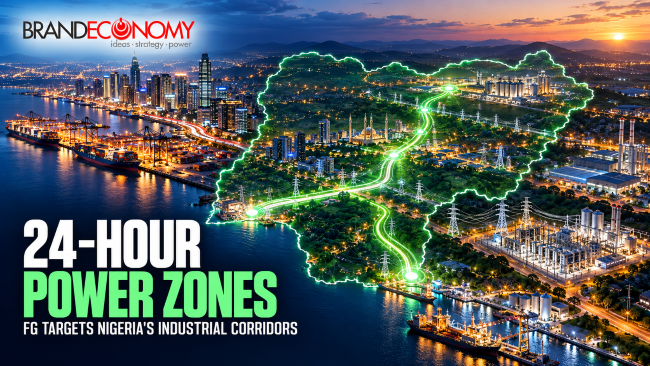
 The Federal Government has unveiled plans to establish special energy zones designed to deliver 24-hour electricity to some of Nigeria’s most commercially active and industrially important locations.
The proposed clusters will cover the Lagos axis, the Abuja–Kaduna–Kano corridor and the Enugu–Port Harcourt axis, according to a statement issued in Abuja by Mr Adeola Labzy, Special Adviser on Media and Publicity to the Minister of Power, Joseph Tegbe.



The initiative emerged from a closed-door meeting between Tegbe and the leadership of selected electricity distribution companies. Representatives of Abuja Electricity Distribution Company, Ikeja Electric, Eko Power, Ibadan Electricity Distribution Company and Sahara Energy Group attended the engagement.
Tegbe presented the zones as part of a more disciplined and sequenced approach to Nigeria’s electricity crisis, aligned with President Bola Tinubu’s Renewed Hope Agenda and its emphasis on energy as an enabler of industrialisation, investment and employment.
The proposal reflects an important shift in emphasis. Nigeria’s electricity problem is not restricted to insufficient generation or constrained transmission. A considerable part of the challenge lies at the distribution end: how much available electricity can be taken up, delivered, accurately metered and commercially recovered.
The planned zones are intended to close that gap by concentrating infrastructure in locations where electricity demand is high and customers have stronger capacity to pay. This could improve power delivery while strengthening DisCo billing, collections and overall commercial viability.
For manufacturers, technology companies, logistics operators, financial institutions and service businesses, dependable electricity could significantly reduce reliance on diesel generators and other costly self-generation systems. It could also improve production planning, protect equipment and enhance service reliability.
The economic logic is persuasive. Electricity investments are more likely to attract capital where demand is concentrated, consumption can be measured and revenue can be collected. Successful zones could subsequently provide a template for extending reliable supply to additional industrial clusters.
However, the announcement remains a proposal rather than an operational programme. No implementation timetable, funding structure, generation allocation, tariff model or service-guarantee framework has been disclosed.
Those details will determine whether the initiative becomes a bankable power-market intervention or another ambitious policy declaration.
There are also questions of equity. Concentrating premium electricity services in profitable industrial and urban corridors may accelerate production, but it could widen the divide between commercially attractive customers and communities already experiencing weak supply. Government must therefore position the zones as a first stage in system-wide improvement, not as permanent islands of electricity reliability.
Market and Investor Implications
If properly structured, the zones could create opportunities for embedded generation, renewable energy, battery storage, smart metering, distribution automation and infrastructure finance.
DisCos operating within the selected corridors could benefit from higher energy throughput and stronger collections. Industrial property values may also rise in locations covered by credible supply guarantees.
Investors will nevertheless require clarity on tariff certainty, payment security, grid access, contractual enforcement and responsibility for infrastructure losses. The decisive issue is not whether round-the-clock electricity is technically possible, but whether its delivery can be made financially sustainable.
Brand Implications
Reliable electricity would significantly improve Nigeria’s investment proposition and the competitiveness of locally manufactured brands. Fewer production interruptions could support consistent quality, more dependable delivery and better customer experience.
For the government and participating DisCos, however, the reputational risk is considerable. Promising 24-hour electricity in a country accustomed to outages creates a high bar for performance. Credibility will depend on measurable service standards and transparent reporting, not ceremonial launches.
BRANDECONOMY Insight
Energy zones could offer Nigeria a pragmatic route to power-sector recovery by matching infrastructure investment with concentrated demand and commercial discipline.
But the strongest policy would move beyond geographic labels. Each zone needs defined service obligations, independently verifiable performance targets, credible financing and consequences for failure.
If the government gets those fundamentals right, the 24-Hour Electricity initiative could become more than an electricity programme. It could provide the productive infrastructure required to turn Nigeria’s economic corridors into genuine industrial growth engines.