
Fuel Relief Behind an App: NNPC’s ₦66 Petrol Discount Exposes Nigeria’s Digital Divide

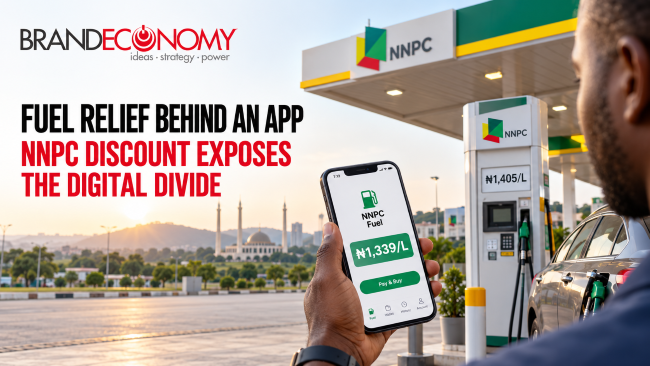 A one-month petrol discount intended to cushion rising energy costs has instead opened a wider debate about digital exclusion, limited retail reach and whether temporary price concessions can deliver meaningful relief to Nigerian households.
A fuel-price intervention designed to offer Nigerians some respite from escalating living costs is running into an uncomfortable access problem: many motorists cannot obtain the discount unless they own a compatible smartphone, download the NNPC Fuel App and complete payment digitally.




Checks at Nigerian National Petroleum Company Limited retail stations in Abuja on Sunday showed a two-tier transaction structure. Customers paying conventionally at the pump were charged about ₦1,405 per litre, while motorists completing their purchases through the mobile application paid ₦1,339—a difference of ₦66 per litre.
NNPC Ltd introduced the discount on October 1, 2026, as part of activities marking Nigeria’s 66th Independence anniversary. The company subsequently extended the promotion to October 31, maintaining that it was surrendering its retail profit margin rather than restoring the petrol subsidy abolished in May 2023. nnpcgroup.com
The intervention followed measures announced by the Minister of Finance and Coordinating Minister of the Economy, Taiwo Oyedele, to moderate the effect of global fuel-price volatility on households and businesses. The government has also proposed a wholesale petrol-price ceiling of about ₦1,350 per litre—distinct from a universal retail pump price—and expects market participants to manage temporary cost increases within that framework. The State House, Abuja
However, the emerging controversy is no longer simply about the size of the discount. It is about who can access it, how widely it can be distributed and whether a relief measure should be conditioned on digital capability.
A discount many motorists cannot reach
Motorist Babatunde Atoye said the lower price was not automatically applied at NNPC retail outlets. Customers must first access the company’s mobile platform and follow its digital payment process.
A fuel attendant, who asked not to be named, similarly explained that conventional pump transactions did not qualify for the concession under the arrangement operating at the station.
For Abdulrahim Malik, the policy raises a deeper social-equity question. A considerable number of Nigerians still use basic mobile phones, while others face difficulties with literacy, mobile data costs, internet connectivity and digital-payment systems. An app-dependent relief programme could therefore exclude some of the people most exposed to high transport and energy costs.
George Ochendu welcomed the price reduction but warned that network instability could frustrate customers even when they possess smartphones. A stalled payment, failed authentication or unavailable data connection at a petrol station could be enough to deny a motorist the discount.
Toyin Daniel made a similar observation, questioning how motorists unfamiliar with mobile applications were expected to navigate the process.
The concern is economically significant. On a 50-litre purchase, the discount saves a motorist ₦3,300. For a commercial driver or small business operating several vehicles, the cumulative reduction could be meaningful. But the value can quickly be eroded by the cost of travelling to an NNPC station, waiting in a queue, purchasing data or resolving a failed digital transaction.
A discount that is technically available but operationally difficult to obtain offers less welfare value than its headline figure suggests.
When digital innovation becomes a barrier
There are legitimate commercial reasons for linking promotions to an application. Digital payments can create auditable transaction records, reduce cash handling, discourage multiple claims and help NNPC understand customer behaviour. The app can also become a platform for loyalty programmes, location services and future energy products.
But those are primarily operational and marketing benefits. They should not be allowed to overwhelm the public purpose of a programme presented as economic relief.
If the concession is intended to cushion vulnerable households and transport operators, access should be broad, simple and technologically neutral. Making the discount app-exclusive effectively converts a public-facing relief intervention into a customer-acquisition campaign.
That distinction matters.
Digital transformation should widen access and improve service efficiency. When it becomes the only gateway to a basic price benefit, it can reinforce the very inequalities it ought to reduce.
A better model would apply the approved discount directly at participating pumps while allowing customers to use the app for additional benefits, transaction histories or loyalty rewards. Assisted registration at stations, USSD access, payment cards and verified public-transport vouchers could complement the smartphone channel.
Limited outlets weaken the national impact
Public analyst Jide Ojo questioned the wider economic value of restricting cheaper petrol to NNPC stations, given the company’s relatively limited retail footprint compared with the total number of filling stations operated by independent and major marketers.
For motorists located far from an NNPC outlet, travelling several kilometres to save ₦66 per litre may produce no real benefit after fuel consumption, lost working time and transport costs are taken into account.
The restricted distribution network could also generate queues at participating stations, with congestion creating further productivity losses. Where demand exceeds supply, there is an additional risk of informal resale, preferential access or other forms of arbitrage.
Ojo also argued that ₦1,339 per litre remains beyond the comfort of many households. The discount may soften the burden at the margin, but it does not fundamentally change the economics confronting commuters, microbusinesses and families dependent on petrol generators.
Its inflation impact is also likely to be limited unless commercial transport operators can access the lower price at scale and pass some of the savings to passengers. Without measurable transmission into fares and distribution costs, the intervention risks becoming a retail promotion with little effect on the wider economy.
The Dangote question and the danger of hidden subsidies
Ojo called for greater clarity around domestic crude supply to the Dangote Refinery, arguing that more reliable access to Nigerian crude could support cheaper locally refined petroleum products.
He suggested that crude could be supplied at a concessionary rate in return for corresponding reductions in domestic fuel prices. He also referred to the Federal Government’s reported equity interest in the refinery as a potential basis for closer monitoring of supply volumes and pricing outcomes.
The proposal highlights a genuine policy concern, but it requires caution.
Selling crude below its market value without a transparent formula could recreate a subsidy elsewhere in the value chain. The cost would still be borne—through lower Federation revenue, reduced transfers to the three tiers of government or an accumulating obligation that eventually reaches taxpayers.
Any concessionary crude arrangement would therefore require independently verified volumes, enforceable domestic-supply commitments, a transparent pricing formula and clear rules governing how savings must be passed to consumers.
The more sustainable objective is not to subsidise a particular refinery indefinitely. It is to build a competitive domestic refining market in which reliable crude supply, efficient logistics, foreign-exchange stability and fair competition reduce production costs across multiple operators.
Nigeria’s petroleum paradox remains unresolved
Economist Aliyu Illias said Nigeria had not extracted sufficient developmental value from more than six decades of oil production. Although the country possesses substantial crude oil and gas resources, it has struggled to build a refining, petrochemical and industrial ecosystem capable of delivering affordable energy, exports and large-scale employment.
Nigeria’s state-owned refineries have repeatedly failed to provide dependable output despite years of expenditure. The Dangote Refinery represents an important addition to domestic capacity, but one large facility cannot by itself resolve the country’s structural energy weaknesses.
Illias also pointed to the slow development of compressed natural gas as an alternative transport fuel, noting that Nigeria is expanding CNG adoption at a time when several economies are accelerating towards electric mobility.
CNG should not automatically be dismissed as obsolete. For a gas-rich country with limited charging infrastructure and an electricity system still struggling to meet demand, it can serve as a transitional fuel for buses, taxis and logistics fleets. But transition must not become permanent delay.
Nigeria needs a coordinated energy-mobility strategy encompassing gas infrastructure, electric vehicles, public transport, renewable electricity, local battery assembly and reliable urban charging networks.
The objective should be to reduce the economy’s vulnerability to one product—petrol—and to the international price, exchange-rate and shipping shocks that influence its domestic cost.
Market implications
The NNPC discount may create temporary competitive pressure on other retailers, particularly in locations where the company operates high-volume stations. Rival marketers could respond with loyalty programmes, fleet discounts or digital-payment incentives.
However, the intervention is unlikely to reset the national petrol market unless other retailers participate or wholesale costs fall sufficiently to support broader price reductions.
The scheme may also increase patronage at NNPC stations, but that benefit carries operational responsibilities. Stock availability, app reliability, transaction speed and complaint resolution will determine whether higher customer traffic strengthens the company’s position or damages it.
For transport operators and small businesses, the central question is predictability. A one-month price concession offers temporary savings but provides little basis for long-term budgeting, fare setting or logistics planning.
Brand implications
For NNPC Ltd, this is as much a brand-trust test as a pricing exercise.
The company’s promise is relief. Yet many customers encounter a qualifying condition only when they reach the point of purchase. That gap between the public message and the retail experience can create disappointment even when the programme is commercially well-intentioned.
A customer who sees a discounted price but is unable to obtain it because of technology, network failure or lack of information is unlikely to remember the policy rationale. The lasting impression will be exclusion.
NNPC should clearly communicate the eligibility rules, participating outlets, transaction process, complaint channels and duration of the promotion. Station attendants must also be trained to assist customers rather than merely turn them away.
For other consumer-facing brands, the lesson is clear: digital innovation must be designed around the realities of the market, not an idealised customer who owns the right device, has reliable connectivity and understands every payment process.
Investor relevance
Investors will be watching whether the discount remains genuinely temporary, commercially funded and transparent.
A defined retail-margin waiver is different from an open-ended government subsidy. But if the intervention is repeatedly extended, financed through opaque accounts or imposed on private operators without clear compensation rules, it could generate fresh concerns about quasi-fiscal obligations and policy unpredictability.
The government and NNPC should disclose the volumes sold under the programme, the total value of the margin surrendered, the number of participating stations and the number of customers who successfully accessed the discount.
Such transparency would help markets distinguish a limited promotional intervention from a return to administered fuel pricing.
The controversy also points to investment opportunities in fuel-payment technology, retail automation, CNG conversion, mass transit, domestic refining, storage, electric mobility and decentralised energy. Yet capital will flow more confidently where pricing rules are stable and government interventions are clearly defined.
BRANDECONOMY Insight
The contradiction at the heart of the NNPC petrol discount is striking: a measure presented as relief for Nigerians is available only to those who can cross a digital gate.
Technology is not the problem. Poorly designed access is.
If the Federal Government wants the programme to deliver social and economic value, the discount should be visible at the pump and available through multiple payment channels. The app can remain an optional platform for enhanced benefits, data gathering and customer engagement—not the sole passport to relief.
NNPC should also publish a transparent performance dashboard showing discounted volumes, geographical coverage, transaction success rates and estimated consumer savings. Without such disclosure, it will be difficult to determine whether the initiative is delivering broad relief or merely rewarding a relatively small group of digitally enabled motorists.
More fundamentally, Nigeria cannot discount its way out of structural energy insecurity. Temporary concessions may offer political comfort and limited household savings, but enduring relief will come from competitive domestic refining, reliable crude supply, efficient distribution, expanded public transport and a credible transition towards gas and electric mobility.
A fuel intervention should lower barriers, not introduce new ones. When economic relief is placed behind an app, the policy risks becoming more sophisticated in technology than it is inclusive in design.