Trust in Science Slides as Global Confidence Falls Below Pre-COVID Levels

 The Wellcome Global Monitor 2026 reveals a widening credibility crisis shaped not only by misinformation, but also by inequality, weak institutions and the failure of scientific progress to translate into visible improvements in people’s lives as Trust in Science slides.
Public confidence in science has fallen below its pre-pandemic level, raising fresh concerns about the world’s ability to mobilise citizens around vaccination, climate action, artificial intelligence, mental health and future disease outbreaks.



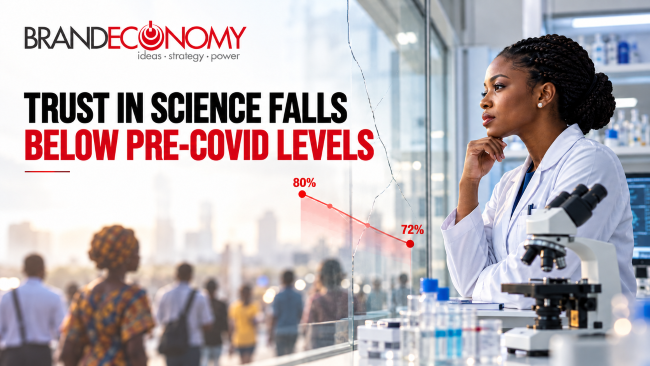
The Wellcome Global Monitor 2026, released at the World Health Summit in Berlin, found that 72 per cent of respondents across countries surveyed consistently in 2018, 2020 and 2025 expressed at least some trust in science last year. That was down from 80 per cent during the COVID-19 emergency and below the 77 per cent recorded in 2018.
The study—the third edition of what Wellcome describes as the world’s largest examination of attitudes towards science and health—drew responses from more than 140,000 people across 140 countries. Fieldwork was conducted in 2025 through nationally representative face-to-face, telephone and online interviews delivered through the Gallup World Poll, with Ipsos leading the quantitative analysis and interpretation. Wellcome
There is an important methodological distinction. The 72 per cent trend figure covers the 108 countries included in all three survey waves. Across the complete 140-country sample for 2025, 70 per cent expressed either “some” or “a lot” of trust in science.
In either case, the direction is unmistakable: the extraordinary confidence generated when scientists raced to understand COVID-19, develop vaccines and guide public-health responses has not endured.
The pandemic trust dividend has disappeared
During the height of the pandemic, scientists occupied an unusually prominent place in public life. Epidemiologists, virologists and public-health officials became familiar faces on television, while laboratories delivered vaccines at unprecedented speed.
That visibility created a temporary trust dividend. Yet it also exposed science to political conflict, contradictory messaging, institutional mistakes, misinformation and the pressures of communicating incomplete knowledge in real time.
By 2025, the proportion of people expressing little or no trust in science had risen to 19 per cent, compared with 13 per cent in both 2018 and 2020. Confidence in scientists proved particularly volatile: the proportion expressing strong trust rose from 34 per cent in 2018 to 43 per cent in 2020, before retreating to 32 per cent in 2025.
Scientists remain more trusted than journalists and national governments and sit behind doctors and nurses among trusted professional groups. However, their sharp post-pandemic decline shows that institutional reputation cannot be sustained by technical competence alone.
Scientific institutions must also demonstrate independence, communicate uncertainty honestly and show that research delivers benefits beyond wealthy countries, political elites and commercially attractive markets.
The economics of distrust
One of the report’s most consequential findings is that confidence in science is strongly associated with economic security.
Among people who said they were living comfortably on their present income, 39 per cent reported a high level of trust in science. Among those struggling financially, the figure was only 20 per cent.
The trust gap between these groups widened from 13 percentage points in 2018 to 19 points in 2025. People experiencing the greatest financial pressure also recorded the steepest deterioration in confidence.
This challenges the assumption that distrust is mainly a problem of ignorance or poor science education. People may understand scientific claims and still distrust the institutions delivering them if their lived experience is characterised by expensive healthcare, inaccessible medicines, unemployment, corruption and widening inequality.
Trust in science does not exist in isolation. It is influenced by whether hospitals function, governments appear credible, public institutions treat citizens fairly and technological progress produces improvements that people can see.
Globally, only 26 per cent of respondents expressed strong trust in science. Among those with high confidence in their country’s hospitals and clinics, that proportion rose to 43 per cent. The study also found lower scientific trust among populations reporting weak confidence in government, greater perceptions of corruption and wider economic inequality. Wellcome
This suggests that a badly equipped clinic can weaken confidence in science just as effectively as a conspiracy theory. When citizens repeatedly encounter unavailable medicines, misdiagnosis, unaffordable treatment or neglected public-health infrastructure, they may struggle to separate scientific knowledge from the institutions failing to deliver it.
Africa’s trust problem is deepening
The deterioration is especially troubling across sub-Saharan Africa, where the proportion of people expressing strong trust in science declined from 28 per cent in 2018 to 21 per cent in 2025.
Over the same period, the share reporting “not much” trust rose from 16 per cent to 21 per cent, while those expressing no trust increased from five per cent to nine per cent.
Unlike regions where confidence rose during COVID-19 before falling, sub-Saharan Africa experienced a gradual decline across all three survey waves. Scepticism also became more entrenched, with more people moving towards the lowest trust categories. cms.wellcome.org
The regional average nevertheless conceals substantial national and demographic differences.
In South Africa, 51 per cent of respondents expressed at least some trust in science, while 39 per cent reported little or no trust. The country’s deep socioeconomic inequality, perceived corruption and uneven institutional performance provide part of the context, although the report cautions that such social conditions do not fully explain public attitudes.
Kenya revealed a pronounced generational divide. A quarter of respondents aged between 15 and 24 said they trusted science strongly, compared with only six per cent among people aged 65 and above.
This suggests that younger Africans may be more receptive to scientific and technological solutions, possibly because of greater exposure to digital education, innovation platforms and global information. Older citizens may rely more heavily on accumulated experience, community networks, religious institutions and traditional sources of authority.
The appropriate response is not to dismiss either group. Communication must be tailored to how different communities establish credibility and make decisions.
Nigeria’s confidence deficit
Nigeria’s figures demand particular attention.
Only 15 per cent of Nigerians surveyed in 2025 said they trusted science “a lot”. Although this represented a modest improvement from 13 per cent in 2020, it remained far below the 26 per cent recorded in 2018.
Overall, 57 per cent expressed at least some trust in science, leaving a substantial proportion either sceptical, openly distrustful or uncertain.
Attitudes towards vaccination illustrate the practical consequences. Thirty-five per cent said they would immediately take a vaccine recommended by a doctor or nurse, while 36 per cent preferred to take time before deciding. Another 24 per cent said they did not receive vaccines at all.
The large middle group should not automatically be labelled anti-science. Wanting time to assess a medical recommendation may reflect caution rather than rejection. The strategic challenge is to ensure that uncertainty is addressed by credible information before it is captured by rumours, fear-based content or deliberate disinformation.
Nigeria’s trust deficit has deep institutional roots. Citizens have repeatedly experienced poorly funded hospitals, abandoned research, inconsistent health campaigns, counterfeit medicines, changing government narratives and limited accountability when programmes fail.
Scientific communication also remains too concentrated in official statements, technical conferences and urban media. It frequently fails to reach communities through trusted local voices, languages and channels.
When authorities communicate only during emergencies, they surrender the intervening space to unverified claims. Public trust must therefore be cultivated before the next epidemic, not improvised after it begins.
AI raises the stakes
The trust challenge is becoming more complex as artificial intelligence transforms how information is produced and distributed.
Generative AI can expand access to health information, translate scientific explanations into local languages and support disease surveillance, diagnosis, education and agricultural productivity. Yet the same technology can create convincing falsehoods, fabricated experts and manipulated medical advice at enormous scale.
This creates a difficult paradox: societies need greater scientific literacy at precisely the moment when distinguishing credible evidence from synthetic misinformation is becoming harder.
Technology companies, health platforms and public institutions cannot treat accuracy as a back-office compliance issue. They will need visible verification systems, transparent data practices, qualified human oversight and rapid correction mechanisms.
The brands that thrive in health technology, biotechnology and AI-enabled services will not necessarily be those with the most sophisticated products. They will be those that can explain what their systems do, what they cannot do, how decisions are reached and who is accountable when something goes wrong.
Market implications
Declining confidence in science represents an adoption risk across several industries.
Pharmaceutical manufacturers may face greater resistance to vaccines and newly developed treatments. Health-technology companies could struggle to persuade patients to trust digital diagnosis, remote consultations and AI-supported clinical decisions. Insurers may encounter resistance to data-driven health products, while agritech companies could find farmers reluctant to adopt unfamiliar seeds, biological inputs or climate technologies.
The commercial cost extends beyond slower sales. Businesses may require larger education budgets, more extensive community engagement, stronger post-market surveillance and longer periods to secure social acceptance.
Trust should therefore be treated as part of market infrastructure. A scientifically effective product that communities reject is commercially weak, regardless of the quality of its research.
Organisations entering lower-trust markets must invest in local evidence, credible partnerships and accessible explanations. Global reputations alone may not be sufficient, particularly where multinational institutions are perceived as distant from the realities of ordinary citizens.
Brand implications
Science-based organisations have often communicated as though evidence automatically produces belief. The Wellcome findings show that this assumption is increasingly unsafe.
Facts matter, but so do the messenger, the institution behind the message and the audience’s experience of the system.
Pharmaceutical, healthcare, technology and research brands must communicate uncertainty without appearing evasive. They should disclose funding relationships, explain risks alongside benefits and acknowledge failures promptly.
Community health workers, doctors, nurses, teachers, faith leaders and respected local advocates may carry greater persuasive power than corporate advertising or ministerial declarations. Brands must therefore build networks of trusted intermediaries rather than relying exclusively on centralised communication.
Most importantly, the promise must match the experience. A campaign celebrating medical innovation will ring hollow if patients cannot obtain the treatment. A health app cannot build lasting credibility if it excludes people with limited connectivity. A research institution cannot demand public trust while remaining inaccessible and unresponsive.
Trust is ultimately built through performance.
Investor relevance
For investors in pharmaceuticals, biotechnology, health technology, artificial intelligence, agriculture and climate solutions, public confidence is an increasingly material risk.
A market may possess enormous unmet need and still deliver slow adoption if consumers distrust the product, the regulator or the institutions promoting it. Market-entry assessments should therefore examine more than population size, disease burden and purchasing power.
Investors should evaluate institutional credibility, healthcare access, community sentiment, local communications capacity, misinformation exposure and the company’s ability to demonstrate practical benefits.
The report also points to opportunity. Businesses capable of building trusted distribution networks, providing transparent evidence and adapting products to local realities can create durable competitive advantage.
In low-trust markets, credibility is not merely a defensive asset. It can become a barrier to entry that protects companies willing to earn it.
BRANDECONOMY Insight
The collapse in scientific trust is not simply a communications problem. It is a warning that millions of people do not believe scientific progress is working sufficiently for them.
A laboratory breakthrough that never reaches the local clinic is not experienced as progress. A climate model means little to a farmer who receives no practical support. An AI diagnostic tool has limited social value if patients cannot access treatment after receiving the result.
Institutions cannot demand trust while ignoring inequality, weak service delivery and legitimate public anxiety. Nor should sceptical citizens be casually dismissed as uninformed. Suspicion often grows where promises are abundant but benefits are scarce.
For Nigeria, rebuilding confidence requires more than public-awareness campaigns. Government must strengthen hospitals, fund research consistently, protect regulatory independence, support science education and ensure that innovation produces visible improvements in everyday life.
Scientists must communicate more openly, including when evidence is incomplete. Media organisations must resist turning uncertainty into sensational contradiction. Technology platforms must take greater responsibility for amplifying falsehoods. Brands operating in science-dependent sectors must move from promotional communication to sustained public engagement.
Wellcome Chief Executive John-Arne Røttingen’s central message is that scientific discovery alone cannot secure public confidence. Trust must be earned through openness, responsiveness and a genuine understanding of people’s circumstances.
That is the defining challenge. Science may produce the solutions to humanity’s most difficult problems, but societies will benefit only when people believe those solutions are credible, fairly distributed and designed with their lives in mind.