Nigeria’s 90,000km Fibre Bet: Can Project BRIDGE Turn Connectivity into Innovation?

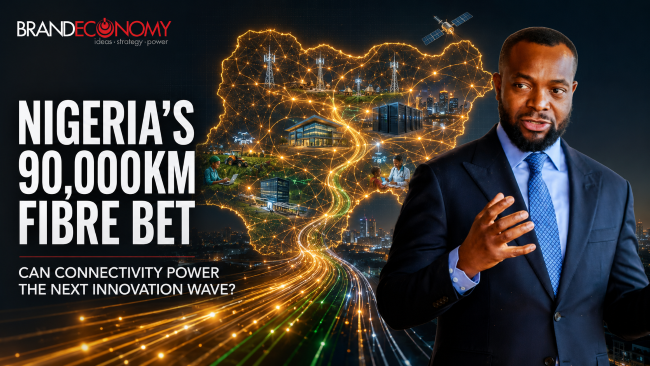 Nigeria is preparing one of the most ambitious digital-infrastructure expansions on the African continent: a 90,000-kilometre fibre-optic network intended to connect underserved communities, strengthen the country’s technology ecosystem and provide the backbone for a more inclusive digital economy.
Minister of Communications, Innovation and Digital Economy, Dr Bosun Tijani, disclosed the government’s continuing investment in the programme at the National Innovation Hub Standards Framework Workshop in Abuja.




The nationwide rollout is expected to commence in October, with substantial implementation progress targeted by December. When completed, it would expand Nigeria’s national fibre backbone from approximately 30,000 kilometres to about 120,000 kilometres and place the country among Africa’s largest terrestrial-fibre markets.
The programme, known as Project BRIDGE—Building Resilient Digital Infrastructure for Growth—is more than a conventional public-works project. It is structured as a public-private partnership through a special-purpose company, Bridge Open Access, with an estimated implementation cost of $2 billion.
Funding is expected to combine development-finance debt, private equity and a minority Federal Government shareholding. The open-access model is intended to allow telecommunications companies and internet-service providers to use the infrastructure without one dominant operator controlling the national backbone.
That design is strategically important. Nigeria does not merely need more fibre in the ground; it needs competitively priced, non-discriminatory wholesale capacity that can reduce the cost of taking reliable broadband to homes, businesses, schools, hospitals and government institutions.
Technology’s three-layer economy
Tijani described technology-led development as operating through three connected layers.
The first is foundational infrastructure: fibre networks, satellites, telecommunications towers, data centres, electricity and basic connectivity. Without this physical layer, digital transformation becomes a collection of ambitious applications competing for weak bandwidth and unreliable power.
The second layer consists of technology systems that allow businesses and innovators to build at scale. These include digital identity, trusted data-exchange platforms and interbank settlement infrastructure.
The third is the application layer, where entrepreneurs develop products and services for agriculture, education, healthcare, commerce and public administration.
Nigeria’s fintech success illustrates the model. Telecommunications liberalisation beginning around 1999, followed by private investment in mobile networks, towers and fibre, expanded the connectivity foundation. The development of interbank settlement infrastructure subsequently enabled financial institutions and startups to build payment services at scale.
The result was an ecosystem that produced some of Africa’s most valuable technology companies. The lesson is clear: celebrated applications and billion-dollar startups are usually built on less glamorous investments in cables, data centres, identity systems, payment rails and regulation.
Project BRIDGE seeks to extend that enabling infrastructure beyond Nigeria’s major commercial centres. But its developmental value will depend on whether connectivity reaches productive users—not merely state capitals, government offices and profitable urban corridors.
A national backbone does not automatically solve the last-mile problem. Local distribution networks, affordable devices, community access points, dependable electricity and digital skills will still determine whether a farmer, rural health centre or small-town entrepreneur can benefit.
Standardising the innovation-hub ecosystem
The National Innovation Hub Standards Framework is intended to address another part of that challenge: the uneven quality of startup support across Nigeria.
Innovation hubs frequently function as incubators, training centres, co-working spaces, investor connectors and local gateways into the technology economy. Yet capabilities differ widely. Some offer structured incubation and experienced mentors; others possess little more than physical space and aspirational branding.
Tijani said the framework would provide a stronger environment for startups developing solutions to national problems.
Hilda Ayejimiwo, Senior Programme Manager at the Embassy of Denmark, described a common national benchmark as a basis for coordinated and evidence-driven support from government and development partners. She stressed that implementation would require sustained collaboration among public institutions, hubs, entrepreneurs, investors and the private sector.
Victoria Fabumi, National Coordinator at the Office for Nigerian Digital Innovation, said the framework would strengthen the institutions nurturing startups and help decentralise innovation. She compared startups to babies and innovation hubs to mothers whose capacity determines whether young ventures survive and grow.
The metaphor is useful, but standards must not become bureaucratic barriers. A small hub in Maiduguri, Akure or Uyo should not be judged exclusively by the infrastructure and funding available to established accelerators in Lagos.
Nigeria needs tiered standards covering governance, programme quality, mentor competence, safeguarding, financial management, founder outcomes and sustainability. Certification should signal credibility while preserving room for local experimentation.
Market implications
The fibre programme could expand opportunities for telecommunications operators, internet-service providers, data-centre companies, cloud platforms, fibre manufacturers, civil-engineering firms and digital-service businesses.
Greater backbone capacity should improve network resilience, reduce wholesale bandwidth costs and make smaller cities more commercially attractive. Agriculture platforms could connect farmers to markets and extension services. Schools could access digital learning, while health facilities could use telemedicine, electronic records and remote diagnostics.
However, lower wholesale costs must translate into affordable retail prices. If savings remain within the operator chain, fibre expansion will improve infrastructure statistics without materially changing digital inclusion.
State governments will also be decisive. High right-of-way charges, slow permits, multiple taxation and uncoordinated road construction can delay deployment or repeatedly damage installed cables.
Investor relevance
Project BRIDGE creates a long-duration infrastructure opportunity supported by Nigeria’s population, rising data consumption and large underserved market.
Investors should nevertheless examine the independence of Bridge Open Access, wholesale-pricing rules, anchor customers, foreign-exchange exposure, construction risk, rights-of-way, security, demand forecasts and revenue-sharing arrangements.
The integrity of the open-access promise will be particularly important. Private capital will require predictable returns, but telecom operators must have confidence that access terms are transparent and no politically connected participant receives preferential treatment.
Investment opportunities will also emerge downstream—in regional data centres, cybersecurity, cloud services, digital identity, logistics technology, agritech, healthtech and education platforms.
Brand implications
For the Tinubu administration and Tijani’s ministry, Project BRIDGE could become a defining digital-economy achievement. It could also become a reputational liability if kilometres are announced without affordable, functioning connectivity.
Bridge Open Access must build its brand around neutrality, competent governance and measurable service delivery. Innovation hubs, meanwhile, will need to demonstrate founder outcomes rather than rely on events, training photographs and grant-funded visibility.
BRANDECONOMY Insight
Nigeria should resist celebrating fibre length as the principal measure of progress. The world’s longest cable is economically useless if it remains unlit, frequently damaged, prohibitively expensive or disconnected from the last mile.
Government should publish a Project BRIDGE dashboard reporting kilometres completed, kilometres activated, local governments reached, network uptime, institutions connected, wholesale prices, retail broadband costs and private capital deployed.
The Innovation Hub Standards Framework should similarly measure startups surviving beyond two years, capital raised, products commercialised, revenues generated and jobs created.
Fibre is the foundation—not the finished building. If Nigeria combines open-access infrastructure with dependable power, digital public systems, capable innovation hubs and competitive last-mile services, the 90,000-kilometre network could distribute opportunity far beyond Lagos and Abuja.
That is the real prize: not owning one of Africa’s longest fibre networks, but converting connectivity into productive businesses, stronger public services and a genuinely national innovation economy.