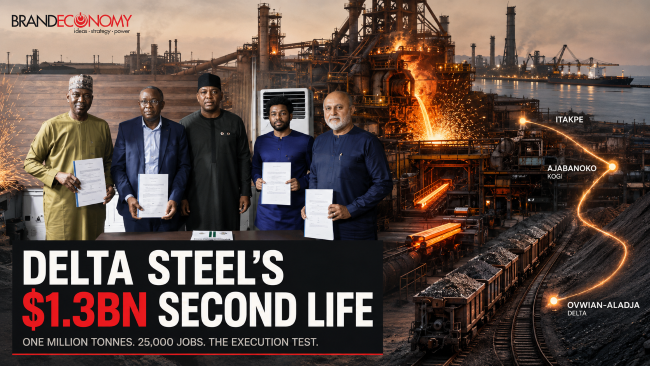
Nigeria has signed another agreement to awaken one of its sleeping industrial giants. The Federal Government and Premium Steel and Mines Limited are betting more than $1.3 billion on restoring the former Delta Steel Company at Ovwian-Aladja, Delta State.
The ambition is substantial: revive integrated steelmaking, reactivate iron-ore mining, create jobs and reduce import dependence. Yet Nigeria’s steel history counsels discipline. The success of this deal will be measured in molten metal—not signatures, projected jobs or optimism.

The Sub-lease and Operations Agreement, executed on August 20 between the National Iron Ore Mining Company, Itakpe, and PSML, establishes the framework for restoring the plant and securing its raw-material requirements. Salamatu Jibaniya, Head of Press and Public Relations at the Federal Ministry of Steel Development, announced the agreement in Abuja.
Minister of Steel Development, Prince Shuaibu Abubakar Audu, said PSML had committed more than $1.3 billion to iron-ore exploration and exploitation, plant rehabilitation and modernisation. The target is to return the complex to its designed capacity of one million metric tonnes of liquid steel annually.
Commercial operations are expected within 18 to 24 months, subject to sustainable iron-ore supply. That qualification is decisive. An integrated steel plant cannot thrive as an isolated factory; it requires an uninterrupted chain linking mines, beneficiation, rail, power, production, storage and markets.
The project is expected to reactivate NIOMCO, advance development of the Ajabanoko iron-ore deposits, increase freight on the Central Rail Line and improve utilisation of the Delta Steel Company jetty. These assets could become an industrial corridor extending from Kogi’s ore deposits to Delta’s production and maritime infrastructure.
Commissioned in 1982, Delta Steel was designed to produce one million tonnes of liquid steel annually. It reportedly operated at only about a quarter of capacity before prolonged difficulties ended integrated production. Government privatised it to Global Infrastructure Holdings Limited in 2005; the Asset Management Corporation of Nigeria subsequently sold it to PSML in 2015 to recover distressed obligations.
That history makes the agreement a test of whether Nigeria has learnt from fragmented ownership, unreliable inputs, weak infrastructure and performance enforcement.
Audu described the revival as part of President Bola Tinubu’s Renewed Hope Agenda and a foundation for local manufacturing, youth employment and economic diversification. Government projects 5,000 direct and more than 20,000 indirect jobs, while the plant’s output would contribute one-tenth of Nigeria’s target of 10 million tonnes of liquid steel annually by 2030.
Market implications
Steel is industrialisation made visible. Construction, railways, automobiles, shipbuilding, energy infrastructure, machinery, appliances and fabrication depend on it. Reliable domestic output could shorten supply chains, reduce exposure to exchange-rate shocks and give manufacturers more predictable access to a critical input.
But import substitution is not automatically competitiveness. If erratic power, inefficient logistics, weak ore quality or excessive financing costs make Nigerian steel more expensive than imports, downstream firms will merely exchange foreign-exchange risk for higher domestic costs.
The plant must therefore compete on quality, delivery reliability and total cost—not rely indefinitely on tariffs or administrative protection. Its revival should also deepen local supplier networks in engineering, maintenance, transport, refractories, fabrication and industrial services.
Investor relevance
The $1.3 billion commitment is impressive, but investors will distinguish an announced intention from bankable capital. Key unanswered questions include the equity-and-debt structure, financial-close timetable, rehabilitation contractor, power solution, ore-beneficiation requirements, rail availability, environmental liabilities and binding offtake arrangements.
Milestone disclosure will be essential. Markets should see evidence of mine development, capital mobilisation, equipment orders, site rehabilitation, workforce recruitment and test production. A credible performance bond, clear default provisions and independent technical verification would reduce the risk of another legacy asset remaining trapped between promises and partial execution.
For Delta and Kogi communities, the project offers employment, contracting and infrastructure opportunities. It also creates expectations around environmental management, land impacts, worker safety and local procurement. Social licence must be built through transparent community agreements, not improvised after operations begin.
Brand implications
For PSML, the revival could define its reputation as the company that restored a strategic Nigerian asset. Failure or prolonged delay would attach its brand to the same cycle of dormant plants and unmet commitments that has damaged confidence in the sector.
For the Steel Development Ministry, credibility requires transparent oversight rather than celebratory communication. Publishing implementation milestones and quarterly progress would strengthen public confidence in the agreement and the Renewed Hope industrialisation narrative.
BRANDECONOMY Insight
Nigeria does not lack steel ambition; it lacks a reliably managed steel ecosystem. Delta Steel Company can succeed only if government and PSML treat Itakpe, Ajabanoko, the Central Rail Line, power supply, Aladja and the jetty as one commercial chain with shared deadlines and measurable responsibilities.
The Federal Government should publish a project scorecard covering committed and deployed capital, ore delivered, rail availability, rehabilitation completion, local procurement, jobs created and production achieved.
One million tonnes of liquid steel will not by itself transform Nigeria. But a commercially disciplined Delta Steel revival could prove that the country can convert mineral deposits, abandoned infrastructure and private capital into competitive industrial output.
That would be the real breakthrough: not reviving a monument to past ambition, but building a functioning platform for Nigeria’s manufacturing future.