CBN’s Vision 2028 Puts Digital Payments at the Centre of Nigeria’s Inclusion Drive

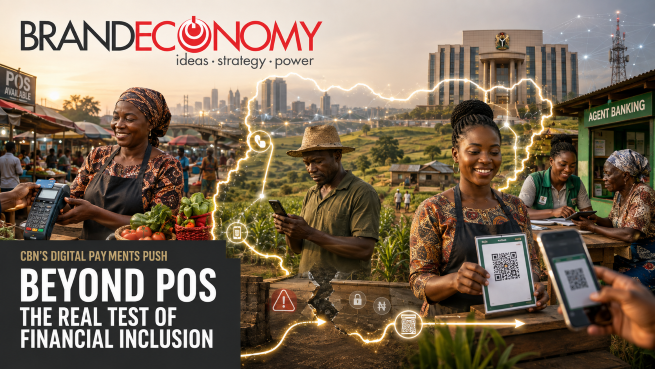 Nigeria has built one of Africa’s most energetic digital-payments markets, yet millions of citizens remain outside—or only marginally connected to—the formal financial system. The Central Bank of Nigeria’s push for wider adoption of alternative payment channels therefore addresses an important development challenge. But the real test is no longer how many channels exist; it is whether Nigerians can use them affordably, safely and productively.
At the 2026 CBN Fair in Lokoja, Kogi State, the apex bank called for greater use of agent banking, mobile money, Point-of-Sale terminals, USSD, digital wallets, QR codes and electronic banking to deepen inclusion and accelerate economic development.




The fair, themed “Driving Alternative Payment Channels as Tools for Financial Inclusion, Growth and Accelerated Economic Development,” also provided public engagement on CBN policies, financial services and consumer protection.
CBN Acting Director of Corporate Communications and Investor Relations, Mrs Hakama Sidi-Ali, represented by the Lokoja Branch Controller, Mr Zubairu Salihu, said reforms under Governor Olayemi Cardoso were strengthening macroeconomic stability and confidence.
She cited headline inflation, which moderated from 15.91 per cent in June to 15.43 per cent in July 2026, and external reserves exceeding $52.5 billion—a level the CBN described as a 17-year high.
Sidi-Ali also highlighted foreign-exchange reforms, banking-sector recapitalisation, the non-resident Bank Verification Number platform, the B-MATCH electronic foreign-exchange trading system, Nigeria Payments System Vision 2028 and the Nigerian Overnight Financing Rate.
Developed with the Financial Markets Dealers Association, NOFR provides a transaction-based reference for short-term funding. It is not an inclusion product, but transparent wholesale pricing can improve policy transmission, risk management and the credibility of the financial architecture supporting retail innovation.
The non-resident BVN reduces identity barriers for Nigerians abroad, while Payments System Vision 2028 seeks a more interoperable, secure and inclusive ecosystem. Together, the reforms target both retail access and the institutional plumbing beneath it.
Access is not inclusion
Salihu, represented at the event by Mr Friday Abah, said alternative channels were particularly important to farmers, traders, small businesses and informal-sector operators. He cited EFInA’s 2023 Access to Financial Services Survey, which placed Kogi first in banking penetration at 94 per cent.
The statistic also illustrates why inclusion must be measured beyond account ownership. A person may possess an account but rarely use it because fees are high, agents lack liquidity, networks fail or fraud has destroyed trust. An entrepreneur receiving transfers through a POS agent may still lack affordable credit, insurance, savings or working-capital support.
Governor Ahmed Ododo, represented by his Special Adviser on Budget and Finance, Mr Elijah Evinemi, said alternative channels could close access gaps in rural and underserved communities. He urged stakeholders to strengthen financial literacy and promote secure platforms.
Digital payments can reduce the cost and risk of carrying cash, create transaction histories for thin-file customers, improve government-transfer traceability and connect small firms to formal commerce. For farmers, faster settlement can shorten the gap between delivery and payment. Nearby agents can also reduce costly travel to bank branches.
Yet digitisation can reproduce exclusion. Weak connectivity, unreliable electricity, limited smartphone ownership, low literacy and inaccessible interfaces remain barriers. USSD and offline-payment functionality are therefore essential inclusion infrastructure, not outdated products.
Market implications
For banks, fintechs, mobile-money operators, telecommunications companies and processors, the agenda expands opportunities in merchant acquiring, agent networks, wallets, remittances, embedded finance, rural payments and data-enabled credit.
Volume alone will not guarantee sustainable economics. Rural agents require liquidity, fair commissions and dependable dispute resolution. Merchants need predictable settlement and transparent charges. Customers require clear pricing, rapid reversal of failed payments and human support when automated systems fail.
Interoperability will be decisive. Banks, wallets, switches and agents must operate as one dependable network. Closed platforms would increase costs and weaken the network effects on which digital finance depends.
Investor relevance
Nigeria’s population, informal economy and electronic-payment culture create an attractive long-term investment case. Payment companies can build scale, recurring transaction revenue and valuable distribution networks without the balance-sheet intensity of conventional banking.
The risks are equally material. Investors should examine transaction success rates, active rather than registered users, revenue per user, agent churn, fraud losses, customer-acquisition cost, compliance and dependence on fee increases. Platforms growing through hidden charges or weak consumer protection may create short-term revenue but accumulate regulatory liabilities.
Bank recapitalisation could support technology spending and stronger risk systems, but larger capital bases will not automatically generate inclusion. Institutions must convert capital into resilient infrastructure, useful products and responsible credit for underserved households and enterprises.
Brand implications
In financial services, trust is the real currency. Every failed transfer, delayed reversal, unauthorised debit or unresponsive complaint centre weakens the promise of digital convenience.
Banks and fintechs should treat inclusion as a customer-experience discipline, not a public-relations label. Winning brands will communicate charges plainly, design in local languages, support feature phones, protect vulnerable customers and resolve fraud quickly.
For CBN, fairs such as Lokoja’s can humanise an institution often experienced through circulars and policy announcements. But its credibility will depend on whether consumer education is matched by enforceable standards and transparent reporting of payment failures, complaints and fraud.
BRANDECONOMY Insight
Nigeria does not need alternative payment channels merely as substitutes for bank branches. It needs them as gateways to economic capability.
CBN should publish a financial-inclusion scorecard measuring active usage, rural and gender gaps, transaction costs, failure rates, fraud losses, complaint-resolution time and access to savings, credit, insurance and pensions. Account totals and POS deployment figures are inadequate measures of progress.
Kogi’s 94 per cent banking penetration should become a laboratory for the next question: how many banked citizens are using formal finance to grow income, manage shocks, invest and build businesses?
The strongest payment system is not the one with the most apps or terminals. It is the one that becomes almost invisible—available everywhere, affordable to the poorest customer, secure enough to earn trust and reliable enough to support daily commerce.
If Payments System Vision 2028 delivers that standard, alternative payment channels will do more than move money. They will convert financial access into productivity, resilience and broader participation in Nigeria’s economy.