GTI Report Exposes the Structural Failures Driving Lagos’ Housing Crisis

 Lagos does not simply have a shortage of houses. It has a deeper mismatch between what residents earn, what developers build, where infrastructure is located and how long-term capital is allocated. Indeed, the Lagos housing crisis is real and biting harder.
That is the central finding of a new report by GTI Investment Group, which argues that the city’s affordability emergency cannot be solved by concentrating narrowly on cement prices or increasing the number of luxury developments carrying the label of new housing supply.



The 86-page study, Beyond Rent: Mapping Lagos’ Housing-Led Capital Expansion, was unveiled at the hybrid “Beyond Rent: A Lagos Housing and Capital Forum” in Lagos. The event, themed “Housing, Capital and the Future of Lagos,” brought together stakeholders from government, finance, property development, academia and the capital market.
Presenting an overview, GTI’s Head of Research and Strategy, Mr Abiodun Ogunniyi, identified weak household incomes, expensive and inaccessible mortgages, high land and construction costs, infrastructure gaps and inefficient land administration as the binding constraints on homeownership.
The report’s most striking intervention concerns cement. Its modelling suggests that even an extraordinary 82 per cent reduction in cement prices would lower the final price of a house by only about 14 to 15 per cent.
This does not make cement costs irrelevant. Rather, it exposes the danger of reducing a complex housing system to the price of one building material. Land acquisition, title perfection, finance, approvals, infrastructure, professional services, security, taxation and developer risk premiums all accumulate before a property reaches the buyer.
Housing affordability is ultimately an income-to-price problem. A cheaper house remains unaffordable when earnings are stagnant, mortgage rates are prohibitive and repayment tenors are too short.
A market without mortgages
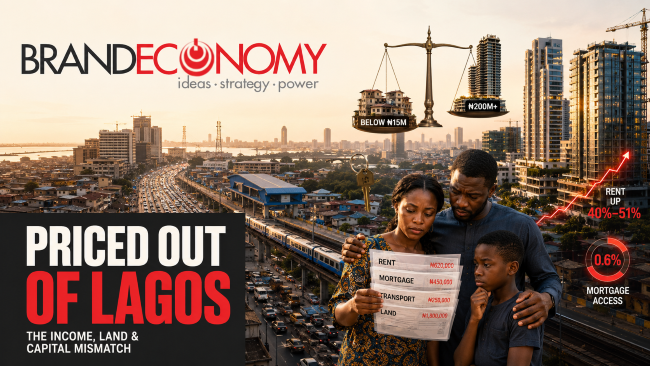
Only about 0.6 per cent of Nigerian households currently use mortgages, according to the report. That statistic reveals an ownership market operating largely on cash, informal instalments, family capital and personal savings.
In functional housing markets, long-term finance allows households to spread the cost of ownership across their productive years. In Nigeria, the mortgage system excludes most workers before they reach the application stage.
High interest rates produce monthly repayments that bear little relationship to average wages. Inconsistent income documentation, limited credit histories, title uncertainty and the absence of sufficiently deep refinancing structures further restrict lending.
GTI advises prospective borrowers to keep mortgage repayments within 30 to 35 per cent of household income. That is prudent, but it also demonstrates the scale of the problem: few formally marketed Lagos properties can meet that threshold for middle-income earners.
The result is a city where millions rent not necessarily by preference, but because the bridge between monthly income and property ownership is missing.
When rent outruns inflation
The pressure is also intensifying in the rental market. GTI found that annualised rent growth exceeded 40 per cent across some Mainland corridors and reached approximately 51 per cent in prime Island locations, compared with headline inflation of 15.9 per cent as of June.
About 80 per cent of surveyed respondents considered Lagos severely unaffordable. Even households earning around ₦500,000 monthly could spend between 40 and 60 per cent of their income on rent in some Mainland locations.
Once food, transportation, energy, school fees and healthcare are added, such households have little capacity to save towards homeownership. Rent inflation therefore does more than raise accommodation costs; it destroys the financial pathway out of renting.
This has significant social consequences. Families are pushed into overcrowded homes, workers move farther from employment centres and young professionals postpone marriage, independent living or property acquisition. Employers also pay indirectly through wage pressure, lateness, fatigue and lower productivity.
The hidden price of the outskirts
Peripheral housing is frequently presented as Lagos’ affordable alternative. GTI’s analysis shows why that description may be misleading.
Using Marina as an employment benchmark, the researchers examined 3,200 property listings across 15 submarkets. They found that transportation expenses could consume much of the rent saved by living in distant locations.
Affordability must therefore be calculated as rent or mortgage payment plus commuting cost, travel time and the economic value of unreliable infrastructure. A cheaper apartment that requires expensive daily transport, private electricity and several hours in traffic may impose a higher total cost than a smaller property closer to work.
The report also found that properties located within one to two kilometres of rail stations could command significant premiums. That underlines the power of infrastructure to create property value—but also raises the danger that public transport investments could price lower-income residents out of the neighbourhoods they are intended to serve.
Lagos will need transit-oriented, mid-density housing around rail and bus corridors, supported by inclusionary planning that preserves access for working households.
Capital is building the wrong houses
The report divides Lagos into three broad housing economies: capital-preservation locations, productive employment corridors and peripheral expansion areas.
Yet supply is heavily tilted towards the first category. Properties priced below ₦15 million reportedly represent approximately 55 per cent of demand but only a small share of available supply. Meanwhile, luxury developments above ₦200 million account for a substantial proportion of new construction.
Developers are responding rationally to a distorted system. High land costs, expensive finance, title risks and infrastructure obligations encourage projects with larger margins and wealthier buyers. Luxury housing also attracts diaspora capital and investors seeking protection against inflation and currency weakness.
But what is commercially rational for individual developers can become economically dysfunctional for the city. Lagos accumulates expensive units as investible assets while producing too few homes for teachers, healthcare workers, civil servants, artisans and young professionals.
This is the “capital architecture problem” identified by GTI: money is entering real estate, but not necessarily the price bands, locations and financing structures where housing demand is deepest.
Investor relevance
The gap represents a major investible opportunity—but affordable housing cannot be financed as disguised luxury development.
Nigeria’s pension fund administrators hold more than ₦31 trillion in assets, with the report estimating that about 75 per cent is invested in government securities. Redirecting even a carefully structured portion towards housing could unlock substantial long-term capital.
However, pension savings must not be treated as an easy pool of public money. Housing vehicles must offer transparent governance, predictable cash flows, professional asset management, credible valuations and risk-adjusted returns.
Real Estate Investment Trusts, mortgage-backed instruments, rental housing funds, infrastructure bonds and blended-finance structures could provide investible channels. Government or development-finance institutions may need to absorb early-stage risks through guarantees, serviced land, first-loss capital and dependable title systems.
Investors should focus on occupancy, collection rates, infrastructure access, title integrity and total household affordability—not merely projected property appreciation.
Brand implications
For developers, the underserved middle-income segment offers an opportunity to build brands around trust, functionality and attainable ownership. Winners will be those that deliver smaller, efficient and well-connected homes with transparent pricing and credible payment plans.
For GTI Investment Group, the report strengthens its positioning beyond conventional financial services towards research-led capital formation. Its brand opportunity lies in converting the publication into transactions, investible vehicles and measurable housing outcomes.
For the Lagos State Government, housing affordability is a test of institutional reputation. Faster title processing, transparent planning approvals, serviced land and coherent transport-linked development would communicate competence more powerfully than ceremonial housing launches.
BRANDECONOMY Insight
Lagos must stop measuring housing progress principally by the number of estates launched or units commissioned. The more revealing scorecard is how many working households can live within reasonable distance of employment while spending no more than 35 per cent of income on housing.
To ameliorate the housing crisis, the state should create a unified housing-capital platform bringing together land administration, transport planning, pension capital, developers, mortgage institutions and infrastructure finance.
Informal land interests should be converted into secure, bankable titles. Infrastructure value-capture mechanisms and betterment levies can help finance new corridors, but they must be designed to prevent displacement and speculative land hoarding.
Financial institutions should adopt location-sensitive underwriting that accounts for transport savings and infrastructure quality. Such models must remain transparent, however, to prevent disadvantaged communities from being financially “redlined.”
Ultimately, Lagos cannot build its way out of the crisis while capital continues to chase trophy apartments and households are left with unaffordable mortgages, rising rents and punishing commutes.
The city needs more than housing units. It needs a functioning housing system—one that connects income to finance, finance to bankable land, land to infrastructure and development capital to the places where Lagosians actually live and work.