

Cement at ₦15,000: FCCPC Probe Puts Nigeria’s Price Paradox Under Scrutiny

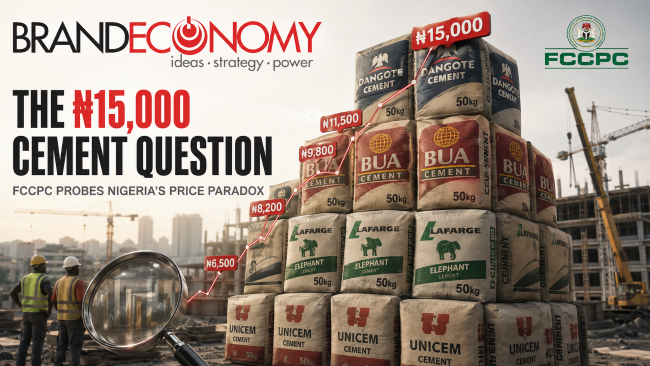 Nigeria’s cement market presents an uncomfortable paradox: a country rich in limestone, with far more installed capacity than it consumes and exports to neighbouring markets, still sells a basic building material at prices many households and contractors cannot afford.
That contradiction is under regulatory scrutiny. The Federal Competition and Consumer Protection Commission says preliminary findings from an industry-wide inquiry indicate possible price manipulation and warrant deeper investigation.




In a statement issued in Abuja on Tuesday, FCCPC Director of Corporate Affairs, Mr Ondaje Ijagwu, said the Commission served key industry participants with notices commencing further investigation and summonses to produce records. The requested material covers pricing methods, output, capacity utilisation, exports and relevant commercial relationships.
The summonses are not findings of guilt. They show that the regulator considers the questions serious enough to move from market observation to documentary examination.
The inquiry followed public complaints about cement prices and a three-month cross-border study by the FCCPC’s Anti-competitive Practices Department. Its preliminary assessment places national installed capacity at more than 60 million to 65 million metric tonnes annually, against domestic consumption of roughly 25 million to 30 million tonnes. Nigeria is also a net exporter.
In a competitive market, such surplus capacity should encourage producers to compete harder on price and volume. Yet three major undertakings reportedly control more than 90 per cent of installed capacity, creating a concentrated market in which a few companies shape national outcomes.
Concentration is not unlawful, and similar prices do not prove coordination. Cement is capital-intensive; plants require enormous investment, continuous energy, specialist maintenance and long payback periods. But concentration raises the stakes because weak rivalry can allow inefficiency—or market power—to persist.
The Commission compared Nigeria with Kenya, Tanzania, South Africa, Egypt, Morocco and Algeria. It reported a Nairobi retail price of about $5.40, or ₦7,344, for a bag, against approximately $4.80, or ₦6,528, in Tanzania. In Togo, which lacks limestone deposits, the cited price was $6.75, or ₦9,180.
Nigeria’s 50-kilogramme bag reportedly rose from ₦9,300–₦9,700 in January 2026 to ₦10,500–₦13,000 by mid-year. By July, consumers in some locations paid ₦13,000–₦15,000.
Cross-country comparisons require care. Exchange rates, taxes, product specifications, energy systems, freight distances, dealer margins and whether prices are factory-gate or retail can distort conclusions. Installed capacity is not actual output: maintenance, energy constraints or logistics failures may leave nominal capacity unavailable.
Manufacturers cite energy expenses, naira depreciation, imported machinery and spare-parts costs, transportation and logistics. These are credible pressures. The decisive question is whether verified cost movements explain the scale and speed of retail increases—and whether pricing across the producer-to-distributor chain reflects genuine rivalry.
FCCPC Executive Vice Chairman and Chief Executive Officer, Mr Tunji Bello, described the inquiry as fact-finding, not an attempt to dictate commercial decisions. Companies may earn returns, he said, but competition law must ensure that prices and output result from legitimate competition rather than unlawful restriction.
That balance matters. Politically imposed price controls could cause scarcity, deter investment and create informal-market premiums. Regulatory passivity would leave consumers exposed if supply restriction, abuse of dominance, coordinated behaviour or anti-competitive distribution is established.
Market implications
Cement prices transmit throughout the economy. Higher costs inflate budgets for homes, schools, hospitals, roads, factories and commercial property. Developers increase selling prices and rents, reduce specifications or postpone construction. Government projects suffer overruns, while contractors face thinner margins and disputes.
For households, home ownership moves further beyond reach, self-build projects slow, and landlords pass construction and maintenance costs into rents. Block-makers, artisans, builders and merchants also face weaker demand, threatening jobs across a labour-intensive value chain.
Investor relevance
For shareholders in listed cement producers, high prices may support near-term margins, but a competition inquiry creates regulatory, litigation and reputational risk. Investors should examine domestic volumes, plant utilisation, energy cost per tonne, realised prices, dealer concentration, export allocation and the gap between ex-factory and retail prices.
The strongest long-term investment case is not scarcity-driven pricing. It is efficient production, expanding volumes, dependable distribution and returns that remain defensible under scrutiny.
Brand implications
Cement brands sell more than powder; they sell confidence in shelter, infrastructure and national development. A perception that producers profit excessively from a housing crisis can erode years of corporate citizenship messaging.
Industry leaders should answer with evidence, not advertising: disclose cost bridges, publish recommended prices, strengthen dealer monitoring and explain regional differences. FCCPC must protect its institutional brand through due process, analytical rigour and transparent conclusions.
BRANDECONOMY Insight
The investigation should trace every naira between factory gate and building site. FCCPC needs a like-for-like model separating legitimate production pressures from capacity withholding, export incentives, distributor mark-ups and potentially coordinated conduct.
If wrongdoing is established, enforcement must be decisive. If power, transport, foreign exchange and fragmented distribution are the main culprits, government must fix those bottlenecks rather than criminalise profit.
Nigeria does not need temporarily cheaper cement created by political theatre. It needs a contestable market where efficient producers expand output, new entrants can compete, distributors cannot manufacture scarcity and consumers benefit from the country’s limestone and industrial capacity. That outcome would lower construction costs, improve housing access and strengthen confidence in Nigeria’s regulatory economy.