Beyond Crude: How Nigeria Can Turn a ₦7.55trn Trade Surplus Into Export Brand Power

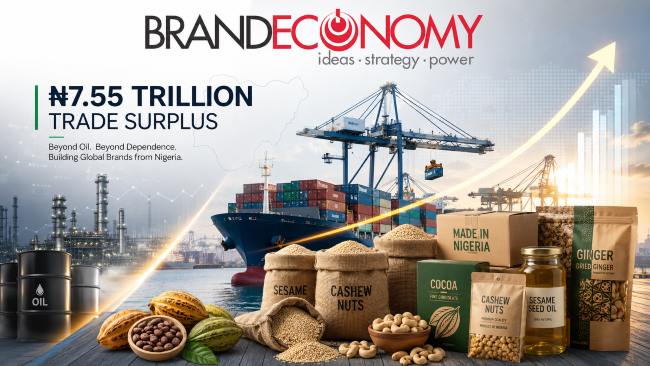 Nigeria’s first-quarter 2026 trade surplus of roughly ₦7.55 trillion offers a welcome sign of external-sector strength. Yet the headline conceals a harder truth: the country is earning more from exports, but it has not yet escaped the gravitational pull of oil. Crude oil and petroleum products still dominate the export basket, while genuinely non-oil goods account for a far smaller share. The real opportunity now is not merely to export more volume, but to convert Nigeria’s commodity advantage into branded, processed and investable products with stronger margins, repeat demand and global recognition.
Nigeria’s trade numbers are beginning to look more impressive. The question is whether they are becoming more transformative.


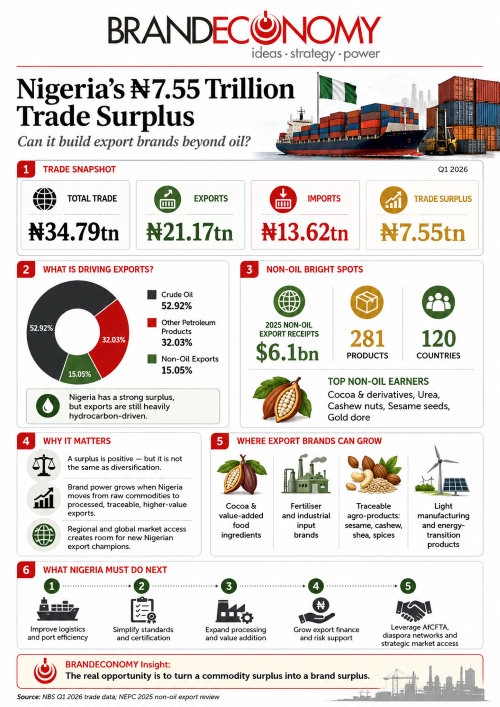
In the first quarter of 2026, Nigeria recorded total merchandise trade of about ₦34.79 trillion. Exports reached ₦21.17 trillion, while imports declined to ₦13.62 trillion, producing a trade surplus of approximately ₦7.55 trillion.
For a country long troubled by foreign-exchange shortages, import dependence and recurring balance-of-payment stress, such a surplus is clearly good news. It supports currency stability, improves external confidence and provides some evidence that the economy is beginning to benefit from stronger export earnings and lower import demand.
But a trade surplus is not automatically an export revolution.
Nigeria’s latest result remains overwhelmingly dependent on hydrocarbons. Crude oil contributed more than half of total exports, while other petroleum products supplied another substantial share. In practical terms, oil and oil-linked products still account for the overwhelming majority of Nigeria’s export revenue.
The non-oil segment is growing, but it remains comparatively small.
That distinction is critical. Nigeria may have achieved a surplus, but it has not yet achieved export diversification at the scale required to make the economy genuinely resilient.
The country is still exporting far more of what it extracts than what it transforms.
 A Surplus With a Structural Warning
 A Surplus With a Structural Warning
Nigeria’s strong first-quarter trade balance was helped by two developments: higher export proceeds and a sharp reduction in imports, particularly petroleum-product imports.
The fall in fuel imports is important. It suggests that domestic refining activity and changes in fuel-market dynamics may be reducing Nigeria’s long-standing reliance on imported refined petroleum products. That has clear benefits for the trade balance.
Yet it also means the surplus should not be interpreted only as proof of booming non-oil competitiveness. Part of the improvement reflects import compression and petroleum-sector performance.
The concentration of exports remains striking.
Mineral products still dominate Nigeria’s outward trade, while chemicals, processed food products and manufactured goods account for much smaller shares. Manufactured exports remain especially modest, despite being among the most promising routes to stronger export brands, higher value addition and broader industrial employment.
Nigeria’s trade profile is therefore stronger than it was, but still narrower than it needs to be.
The country earns foreign exchange from bulk exports. What it has yet to build at sufficient scale is a broad portfolio of branded, processed and differentiated exports that command higher margins in global markets.
That should be the next frontier.
From Commodity Exports to Brand Exports
The strongest export economies do not merely sell raw output. They build identity, consistency and trust around what they produce.
A cocoa-producing country can export cocoa beans. But it can also export cocoa butter, cocoa powder, premium chocolate ingredients, beauty products, wellness formulations and traceable specialty products.
A cashew-producing country can export raw nuts. But it can also export shelled, roasted, packaged and branded cashew products for supermarkets and food-service chains.
A fertilizer producer can export bulk urea. But it can also build a global industrial reputation around quality assurance, dependable delivery, technical support and regional market leadership.
This is how commodity wealth becomes brand wealth.
Nigeria already has the raw material base for this transition. Cocoa, sesame, cashew, soy, shea, spices, seafood, fertiliser, petrochemicals, selected solid minerals and light-manufacturing products all offer viable pathways.
The issue is no longer whether Nigeria has something to sell. It is whether the country can process, certify, package, finance, transport and market those products with enough reliability to win repeat orders.
The most promising export brands may not initially emerge as globally famous consumer labels. They are more likely to begin as trusted business-to-business brands: a premium Nigerian cocoa butter supplier, a certified sesame exporter, a reliable regional fertiliser platform, a quality shea ingredient company, a halal-certified processed-food producer or a solar-components manufacturer serving African markets.
That is not a lesser ambition. It is how global export reputations are usually built.
Cocoa, Fertiliser and the New Export Ladder
Cocoa is perhaps Nigeria’s clearest opportunity.
The country has long exported cocoa beans, but the bigger prize lies in processing. Cocoa butter, cocoa powder, liquor, cosmetics ingredients and premium food inputs offer greater value than the shipment of unprocessed beans alone.
A country that sells raw cocoa participates in global trade. A country that sells traceable, certified and processed cocoa derivatives builds an industrial position.
Fertiliser is another major opportunity.
Nigeria’s urea exports have already established the country as a serious player in industrial inputs. But global industrial markets reward more than volume. They reward reliability, product consistency, logistics competence, contract performance and origin credibility.
Nigeria can build a business-to-business export brand around its fertiliser capacity if producers, ports, regulators and financial institutions align around quality and delivery.
The same is true for sesame, cashew, soy, shea and other agricultural outputs.
The immediate objective should not be to flood foreign shelves with finished Nigerian consumer products. It should be to move gradually up the value chain: from raw commodity to processed ingredient; from processed ingredient to trusted supplier; from trusted supplier to recognised origin brand; and eventually from origin brand to consumer-facing export label.
That is a more realistic and more investable pathway.
Africa Should Be the First Market
Nigeria’s strongest export-brand opportunity may lie closer to home.
African markets already account for a meaningful share of Nigeria’s exports, with ECOWAS countries providing a natural first destination for food products, light manufacturing, cosmetics ingredients, building materials, household products and industrial supplies.
This matters because brands rarely become global overnight.
They usually grow regionally first, where freight costs are lower, consumer preferences are more familiar and regulatory systems are easier to navigate. A Nigerian food, beauty, packaging, fertilizer or solar-energy brand can test its strength in West Africa before attempting the more demanding markets of Europe, North America or East Asia.
The African Continental Free Trade Area should therefore be treated as more than a policy agreement. It should become a launchpad for Nigerian export brands.
Nigeria has the scale. It now needs the market strategy.
The Real Obstacles Are Operational
The country’s export challenge is no longer simply a shortage of products. It is a shortage of frictionless systems.
Exporters continue to face high logistics costs, slow port procedures, fragmented certification requirements, weak access to trade finance, inconsistent quality standards and inadequate market intelligence.
A large company can sometimes absorb these costs. A medium-sized exporter often cannot.
The result is that many Nigerian businesses remain too small to scale internationally, even when their products are commercially attractive.
Port reform is central to solving this.
A country cannot build serious export brands if its exporters cannot predict how long cargo will take to clear, how much documentation will cost, or whether goods will arrive in time for seasonal demand. Customs reform, authorised economic operator schemes, the National Single Window and more efficient cargo processing must become core export policy, not peripheral administrative initiatives.
Standards are equally important.
Foreign buyers do not merely purchase products. They purchase confidence. They want assurance on safety, traceability, origin, packaging, certifications and delivery.
Nigeria must therefore make export compliance simpler, faster and more affordable. A single digital export file, interoperable across Customs, NAFDAC, the Nigerian Agricultural Quarantine Service, SON, banks and trade agencies, would reduce duplication and help smaller exporters compete.
Why Investors Should Pay Attention
The next export winners may not be found only in oil extraction or commodity trading.
They are more likely to emerge in the missing middle of the value chain: processing plants, packaging companies, aggregation platforms, quality laboratories, cold-chain operators, logistics providers, traceability software, export warehousing, certification firms and trade-finance businesses.
These are the businesses that make exports dependable.
Investors should therefore look beyond the headline commodity sectors and focus on the infrastructure that allows Nigerian products to move from farms, factories and mines into repeat international trade.
A well-run cocoa-processing facility may be more valuable than a raw-bean trading business. A packaging firm capable of meeting international standards may become more strategic than a commodity aggregator. A logistics platform that reduces port delays may unlock value across multiple sectors.
The export economy needs not only producers. It needs enablers.
The Policy Test
Nigeria does not need to become a non-oil export powerhouse overnight.
It needs a disciplined export pipeline.
Government should concentrate support around sectors that already show traction: cocoa and cocoa derivatives, fertiliser, sesame, cashew, soy, shea, selected processed foods, solar and energy-transition products, and a narrow group of regionally competitive manufactured goods.
The policy sequence should be clear:
First, improve port and logistics performance.
Second, simplify compliance and certification.
Third, expand export finance, insurance and foreign-exchange risk management.
Fourth, encourage local processing through incentives linked to real value addition.
Fifth, help exporters understand foreign market rules, packaging standards and consumer preferences.
Nigeria’s trade surplus provides an opening. It should not be mistaken for the destination.
BRANDECONOMY Insight
Nigeria’s ₦7.55 trillion trade surplus is a strong macroeconomic signal, but it is not yet proof that the country has solved its export-diversification challenge.
The trade balance is still powered mainly by oil and petroleum-linked products. That gives Nigeria revenue, but not enough resilience.
The bigger opportunity lies in turning commodity capability into brand capability.
Nigeria does not need to defeat oil before building non-oil export brands. It needs to use the foreign-exchange strength created by oil and reform momentum to finance the infrastructure, systems and institutions that make non-oil exports reliable.
That means faster ports, better standards, smarter financing, stronger processing and more disciplined market-building.
The next Nigerian export success story may not look like an oil tanker. It may look like premium cocoa butter, traceable sesame, Nigerian-made fertiliser, processed cashew, shea ingredients, solar components or a regionally trusted food brand.
The future of exports is not only about what leaves Nigeria.
It is about what the world remembers, trusts and asks for again.
Market Implications
Nigeria’s trade surplus could provide short-term support for external-sector confidence, but sustained market optimism will depend on whether non-oil exports gain a larger share of total trade.
A stronger export mix would reduce the economy’s sensitivity to oil-price volatility, strengthen foreign-exchange earnings and provide a more reliable base for long-term currency stability.
For businesses, the shift toward value-added exports could expand opportunities in processing, logistics, packaging, testing, certification, finance and regional distribution.
For consumers, a stronger export manufacturing base may support job creation, better local supply chains and more competitive domestic industries.
Brand Implications
Nigeria’s next major national-brand opportunity lies in export credibility and sustainable trade surplus.
The country must move beyond being known primarily for crude oil, raw commodities and a large consumer market. It should become known for quality agricultural ingredients, reliable industrial inputs, traceable products, strong regional brands and commercially disciplined exporters.
Brand value will come from consistency, standards, packaging, delivery and trust.
Export branding is nation branding in practical form.
Investor Relevance
Investors should watch four areas closely:
- Agro-processing and ingredient manufacturing
- Export logistics, warehousing and cold-chain infrastructure
- Packaging, testing, certification and traceability services
- Trade finance, export insurance and foreign-exchange risk solutions
The strongest opportunities may emerge in businesses that reduce friction between Nigerian production and foreign demand that generates sustainable trade surplus.