

 The Dangote Refinery has done what decades of policy promises could not: turn Nigerian crude into globally marketable fuels at industrial scale. The public offer now asks ordinary investors to value not only that achievement, but also a highly cyclical business, a colossal expansion plan and a long record of financing, foreign-exchange and regulatory risk.
Analysis date: 19 September 2026 | Desk: Business, Energy, Markets & Brand Strategy



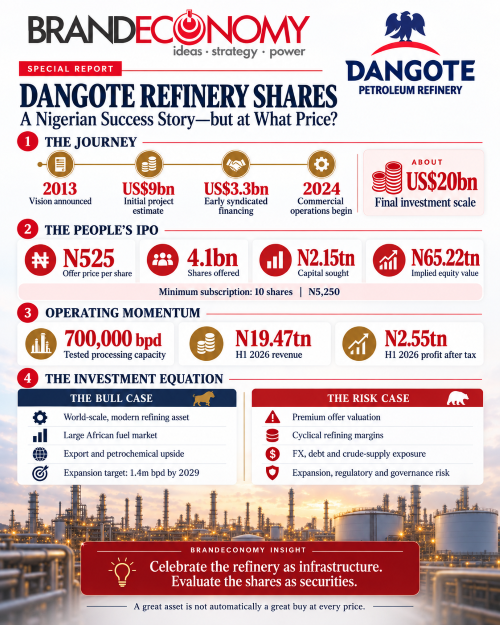
| Offer price N525/share | Offer size 4.1bn shares | Capital sought N2.15tn | Implied value About N65.22tn |
| THE INVESTMENT QUESTION A nation-changing asset can still be an expensive share. The discipline is to separate the refinery’s strategic importance from the return embedded in its offer price. |
The Price of Belief
Nigeria has spent generations living with an energy contradiction: it produces crude oil, yet imports much of the fuel that moves its economy. The result has been a recurring transfer of value abroad—crude exported, refined products imported, foreign exchange consumed, subsidy bills accumulated and domestic industrial capacity deferred. Dangote Petroleum Refinery was conceived as a direct assault on that contradiction.
That is why the refinery’s initial public offering is not being received like an ordinary securities transaction. It is being treated as a national rite of passage.
The historic $1.6 billion initial public offering for the Dangote Refinery opened on September 14, 2026. It has drawn an unprecedented surge of investor demand and over $7 million within its first hour, with Aliko Dangote announcing plans to release an additional 30% to 35% more shares if heavy demand continues. This is sequel to the company already closing a private institutional round in July, pulling in $2.5 billion.
Priced at ₦525 per share with a minimum entry of 10 shares, the Dangote Refinery offering aims to democratize wealth across Africa and attract up to 10 million retail shareholders. The minimum subscription of 10 shares, costing N5,250, has put ownership within reach of millions. Retail-investment platforms strained under first-day traffic, while social media transformed new shareholders into comic ‘board members’ calling for operational briefings. The humour reveals something serious: Nigerians are buying belonging as well as equity.
Yet markets punish sentiment when sentiment outruns cash flow. The refinery may be one of the most consequential private industrial projects ever built in Africa; the shares can still disappoint if the price already capitalises an ideal future. That is the question behind the offer: not whether Dangote Refinery is a Nigerian success story—it plainly is—but how much of that success has already been charged to the incoming shareholder.
 A Vision Born from Nigeria’s Industrial Failure
 A Vision Born from Nigeria’s Industrial Failure
The original logic was brutally simple. Nigeria had the crude, the population and the demand, but not the reliable refining system. State-owned plants repeatedly consumed rehabilitation budgets without producing fuel at dependable commercial scale. For an entrepreneur whose fortune was built on replacing imports with Nigerian production—from cement to sugar—the refining gap was less a paradox than an opportunity of historic proportions.
In September 2013, Dangote Industries announced an integrated refinery, petrochemicals and fertiliser project then costed at about US$9 billion. Standard Chartered led a US$3.3 billion syndicated financing involving local and international banks; Dangote Group committed substantial equity. The proposition was to convert domestic crude into fuels and industrial inputs, reduce imports, create jobs and ultimately sell into regional markets.
The plan expanded. Capacity ambitions moved beyond the early design assumptions, the site settled at Ibeju-Lekki in Lagos and the project became a complete industrial ecosystem: refinery units, polypropylene facilities, storage tanks, power generation, marine infrastructure, pipelines, roads and a deepwater interface capable of receiving crude and exporting products. A refinery was becoming a city of steel—and every additional system multiplied cost, coordination and execution risk.
By the time Dangote Refinery operations began in 2024, the price tag had risen to roughly US$20 billion. In one sense, that escalation documents what went wrong: delays, redesign, inflation, foreign-exchange pressure, logistics, the pandemic and the costly learning curve of doing something at a scale Nigeria had never attempted. In another sense, it documents what was actually built. Comparing US$9 billion and US$20 billion without comparing the evolving scope would be incomplete; ignoring the cost overrun would be equally unserious.
When the Contractor Market Could Not Carry the Dream
Mega-refineries are normally delivered through large engineering, procurement and construction contracts that shift major execution obligations to specialist contractors. Dangote’s route was more fragmented and more dangerous. The company says it became one of the rare project owners to act directly as an EPC constructor for a refinery and petrochemical complex, coordinating multiple packages and vendors itself.
That choice was not simply a display of confidence. At the project’s scale and in Nigeria’s risk environment, obtaining one contractor willing to assume the entire job on acceptable terms was exceedingly difficult. The refinery still used major engineering advisers, equipment manufacturers and construction contractors, but Dangote Industries carried the integration burden that a prime contractor would ordinarily absorb.
The implications were profound. The company had to build technical capability while building the asset; supervise interfaces across thousands of components; manage oversized cargoes in an infrastructure-constrained environment; and develop supporting logistics that should normally exist outside a factory gate. Every missed interface could delay another unit. Every redesign could create fresh procurement and financing needs.
There were also supplier disputes. In 2025, Aliko Dangote alleged that faulty foreign equipment had delayed the project by more than two years. That allegation remains the company’s account, not an independently adjudicated finding, but it illustrates the vulnerability of a complex plant to a small number of mission-critical components. In refining, a facility can be nearly complete in physical terms and still be commercially incomplete if one essential unit cannot perform.
Capital: From Bold Commitment to Balance-Sheet Strain
The Dangote Refinery financing history is central to the investment case because capital structure determines who ultimately enjoys the upside. The 2013 syndicated loan demonstrated that African and international lenders would back the ambition. Africa Finance Corporation later supported the project from the concept stage, including a US$300 million senior term loan, and served as a co-coordinating bank on a US$3 billion syndicated facility.
But a project whose cost more than doubled could not be financed by the original architecture alone. Completion required repeated injections of debt, sponsor capital, asset sales, working-capital arrangements and strategic investment. In 2021, NNPC agreed to acquire 20 per cent for US$2.7 billion, but by 2024 its holding had fallen to 7.2 per cent after it did not fund the full commitment. The episode exposed the limits of the state company’s own balance sheet and left the refinery with less equity capital than originally envisaged from its national partner.
In 2024, Fitch downgraded Dangote Industries Limited and highlighted group-level liquidity pressure. It pointed to the mismatch created when foreign-currency debt meets naira earnings and said the 2023 devaluation produced a N2.7 trillion foreign-exchange loss at the parent group. That rating action concerned Dangote Industries, not a definitive post-IPO assessment of the refinery issuer, but it captures the project’s defining financial hazard: its machinery and much of its financing were dollar-linked, while a large part of its domestic revenue was earned in naira.
The refinery can partly hedge that exposure by exporting fuels and petrochemicals for hard currency. It cannot abolish the risk. Crude purchases, debt service, catalysts, spares, insurance and specialist services may remain linked to dollars, while domestic pricing is politically sensitive and household purchasing power is overwhelmingly naira-based.
The capital story entered a new phase in 2026. AFC led a US$2.5 billion private placement, the refinery’s first equity raise involving investors beyond its legacy ownership. AFC said the transaction was 3.7 times subscribed and attracted international and African institutions, sovereign-linked vehicles and development-finance investors. The IPO now seeks N2.15 trillion from the public, while a further expansion toward 1.4 million barrels per day is expected to demand far more capital.
Foreign Exchange: The Invisible Construction Site
Concrete and steel were not the refinery’s only raw materials. Foreign exchange was another. A Nigerian company could raise naira, but distillation columns, compressors, control systems, specialist labour and engineering contracts were largely priced in dollars, euros or other hard currencies. As the naira weakened, the same imported obligation required more domestic cash. Cost estimates became moving targets.
The FX crisis affected the project in three ways. First, it inflated construction and financing costs. Second, it complicated working capital: a plant of this scale must continuously finance huge crude cargoes before product sales are collected. Third, it affected pricing legitimacy. If the refinery bought crude at an international dollar-linked value, consumers could not reasonably expect petrol to be insulated from exchange-rate movements merely because it was refined in Lagos.
Domestic refining still saves freight, reduces some logistics costs and can conserve foreign exchange at national level. But it does not transform crude into a cheap local input. Crude has an export-parity value. The real economic benefit is the value added in Nigeria, the avoidance of imported-product premiums, a more resilient supply chain, tax and employment effects, and the possibility of earning export revenue—not a permanent exemption from global economics.
From Commissioning Ceremony to Commercial Reality
The Dangote Refinery was inaugurated in May 2023, but commissioning a complex plant is not the same as running it at commercial capacity. Operations began in January 2024 with intermediate and distillate products; petrol production followed in September after further delays and crude-supply constraints. The gap mattered because interest continues to accrue and staff, maintenance and utilities must be paid even while saleable output is below design potential.
By September 2026, the company said it had completed performance tests at about 700,000 barrels per day, above the original 650,000-barrel nameplate, and was operating at full capacity. The reported first-half numbers were formidable: approximately N19.47 trillion in revenue and N2.55 trillion in profit after tax. Reuters separately reported profit of about US$1.82 billion on revenue above US$13 billion, reversing a prior-year loss.
The turnaround was operational—but also cyclical. Disruptions to Middle Eastern supply tightened diesel and aviation-fuel markets, while European inventories fell. Dangote was able to export into that scarcity and became a major supplier of jet fuel to Europe. This validates the refinery’s global relevance and configuration flexibility. It also means investors should not mistake a favourable refining window for a permanent earnings floor.
The Crude-Supply Paradox
The most revealing battle came after construction. Nigeria had finally built a world-scale refinery, yet the refinery struggled to obtain enough Nigerian crude. Production shortfalls, theft, pipeline disruption, pre-existing commercial commitments and crude-backed obligations constrained supply. Dangote bought imported grades, including US crude, while arguing that domestic producers were not meeting the supply duties contemplated by the Petroleum Industry Act.
The company said it sometimes paid a premium of US$3 to US$4 per barrel through international traders—millions of dollars on a single cargo. Producers, for their part, argued that refiners must offer competitive commercial terms. The upstream regulator acknowledged constraints and later warned that producers failing to meet domestic refinery quotas could be denied export permits.
Government responded with a crude-for-naira mechanism and other interventions designed to reduce FX pressure and stabilise local supply. But the deeper issue remains institutional: a listed refinery needs predictable, commercially enforceable feedstock arrangements, not recurring presidential or ministerial rescue. Shareholders should demand disclosure of procurement contracts, pricing formulas, counterparties, volumes, currencies and duration.
Government: Partner, Regulator, Customer—and Adversary
Dangote Refinery has never existed outside the state. Government provided the policy environment, free-zone framework and infrastructure support; NNPC became a shareholder and at one stage the sole petrol buyer; regulators control crude obligations, import licences, product standards and market conduct. The relationship is necessarily intimate—and therefore structurally conflicted.
In 2024, tensions exploded publicly. Dangote accused oil majors and regulators of frustrating crude access and permitting imports of inferior fuel. The downstream regulator questioned the refinery’s completion status, product quality and the wisdom of replacing an import-dependent market with a private monopoly. A parliamentary investigation followed. Comparative tests publicised at the time suggested Dangote diesel had much lower sulphur than some market samples, but the wider argument was never only about chemistry. It was about who gets to define energy security and competition.
The conflict moved into court. Dangote challenged fuel-import licences, arguing that the Petroleum Industry Act permits imports only to cover genuine domestic shortfalls. The regulator, NNPC and marketers maintained that Nigeria still required imports and that qualified parties could participate. One lawsuit was withdrawn in 2025; litigation resurfaced in another round in 2026. Each side has a legitimate public-policy concern: domestic plants should not be undermined by unnecessary imports, but consumers should not be captive to a dominant producer whose outages or pricing decisions could disrupt the entire economy.
The correct answer is neither protection at any price nor imports without discipline. Nigeria needs transparent demand and supply data, published product specifications, rules-based import triggers, independent competition oversight and open-access logistics. A refinery of this scale is a strategic asset. It must not become a substitute for a competitive market.
Labour, Communities and the Social Licence
Industrial success is measured not only by throughput. In 2025, a dispute over large-scale dismissals escalated when PENGASSAN ordered members to halt crude and gas supplies; the union alleged Nigerian workers were being displaced, while the company raised sabotage and operational-security concerns. The confrontation demonstrated how quickly labour relations can become a national fuel-security risk.
Communities around the Lekki industrial zone have also raised concerns over displacement, livelihoods, pollution and unfulfilled expectations. The company emphasises employment, infrastructure, environmental standards and the wider economic value of the complex. Public investors should expect both narratives to be tested through measurable disclosure: local employment ratios, contractor practices, safety performance, emissions, spills, grievance resolution and community investment.
For a consumer-facing national brand, social licence is not an ESG appendix. It is an operating asset. A company that invites teachers, artisans and pension contributors to become shareholders must be unusually transparent about how it treats workers and host communities.
The IPO: What Exactly Is Being Bought?
The Dangote Refinery offer comprises 4.1 billion ordinary shares at N525 each, seeking N2.15 trillion. It opened on 14 September and is scheduled to close on 13 October 2026. At the offer price, NGX reported an implied equity value of approximately N65.22 trillion. The public float represented by the offer is small relative to the total company, leaving legacy shareholders firmly in control.
That structure is not inherently negative. Founder control can support long-horizon execution, especially in infrastructure. But minority investors require counterweights: truly independent directors, strong audit and risk committees, explicit related-party transaction rules, timely disclosure, equitable dividend policy and meaningful free-float development. ‘People’s IPO’ is a powerful brand promise; corporate governance must make it more than a distribution slogan.
The Federal Government’s pensions regulator has also granted fund managers a one-off waiver to participate despite the usual eligibility requirements around profitability and dividend history. PenCom insisted that pension administrators retain their fiduciary duties and internal risk controls. The waiver recognises the refinery’s strategic importance, but it raises the standard of care. Retirement capital cannot be allocated as an act of patriotism; it must be priced against risk, liquidity, concentration and beneficiary time horizons.
At What Price? Reading the Numbers Without Romance
Using NGX’s disclosed N65.22 trillion implied value and the company’s N2.55 trillion first-half profit, a simple annualisation produces N5.1 trillion of earnings and a mechanical price-to-earnings ratio of about 12.8 times. The arithmetic is easy; the interpretation is not. Six months of exceptional refining conditions do not constitute a normalised year, and the calculation says nothing about net debt, working capital, depreciation, maintenance capital, taxes, hedging or future dilution.
| Indicator | Offer-era figure | What investors must ask |
| Implied equity value | About N65.22tn | How much debt and other claims sit above equity? |
| H1 2026 revenue | About N19.47tn | What volume, product mix and realised prices drove it? |
| H1 2026 PAT | About N2.55tn | How much reflects unusually high refining margins or FX effects? |
| Mechanical P/E | About 12.8x annualised H1 PAT | What is the through-cycle, audited earnings base? |
| Expansion target | 1.4m bpd by 2029 | Capex, funding mix, timeline and dilution risk? |
Reuters Breakingviews estimated that the offer valued the business at roughly 8.3 times projected 2026 EBITDA, a premium to large US refiners cited in its comparison. The comparison is imperfect: Dangote combines scarcity value, growth, petrochemicals, regional market access and a relatively new asset. But the premium matters because buyers are being asked to pay today for growth that must still be financed and delivered.
Refining is a spread business. A refinery earns the difference between the value of products sold and crude plus energy, freight, maintenance, financing and operating costs. High crude prices do not automatically help; what matters is the product crack spread. Margins can collapse when new capacity enters, demand weakens or inventories rebuild. A sophisticated investor therefore values mid-cycle cash generation, not the best recent quarter.
The Expansion Bet
Dangote plans to double capacity to 1.4 million barrels per day by 2029 and expand petrochemicals, including polypropylene. A US$400 million equipment agreement with China’s XCMG is intended to support the wider programme. If completed on schedule, the enlarged complex could become one of the world’s biggest refining and petrochemical hubs, deepen exports and create formidable scale economies.
But this is also where history becomes a warning. The first refinery took more than a decade from financing announcement to stable operations, cost roughly twice the initial estimate and required the sponsor to navigate contractor, FX, crude and regulatory crises. The second phase may benefit from an operating site, experienced teams and existing infrastructure; it can still suffer overruns, commissioning delays and funding strain.
Investors must establish whether IPO proceeds are ring-fenced for specific projects, whether expansion debt will rank ahead of ordinary shareholders, whether contractors provide performance guarantees, and what happens if costs exceed budget. Growth is valuable only when its return on invested capital exceeds its cost of capital.
A Practical Investor Scorecard
- Issuer-level balance sheet: audited gross debt, cash, net debt, currency mix, interest cost, maturities, security and covenants—not group-level summaries.
- Quality of earnings: the bridge from revenue to EBITDA, operating cash flow and free cash flow; FX gains or losses; inventory effects; and related-party transactions.
- Crude security: contracted volumes, pricing benchmarks, domestic-supply enforcement, import flexibility and exposure to any single supplier.
- Dividend architecture: stated payout policy, conditions for distributions, expansion-capex priority and whether any promised foreign-currency dividend is legally and operationally deliverable.
- Governance: board independence, control rights, minority protections, disclosure timetable, conflict-management rules and future free-float commitments.
- Operational resilience: utilisation, unplanned downtime, turnaround schedule, maintenance reserves, insurance cover and business-interruption protection.
- Transition risk: product demand under electric mobility, efficiency rules, aviation growth, carbon regulation and the relative economics of petrochemicals.
- Valuation discipline: compare normalised earnings and enterprise value with global refiners, Nigerian risk-free yields and alternative listed assets.
Market Implications
A successful offer would transform the Nigerian Exchange. At approximately N65.22 trillion, the refinery would become a gravitational force in market capitalisation, index construction, pension allocations and foreign-investor attention. It could deepen liquidity and encourage other large private companies to list. It could also concentrate the market around one industrial group: NGX said the refinery, Dangote Cement and Dangote Sugar could form an equity cluster worth about N83.5 trillion.
The transaction also tests whether Nigeria’s capital market can finance infrastructure at sovereign scale. If governance and returns are credible, the model could attract energy, telecoms, logistics and industrial listings. If retail investors are disappointed after a sentiment-led rush, the damage would extend beyond one stock to public trust in equities.
For the downstream sector, the listing could impose beneficial transparency on a company whose prices affect every household and business. Quarterly reporting, investor calls and market scrutiny may do what private negotiations could not: make the economics of domestic refining more visible.
Brand Implications
Dangote has converted a physical refinery into a brand of African possibility. It represents scale, persistence, import substitution and the refusal to accept that the continent must export raw materials and import finished value. The ‘People’s IPO’ extends that narrative from consumption to ownership.
Yet the language creates a duty. A people’s company must communicate with people in plain language, disclose bad news as quickly as good news and avoid using patriotism as a substitute for valuation. The brand risk is not merely a falling share price. It is the perception that mass participation was invited after private capital had secured more favourable economics or after the easiest value creation had already occurred.
The strongest brand move would be radical disclosure: publish operational dashboards, explain refining margins, state dividend and capex policies, report community and environmental performance and show how related-party dealings are priced. Transparency would convert admiration into durable trust.
Investor Relevance
The offer is most defensible as a long-duration allocation to African industrial capacity, not as a quick route to wealth. Investors need the temperament to hold through crude-price swings, naira volatility, shutdowns, political intervention and expansion cycles. They should size the position so a disappointing listing or several dividend-light years do not imperil essential goals.
The low minimum subscription democratizes access, not risk. A N5,250 entry point does not make the share cheap; it only makes a small slice affordable. Valuation is determined by what each naira of ownership can reasonably earn over time.
Prospective buyers should read the final prospectus and audited issuer accounts, confirm the use of proceeds, obtain professional advice where needed and reject any pressure to fund the purchase with school fees, rent, emergency savings or debt. The refinery may build intergenerational wealth, but only if investors preserve the capital and patience required to stay invested.
BRANDECONOMY Insight
| OUR VERDICT Dangote Refinery is already a victory for Nigerian industrial ambition. The IPO is not a referendum on that victory; it is a contract about the price, rights and risks attached to future cash flows. |
The bull case is credible: a new, globally relevant complex in a structurally undersupplied region; strong first-half profitability; export optionality; petrochemical integration; scarcity value; and an expansion platform that could turn Lagos into a major global refining hub.
The bear case is equally real: a valuation carrying a premium to established peers; profits boosted by exceptional market disruption; substantial capital still required; exposure to currency and crude procurement; a history of cost escalation; dominant-founder governance; regulatory friction; labour and community risk; and a public float too small to shift control.
Our conclusion is deliberately unfashionable in a moment of excitement: the right response is neither cynical dismissal nor patriotic overcommitment. It is disciplined participation. Nigeria should celebrate the refinery as infrastructure. Investors should evaluate the shares as securities.
The difference between those two sentences is where lasting wealth will be made—or lost.
Editorial Note
This article is analytical journalism, not a recommendation to buy, sell or hold any security. Figures are based on public disclosures and reputable reporting available as of 19 September 2026. Investors should rely on the final prospectus, audited financial statements and advice suited to their circumstances.