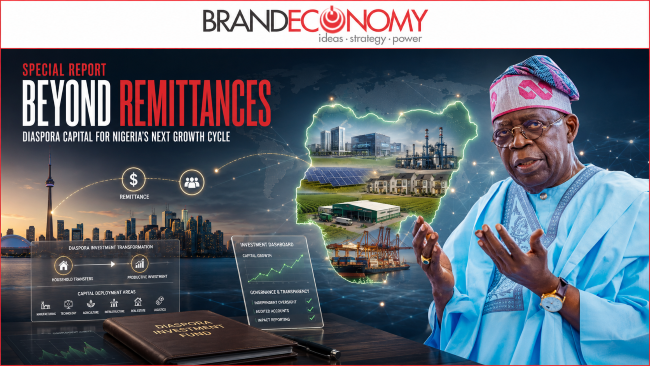
 President Bola Tinubu has challenged Nigerians living abroad to expand their economic relationship with the country beyond family remittances by investing capital, expertise, technology and international networks in productive Nigerian enterprises. He said such diaspora commitment would go a long way to speed up the development of the nation.
Speaking at the maiden Nigeria Diaspora Economic Conference 2026 in Toronto, Canada, Tinubu presented Nigeria as an economy undergoing reform and increasingly capable of supporting sustainable investment.




The President, represented by his Chief of Staff, Femi Gbajabiamila, declared open the three-day conference themed, “Thrive Abroad, Invest in Nigeria.” His remarks were contained in a statement issued in Abuja by presidential spokesperson Bayo Onanuga.
Tinubu praised Nigerians abroad for their resilience, professional achievements and entrepreneurial impact across the global economy, describing them as important ambassadors whose influence extends well beyond the money they send home.
“Nigeria sees you. Nigeria values you. Nigeria needs you,” he told participants.
The President also commended the Chairman and Chief Executive Officer of the Nigerians in Diaspora Commission, Mrs Abike Dabiri-Erewa, for convening the conference, which brought together state governors, members of the Federal Executive Council, senior public officials and diaspora stakeholders.
The investment case
Tinubu’s message represents a strategic attempt to reposition diaspora engagement from consumption support to capital formation.
Remittances remain indispensable to millions of Nigerian households, helping to finance food, education, healthcare, housing and small businesses. However, much of this money is absorbed by immediate consumption rather than channelled into assets capable of producing jobs, exports, innovation and recurring income.
The President argued that remittances should become the foundation—not the limit—of diaspora participation in Nigeria’s economy. He encouraged Nigerians abroad to establish professionally managed investment clubs, sector-focused funds, venture networks and co-investment vehicles.
Such structures could aggregate relatively small individual contributions into sizeable pools of patient capital for housing, agriculture, renewable energy, healthcare, technology, manufacturing and infrastructure.
Tinubu advised prospective investors to demand audited accounts, strong corporate governance and professional due diligence. That warning is important. Diaspora investors are frequently approached through emotional appeals built around patriotism, family relationships or supposedly privileged opportunities. Without independent verification, some have encountered defective property titles, unlicensed promoters, stalled projects and businesses with weak financial controls.
Reforms meet credibility test
Citing official indicators, Tinubu said Nigeria’s gross domestic product expanded by 3.89 per cent in the first quarter of 2026, while manufacturing grew by 3.29 per cent. He also pointed to inflation easing to 15.91 per cent and foreign reserves reaching $45.4 billion at the end of 2025.
The President referenced an International Monetary Fund growth projection of 4.1 per cent for 2026 and the World Bank’s acknowledgement of improvements in macroeconomic stability and fiscal management.
He said the administration’s reforms included a new tax framework intended to simplify compliance and reduce burdens on low-income earners and smaller businesses. Government investment in roads, railways, ports, electricity, digital infrastructure, healthcare, housing and agriculture was also presented as evidence of an economy being prepared for stronger private-sector participation.
These indicators improve the investment narrative, but diaspora capital will respond more decisively to lived commercial experience than official optimism. Investors will judge Nigeria by foreign-exchange accessibility, policy consistency, contract enforcement, security, power supply, logistics costs and the ability to repatriate legitimate returns.
Market implications
A successful diaspora-investment strategy could deepen Nigeria’s supply of long-term capital and reduce excessive dependence on volatile portfolio inflows and government borrowing.
Unlike short-term foreign investors, Nigerians abroad may possess cultural familiarity, family connections and a longer investment horizon. Their international exposure can also introduce better production standards, management systems, technical knowledge and access to overseas markets.
Diaspora-backed enterprises could become valuable bridges between Nigerian producers and global consumers. Agribusinesses could gain export channels; technology companies could access international customers; healthcare ventures could attract specialist knowledge; and manufacturers could connect with foreign suppliers and distribution networks.
The opportunity is consequently larger than the volume of money transferred. The more transformative asset is the combination of capital, competence, credibility and market access.
Investor relevance
For diaspora investors, Nigeria offers scale, unmet demand and opportunities created by gaps in infrastructure and essential services. Those same gaps, however, can increase operating costs and execution risk.
Government must therefore convert its invitation into investable architecture: verified project pipelines, standard disclosure requirements, escrow protection, independent trusteeship, credible dispute-resolution mechanisms and transparent performance reporting.
NiDCOM could work with financial regulators, state investment agencies, banks and professional bodies to establish a national diaspora-investment accreditation framework. Projects seeking diaspora money should disclose ownership, licences, financial statements, use of funds, risk factors and realistic exit options.
Brand implications
Nigeria’s diaspora is one of the country’s most influential global brand communities. Successful professionals and entrepreneurs reinforce perceptions of Nigerian intelligence, resilience and ambition.
Yet asking this community to invest places Nigeria’s national brand under scrutiny. Every opaque transaction, sudden policy change or unresolved fraud case weakens trust. Conversely, each well-governed investment that produces returns, jobs and measurable development strengthens the country’s reputation.
The government’s promise of predictable policies, transparent processes, better consular services and stronger protection against fraud must therefore become a measurable service commitment.
Tinubu also appealed for unity ahead of the 2027 general elections, arguing that political competition should not undermine national stability. For investors, this is not merely political rhetoric: peaceful elections and institutional continuity are material components of country risk.
Dabiri-Erewa described NIDEC as a platform for mobilising diaspora expertise and accelerating economic development. Its success will be determined by the quality of transactions generated after the conference—not the prominence of those attending it.
BRANDECONOMY Insight
Nigeria does not suffer from a shortage of diaspora goodwill. It suffers from insufficiently trusted channels through which that goodwill can become productive capital.
The next step should be a transparent Nigeria Diaspora Investment Marketplace containing independently verified projects, standardised documentation, clear risk ratings and regular performance reports. Participation should be restricted to promoters that satisfy governance, disclosure and regulatory requirements.
Annual scorecards should disclose how much capital was mobilised, the sectors funded, jobs created, projects completed and returns delivered.
Patriotism can open the investment conversation, but it cannot replace commercial discipline. If the government wants Nigerians abroad to move from remittances to equity, it must offer more than economic promise. It must build the trust infrastructure that makes investing in Nigeria rational, secure and rewarding.