The 18th BRICS Summit in New Delhi has offered Nigeria something more important than diplomatic visibility: a glimpse of how emerging economies are trying to redesign the operating system of global power around technology, finance, supply chains, food security, energy resilience and institutional reform.
For Nigeria, now participating as a BRICS partner country, the New Delhi Declaration should not be read as another multilateral communiqué to be filed away after the summit lights dim. It is a strategic menu. The hard question is whether Nigeria can convert BRICS access into bankable infrastructure, technology partnerships, export opportunities, development finance and industrial capability.
The summit, held in the Outreach format, brought BRICS leaders, partner countries and representatives of international and regional organisations together under India’s chairship priorities of resilience, innovation, cooperation and sustainability. Indian Prime Minister Narendra Modi used the session to frame BRICS as a practical platform for the Global South, not merely a political counterweight in a fragmented world.
Modi said BRICS countries had agreed to create an integrated response system for infectious disease outbreaks, alongside recommendations for early-warning data sharing during emergencies. That may sound like a health-sector item, but its economic meaning is profound. The COVID-19 years showed that weak disease surveillance can shut down commerce, disrupt supply chains, damage public finances and deepen poverty. For Nigeria, stronger health-security cooperation could support better pandemic preparedness, laboratory systems, border management and public-sector data coordination.
The New Delhi agenda also pushed into logistics and supply-chain cooperation. BRICS countries prepared a framework programme for logistics supply chains, while also advancing discussions on global value chains. This is particularly relevant for Nigeria, where trade ambition is often weakened by port delays, high freight costs, poor rail connectivity, customs friction, insecurity along transport corridors and limited industrial depth.
If Nigeria is serious, BRICS supply-chain cooperation should become a lever for improving port efficiency, building regional manufacturing corridors, attracting logistics investment and linking Nigerian producers to wider emerging-market demand. Without such execution, Nigeria risks remaining a large consumer market that others sell into, rather than a production base that exports with confidence.
Technology sat at the centre of the summit’s ambition. Chinese President Xi Jinping proposed initiatives to deepen BRICS cooperation in artificial intelligence, including an open-access zone for AI technologies, support for large language models, training programmes, an engineering talent development alliance and youth science and innovation exchanges.
This is where Nigeria should be most alert. AI is becoming the new infrastructure of productivity. It will shape finance, agriculture, health, education, manufacturing, media, security, tax administration and public service delivery. Countries that build AI capacity will improve productivity; countries that merely consume imported tools may become digitally dependent.
Nigeria has talent, a young population, a strong fintech base and an energetic startup culture. But talent alone is not strategy. To benefit from BRICS’ AI push, Nigeria needs clearer pathways around local datasets, cloud access, compute infrastructure, AI safety, language models, digital identity, public-sector digitisation and protection against algorithmic exclusion. The opportunity is not just to train coders; it is to build national capability in applied AI for sectors where Nigeria has urgent developmental needs.
The summit also launched or advanced BRICS Connect, a platform aimed at skills development, employment, women’s empowerment, workforce strengthening and social protection. A BRICS cooperation portal for SMEs was also unveiled to support small businesses. For Nigeria, where SMEs are major employers but frequently constrained by finance, market access, digital skills and regulatory complexity, this could become useful if government agencies and private-sector associations actively connect Nigerian businesses to the platform.
The danger is that Nigeria’s engagement could remain too state-centric. BRICS opportunities will matter more if Nigerian banks, insurers, fintechs, manufacturers, agribusinesses, technology firms, chambers of commerce, universities and state governments are brought into the execution chain. Multilateral platforms become valuable only when domestic institutions know how to use them.
The New Development Bank remains one of the most important instruments in the BRICS architecture. Russian President Vladimir Putin noted that the bank had financed 123 projects worth almost 40 billion dollars, while also calling for a new investment platform that could use modern financial technologies, including digital assets, to support BRICS and partner economies in the Global South and East.
For Nigeria, development finance is the language that matters. The country needs long-tenor capital for power, transport, water, health, housing, digital infrastructure, renewable energy, food systems and climate adaptation. If Nigeria can prepare credible projects, BRICS-linked financing could expand options beyond traditional Western-dominated institutions. But no development bank, whether old or new, will fix weak project preparation, poor procurement discipline, policy inconsistency or execution delays.
Egyptian President Abdel Fattah El-Sisi brought the infrastructure argument into sharper relief. He stressed the need to build more resilient economies by diversifying growth sources, strengthening supply chains, investing in human capital and technology, and expanding cooperation among countries of the Global South. He also highlighted clean energy, technology localisation, concessional lending and the role of the New Development Bank in supporting infrastructure.
Egypt’s emphasis on ports and transport corridors, including the Suez Canal’s place in global trade, should speak directly to Nigeria. Geography is not automatically advantage. It becomes advantage only when ports work, roads connect, rail moves cargo, regulations are predictable and security is dependable.
Iranian President Masoud Pezeshkian argued that resilience, cooperation and sustainable development should guide BRICS’ future work, while stressing that economic resilience is impossible without security. For Nigeria, that point is uncomfortably familiar. Investment follows confidence. Agriculture, mining, energy, logistics and manufacturing all require secure operating environments. A country cannot build competitive value chains on insecurity.
The declaration also addressed cyber security, technology misuse and organised digital fraud. BRICS leaders raised concerns about cybercrime, misinformation, disinformation, deepfakes, cross-border fraud operations, illicit use of financial systems and abuse of emerging payment methods. This is especially relevant to Nigeria’s brand and digital economy. Nigeria’s fintech success has expanded the country’s technology reputation, but fraud, identity abuse and cybercrime continue to weaken trust at home and abroad.
A serious Nigeria-BRICS technology agenda must therefore include digital trust. That means stronger cybercrime enforcement, better identity verification, responsible fintech supervision, consumer protection, fraud analytics, cross-border intelligence sharing and credible prosecution. The digital economy cannot scale sustainably if trust keeps leaking from the system.
The summit’s sustainable-development agenda also included a BRICS Digital Centre of Excellence for Smart Grids and Energy Storage Systems, and centres of excellence in agroecology and regenerative agriculture. These are not remote themes for Nigeria. They touch two of the country’s deepest productivity constraints: power and food.
Smart grids and energy storage could support Nigeria’s distributed energy future, especially as the country struggles with grid instability and expensive self-generation by households and businesses. Agroecology and regenerative agriculture could support climate adaptation, soil health, food security and rural incomes if linked to extension services, financing, mechanisation and market access.
Market Implications
For Nigeria, the market opportunity from the New Delhi Declaration lies in six areas: AI adoption, digital public infrastructure, SME platforms, logistics, energy storage and agriculture. Each of these sectors already has demand. What is missing is scale, finance, trust and execution.
Nigerian firms should watch for BRICS-linked procurement, training, technology-transfer and financing opportunities. The private sector should not wait for government alone. Banks, fintechs, agritech firms, manufacturers, logistics players, universities and business associations should begin mapping where BRICS platforms can open markets or reduce capability gaps.
Brand Implications
BRICS is repositioning itself as a builder of practical solutions for the Global South. That is a stronger brand than simply being seen as an anti-Western bloc. The New Delhi Declaration presents BRICS as a platform for development systems: finance, data, disease response, AI, supply chains, energy transition and food resilience.
Nigeria also faces a brand test. Partner-country status gives access, but not automatic influence. Nigeria must show up with credible projects, disciplined agencies, serious private-sector participation and measurable outcomes. In global diplomacy, national brand equity is built by competence, not attendance.
Investor Relevance
Investors should read the New Delhi Declaration as a signal of where emerging-market capital and policy attention may flow: infrastructure, digital systems, AI, clean energy, logistics, food systems, cybersecurity and local-currency finance.
For Nigeria, the investor opportunity will depend on whether BRICS engagement produces investable pipelines. Capital will not move because Nigeria is large. It will move when projects are structured, risks are priced, regulations are stable and returns are credible.
The New Delhi Declaration matters because it shows BRICS trying to build the plumbing of a new Global South economy. Not just speeches. Not just symbolism. Plumbing: AI systems, supply-chain corridors, development finance, energy storage, cyber cooperation, SME access and public digital infrastructure.
For Nigeria, this is a moment of choice. The country can treat BRICS as another diplomatic badge, or it can use the platform to pursue a sharper national development agenda. The winners in the emerging world will not be the countries that attend the most summits. They will be the countries that turn summits into projects, projects into productivity, and productivity into national power.



 The 18th BRICS Summit in New Delhi has offered Nigeria something more important than diplomatic visibility: a glimpse of how emerging economies are trying to redesign the operating system of global power around technology, finance, supply chains, food security, energy resilience and institutional reform.
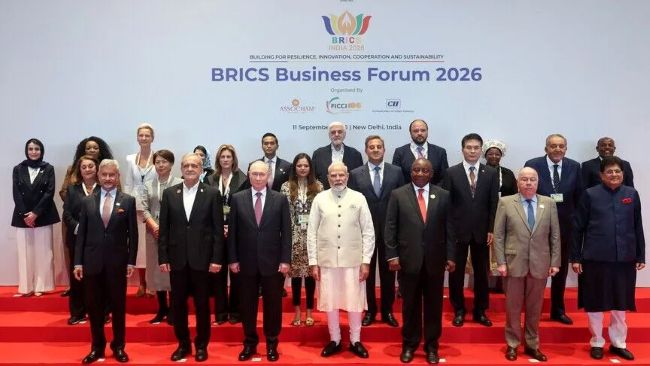 The 18th BRICS Summit in New Delhi has offered Nigeria something more important than diplomatic visibility: a glimpse of how