
SEC, NGX Reforms Put Nigeria on S&P Dow Jones Frontier Market Review List

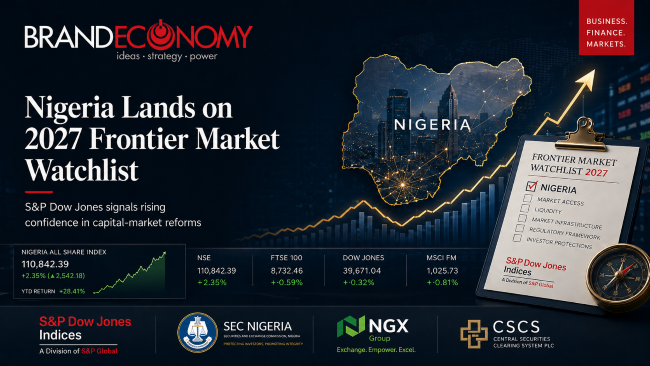 S&P Dow Jones Indices has placed Nigeria on its 2027 Country Classification Watchlist for possible reclassification from a Standalone Market to a Frontier Market. It is not yet an upgrade. But it is a significant signal that Nigeria’s capital-market reforms are beginning to attract renewed global attention.
Nigeria’s capital market has received a notable signal from the global index community.



S&P Dow Jones Indices, S&P DJI, has placed Nigeria on its 2027 Country Classification Watchlist for possible reclassification from a Standalone Market to a Frontier Market, citing improvements in the country’s regulatory environment, transparency and market integrity.
The announcement does not amount to an immediate upgrade. Rather, it places Nigeria under formal review ahead of a possible reclassification decision in 2027.
For Nigeria, that distinction matters.
A watchlist is not a medal. It is an examination.
The opportunity is significant, but the next phase will depend on whether the country can sustain policy consistency, improve operational resilience and prove that ongoing reforms are durable enough to meet the expectations of global institutional investors.
Why It Matters
Index classification shapes how global capital sees a market.
When a country is classified as a frontier or emerging market by major index providers, it becomes more visible to international fund managers, benchmark-tracking investors and specialist funds that allocate money according to index rules.
Frontier markets are generally considered smaller, less liquid or less developed than mainstream emerging markets, but still sufficiently open and accessible to attract international investors.
That is why Nigeria’s possible movement from Standalone to Frontier status is important.
Standalone markets sit outside the main investable country groupings for many global index products. Frontier status, if eventually achieved, could increase Nigeria’s visibility among global institutional investors and improve eligibility for frontier-market benchmark indices and investment products.
But visibility is not the same as automatic capital inflow.
Investors will still look closely at liquidity, settlement efficiency, foreign-exchange access, repatriation confidence, corporate governance, disclosure quality and policy predictability.
Reform Recognition
According to S&P DJI, Nigeria’s regulatory environment has been modernised to support better transparency, enforcement and market integrity.
The development comes amid ongoing reforms driven by the Securities and Exchange Commission, SEC, in collaboration with NGX Group, the Central Securities Clearing System, CSCS, and other market stakeholders.
Those reforms are aimed at strengthening investor protection, improving market transparency, enhancing operational efficiency, modernising post-trade infrastructure and aligning Nigeria’s market more closely with international best practice.
This is the work that matters behind the announcement.
Global index providers do not reward speeches. They assess evidence.
S&P Dow Jones Indices’ classification approach considers market maturity, investability, accessibility, liquidity and institutional reliability in deciding where markets belong within its global country framework.
For Nigeria, the watchlist inclusion suggests that reforms have become visible. The real question is whether they can become dependable.
SEC’s Position
Reacting to the development, the Director-General of the SEC, Dr Emomotimi Agama, said the Commission remains focused on building a transparent, efficient and globally competitive capital market.
Agama said the SEC’s reform agenda is aimed at creating a forward-looking market capable of supporting intelligent investing through faster settlement systems, tokenised securities and deeper derivatives markets.
“At SEC, our priority is to sustain a fair, orderly and transparent market that protects investors and supports long-term capital formation,” he said.
“We will continue to work with exchanges, market infrastructure institutions, operators and other stakeholders to strengthen policy consistency, enforcement, market integrity and operational resilience.”
This is the right language for the moment.
The global investment community is not asking only whether Nigeria has attractive companies. It is asking whether the market architecture around those companies can support safe, efficient and predictable investment.
NGX’s View
The Group Managing Director of NGX Group, Mr Temi Popoola, described the watchlist inclusion as an encouraging development for Nigeria’s capital market.
He said the decision reflected growing international confidence in ongoing reforms and the collective work of regulators, market infrastructure institutions and operators.
According to Popoola, although the development is not yet a reclassification, it validates progress in improving market transparency, accessibility and efficiency.
He said the priority now is to sustain reform momentum by deepening market liquidity, improving accessibility, strengthening investor confidence and positioning Nigeria as a preferred destination for both domestic and foreign investment.
That focus is critical.
A market can have strong reforms on paper and still struggle if investors cannot enter and exit easily, settle trades efficiently, access reliable market data or repatriate funds with confidence.
The Liquidity Test
For Nigeria, liquidity remains one of the central tests.
International investors need markets where they can buy and sell meaningful positions without excessive price disruption. They also need confidence that market rules, custody arrangements and settlement systems will work consistently.
Liquidity is not created by classification alone. It is created by confidence, transparency, active participation, strong listings, research coverage, institutional investor depth and predictable regulation.
If Nigeria wants to convert the S&P DJI watchlist into a stronger market position, it must keep widening participation and deepening trading activity.
The FX Question
Foreign-exchange confidence will also matter.
Global investors do not look only at share prices. They look at the full investment journey: bringing money in, buying assets, receiving dividends, selling securities and taking money out.
Any uncertainty around liquidity, currency convertibility or repatriation can weaken investor appetite, even where listed companies are attractive.
Nigeria has made several reform moves in recent years to restore confidence in the foreign-exchange market, but investors will continue to assess whether improvements are consistent and durable.
For a possible Frontier Market reclassification, the perception of access may be as important as the formal rules.
Post-Trade Infrastructure
The role of CSCS and other market infrastructure institutions is also crucial.
Behind every stock-market transaction is a system of clearing, settlement, custody, record-keeping and risk management.
When those systems are efficient, investors feel protected. When they are slow, opaque or unpredictable, capital hesitates.
Nigeria’s reform push around faster settlement systems, operational resilience and market infrastructure is therefore not a technical footnote. It is part of the country’s investability story.
The New Market Architecture
Agama’s reference to tokenised securities and deeper derivatives markets points to a wider ambition.
Nigeria is not merely trying to restore old confidence. It is trying to modernise the market for a new investment era.
Tokenised securities could eventually broaden access, improve fractional ownership and support new forms of capital formation, provided regulation is strong and investor protection is clear.
Derivatives markets can support risk management, hedging and liquidity, but they also require strong oversight, transparent pricing and sophisticated market conduct rules.
The direction is promising. The execution must be disciplined.
Market Implications
Nigeria’s inclusion on the S&P DJI watchlist could have several implications.
First, it raises the country’s profile among frontier-market investors and Africa-focused funds.
Second, it gives listed companies a stronger reason to improve disclosure, investor relations and governance standards.
Third, it encourages regulators and market operators to accelerate reforms around access, liquidity, settlement and transparency.
Fourth, it can help restore confidence in Nigeria’s capital market as a platform for long-term financing.
Fifth, it may improve future eligibility for index-linked products if reclassification is eventually granted.
The watchlist is therefore a window. Nigeria must use it well.
Brand Implications
For Nigeria’s investment brand, the message is powerful but unfinished.
The country has long had scale, entrepreneurial energy, strong banks, major consumer markets, telecom depth and a large domestic savings opportunity. What global investors have often questioned is market predictability.
The S&P DJI watchlist gives Nigeria a chance to reposition itself as a reforming market with improving governance and renewed seriousness.
For SEC and NGX, this is a brand moment.
Their challenge is to move from promise to proof: faster processes, clearer rules, stronger enforcement, more transparent data and better investor experience.
For listed companies, the brand challenge is also clear. Global visibility brings greater scrutiny. Investor communication, governance discipline and timely disclosure will matter more.
Investor Relevance
For investors, Nigeria’s watchlist status should be monitored, not overinterpreted.
It does not guarantee an upgrade in 2027. It does not guarantee passive inflows. It does not eliminate macroeconomic risk.
But it does signal that Nigeria’s reform direction is being noticed.
Investors should track the following indicators:
Market liquidity
Are trading volumes improving across more stocks or concentrated in a few names?
FX access
Can investors move capital in and out with greater confidence?
Settlement efficiency
Are post-trade systems becoming faster, more reliable and more aligned with global standards?
Disclosure quality
Are listed companies providing timely, detailed and credible information?
Regulatory enforcement
Are market abuses addressed consistently and transparently?
Product depth
Are derivatives, securities lending, market making and tokenised instruments developing responsibly?
Policy consistency
Are reforms sustained beyond announcement cycles?
These will determine whether the watchlist becomes a reclassification or a missed opportunity.
What Nigeria Must Do Next
Nigeria now has a 2027 review window.
The country should use it to consolidate reforms and demonstrate measurable progress.
That means:
- sustaining regulatory consistency
- deepening market liquidity
- improving access for domestic and foreign investors
- strengthening settlement and custody infrastructure
- reducing operational friction
- improving listed-company disclosures
- expanding credible investment products
- enforcing rules visibly
- keeping investor communication clear and regular
The goal is not simply to impress an index committee.
The goal is to build a market that can finance Nigerian enterprise, attract long-term capital and strengthen national competitiveness.
BRANDECONOMY Insight
Nigeria’s placement on the S&P Dow Jones 2027 Country Classification Watchlist into Frontier Market is not yet a victory.
It is a serious opportunity.
The country has been noticed because reforms are visible. It will be upgraded only if reforms become reliable.
For SEC, NGX, CSCS and the broader market ecosystem, the next stage is execution discipline.
Nigeria must prove that transparency, access, liquidity, settlement efficiency and policy consistency are not temporary reform slogans, but permanent features of its capital market.
The watchlist opens the door.
Performance will decide whether Nigeria walks through it.