

Mary-Brenda Akoda’s GenScan AI Wins $100,000 NLNG NPSI Prize for Faster MRI
Becoming First Millennial Individual Winner

A one-step AI reconstruction model could make every compatible MRI scanner work harder. But the NLNG Nigeria Prize for Science and Innovation (NPSI) recognition is only the opening move in the far tougher race to clinical trust, hospital integration and affordable access.
2026 NLNG NPSI Winner at a Glance



| Winner | Mary-Brenda Akoda |
| Prize | 2026 Nigeria Prize for Science and Innovation (NPSI) |
| Innovation | GenScan AI (GenMRI/C-MORE), an AI-powered MRI reconstruction system |
| Core promise | Potentially faster MRI reconstruction without buying new scanner hardware |
| Prize award | US$100,000, scheduled for presentation on 9 October 2026 |
| Competition | 237 entries, the largest field recorded by the Prize |
The most important thing about Mary-Brenda Akoda’s US$100,000 Nigeria Prize for Science and Innovation is not that it has landed on artificial intelligence. It is that it has landed on a stubborn, expensive and painfully practical problem: time inside an MRI scanner.
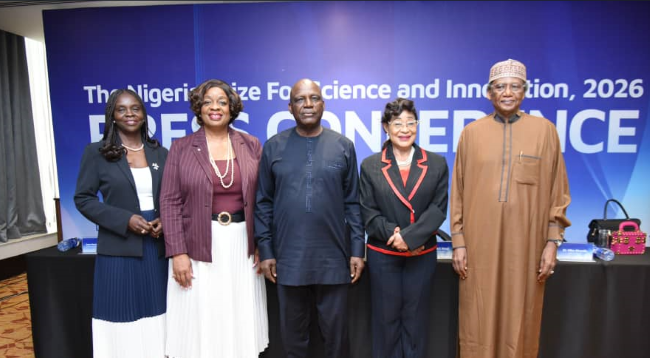
At a Lagos press conference, the Prize named Akoda’s GenScan AI (GenMRI/C-MORE) the winning work from 237 submissions – the largest field in the competition’s history. The result restores a winner to the programme after the 2025 cycle ended without one, a decision NLNG and the Prize administrators present as evidence of a refusal to lower the threshold for scientific merit.
“If an entry is declared worthy of the Prize today, we can be confident that it has earned that distinction through a thorough and credible evaluation process.”
Dr Sophia Horsfall, General Manager, External Relations and Sustainable Development, NLNG
That institutional discipline is significant. In an economy where innovation announcements often outrun deployment, a no-winner year can look awkward. In reality, it can be an asset: it says the prize is intended to certify quality, not simply distribute applause. This year, the Panel of Judges chaired by Dr Omobola Johnson, and the Advisory Board led by Professor Barth Nnaji, found a work they judged both technically credible and commercially consequential.
Horsfall’s own account of the 2026 cycle was deliberately uncompromising. Following the 2025 outcome, she said NLNG took the Prize more directly to the research and innovation community, with a simple message: “the standard remains high, and the door remains open.” The record 237-entry field is the clearest evidence that the message travelled.
A serious technology, not a magic wand
GenScan AI uses an artificial-intelligence approach called C-MORE – Consistency Model-based One-step Reconstruction for MRI – to recover high-quality images from accelerated MRI data. In plain language, it aims to reduce the amount of time a patient needs to spend being scanned while preserving, or potentially improving, the diagnostic usefulness of the final image.
The distinction matters. MRI is not merely a picture-taking exercise. It is a complex diagnostic workflow involving data acquisition, reconstruction, radiologist review, patient preparation, staff scheduling, power reliability, machine uptime and payment. A faster reconstruction method does not manufacture a new scanner, replace a radiologist or erase the infrastructure failures around an imaging centre. What it can do is make an existing compatible scanner more productive – a potentially transformative proposition in a capacity-starved market.
Prize materials say the technology could shorten MRI acquisition time by as much as 90 per cent without new hardware. That should be treated as a technical potential, not a universal service-level promise. Performance in a research setting must still be independently replicated across scanner models, patient groups, imaging protocols and clinical sites. The relevant business question is not simply whether an algorithm can run quickly; it is whether it can deliver dependable, diagnostically safe images in the messy conditions of routine care.
“We have a winning work today that has direct impact on improving lives.” Professor Barth Nnaji, Chairman, Advisory Board, The Nigeria Prize for Science and Innovation
The economics of a scarce diagnostic asset
The Prize’s health-system logic is compelling. The Advisory Board noted that a 2018 study referenced in its assessment reported 58 installed MRI machines in Nigeria, while also acknowledging that no single, current public database confirms how many units are functional today. That caveat should sharpen, not weaken, the argument. In a market with thin and unevenly distributed diagnostic capacity, every reliable hour of scanner time has economic value.
If scan time falls safely, a diagnostic centre can schedule more patients from the same machine, reduce queues, improve asset utilisation and potentially lower the cost per completed examination. For patients, that could mean a shorter and less stressful examination, less time away from work and earlier clinical decision-making. For hospitals, it could ease bottlenecks that force referrals, delay treatment plans and leave expensive imported equipment under-used.
But the word that matters is ‘could’. Faster capacity only becomes public value if it is translated into pricing, access and quality. A private imaging provider could use it to increase premium volumes while leaving prices unchanged. That may still create a viable business, but it would not automatically democratise care. The development prize lies in a model that converts part of the productivity gain into more affordable slots, public-sector partnerships, transparent waiting-time reductions and reach beyond the markets that already have the strongest purchasing power.
“The overwhelming participation in the 2026 edition underscores the inherent capacity, and determination of Nigerian innovators to develop solutions that can address real-world challenges through emerging technologies.” Professor Barth Nnaji
From research result to clinical trust
This is where the story becomes more demanding than the award citation. Health AI earns trust in layers. First comes external clinical validation: can the model maintain diagnostic quality when confronted with data it has not seen, across different populations and disease presentations? Then comes interoperability: can it work reliably with the scanner, workflow software and image-archiving systems already used by hospitals? After that come data governance, cybersecurity, professional liability, local regulatory requirements and a commercial model that does not create a new digital monopoly around a public-health bottleneck.
Akoda’s next milestone should therefore not be a publicity tour. It should be a disciplined, independently evaluated multi-site pilot with credible hospitals and radiologists. The pilot should publish more than a headline percentage: it should measure acquisition time, reconstruction time, image quality, radiologist confidence, repeat-scan rates, workflow failures, patient experience and cost per useful examination. That is the evidence stack an investor, regulator, hospital chief executive and clinician should all want to see.
The prize also signals a maturing innovation ecosystem
For Nigeria LNG Limited, which sponsors the NLNG NPSI Prize, the result is an argument for patient institution-building. Dr Sophia Horsfall, NLNG’s General Manager for External Relations and Sustainable Development, said renewed outreach after the 2025 outcome brought a record response while standards remained intact. Nnaji made the same point from the Advisory Board: novelty alone was not enough; the winning work had to show “practical relevance, measurable impact and prospects for real-world application.”
“The field is quite green with a lot of opportunities that can have great global impact.” Professor Barth Nnaji
The other finalists reinforce the direction of travel. Kemisola Bolarinwa’s EwaDx Smart Bra Diagnostic Device and the MedBrain paediatric triage study by Pol Ricart and Paul Dinwoke show a field that is increasingly asking technology to reduce the distance between limited health resources and urgent patient needs. AI is most useful in Nigeria not when it imitates foreign spectacle, but when it helps scarce systems work with more precision, speed and dignity.
Akoda’s individual milestone is also symbolically important. The Prize says she is its first millennial and first woman individual winner. Her profile – a First-Class Computer Science degree from Goldsmiths, a Distinction MRes in AI and Machine Learning from Imperial College London as a Google DeepMind Scholar, and research and engineering experience at Microsoft – tells a familiar diaspora-success story. The more valuable interpretation, however, is not celebratory biography. It is proof that Nigerian intellectual capital can compete at the frontier of medical AI when it is connected to a concrete development problem and a commercial pathway.
Brand implications: credibility must now travel with evidence
GenScan AI now carries the kind of third-party validation that changes conversations with hospitals, investors, equipment partners and grant-makers. The NPSI badge can open doors, particularly because the selection was unanimous and arose from a record field. But in medtech, a prize is an attention asset, not a clinical licence. The GenScan brand will be strengthened most by measured claims, clear safety boundaries, transparent validation data and a narrative that places clinicians and patients – not algorithmic theatre – at the centre.
For NLNG, the NLNG NPSI award sharpens the reputation of its science platform. It offers a more powerful proof of corporate citizenship than a ceremonial grant: a sponsor supporting research that could improve the productivity of an existing, constrained healthcare asset. The challenge is to sustain that value through post-award visibility, commercialisation support and careful public explanation of what the technology can and cannot yet do.
Investor relevance: value lies in deployment, not the demo
Investors should see GenScan AI as a deep-tech health-infrastructure proposition rather than a generic AI application. The opportunity sits at the intersection of imaging software, hospital operations, clinical workflow and emerging-market access. It could support licensing, enterprise software, usage-based pricing, managed-service partnerships or scanner-vendor integrations. Each route has a different path to revenue, margin and defensibility.
The diligence questions are correspondingly hard: What is the regulatory route in each target market? Which MRI platforms are compatible? How robust is the performance outside the original research environment? Who owns and protects the data? What evidence will persuade radiologists? And can the product price itself so that a centre gains commercially while patients and public systems gain too? A technology that merely accelerates premium clinics will have a narrower investment case than one that demonstrably expands diagnosis at scale.
BRANDECONOMY Insight
| GenScan AI matters because it reframes healthcare innovation as capacity economics. Its commercial promise is not that it makes MRI futuristic; it is that it may help an existing scanner serve more people. The national opportunity will be realised only when speed is converted into independently verified quality, shorter queues, fairer prices and wider clinical access. |
The work starts after the award
“Your submission this year can very well be a starting point for what would promise to be a significant breakthrough next year.” Dr Sophia Horsfall, addressing 2026 contestants at the NLNG/NPSI press conference
Akoda will receive the NLNG NPSI award at the Grand Award Night scheduled for 9 October 2026. By then, the public story will have reached its ceremonial climax. The commercial story should be just beginning: a focused proof programme, a clinical advisory network, a regulatory roadmap, prospective hospital partners and a pricing architecture designed for the realities of Nigerian care.
Nigeria does not need another innovation that is globally admired and locally absent. It needs innovations that can cross the last mile from a research result to a staffed imaging centre, a physician’s decision and a patient whose diagnosis comes earlier because the system finally moved faster. GenScan AI has won the first contest. The next one is more consequential – and it will be judged in waiting rooms, radiology reports and real lives.