
UNILAG VC Urges Nigerian Universities to Reinvent Learning with AI, Not Ban It

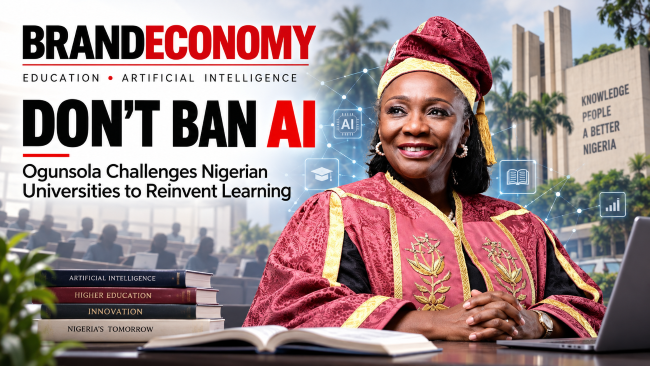
Nigerian universities should stop treating artificial intelligence as contraband and begin governing it as an instrument of learning, research and economic competitiveness, University of Lagos Vice-Chancellor Prof. Folasade Ogunsola has said.
Speaking on Tuesday at the Eighth Lagos State University Research and Innovation Fair, Prof. Folasade Ogunsola argued that prohibition would neither remove AI from campuses nor prepare students for the emerging world. Universities must create ethical frameworks that preserve intellectual rigour while enabling responsible experimentation.




Her presentation, “Opportunities, Risks and Ethical Use of Artificial Intelligence in Teaching and Research,” was delivered at the Aderemi Makanjuola Lecture Theatre, LASU, Ojo. The fair’s theme was “Accelerating National Development Through Artificial Intelligence-Driven Research and Innovation.”
Ogunsola’s central warning was memorable: institutions cannot ban AI, but they must continue teaching minds to think.
A ban would be institutional surrender
That distinction is crucial. Generative AI can retrieve information, summarise material, generate code and execute routine processes rapidly. Used intelligently, it can widen access to tutoring, support researchers and help lecturers serve students with different needs.
But speed is not understanding. A student submitting an elegant AI-generated essay may have mastered prompting without mastering the subject. Universities must teach students to use powerful tools without surrendering the formative struggle through which judgment and originality develop.
Ogunsola warned that an unchallenged mind does not learn to think. Interpreting evidence, testing assumptions and reaching defensible conclusions remain central to education, even when machines produce fluent answers in seconds.
The evidence supports guided adoption
To illustrate AI’s potential, Ogunsola cited a supervised learning intervention in which students used AI to improve their English. Within six weeks, participants achieved gains researchers compared with roughly two years of conventional learning.
The design contains the more important lesson: teachers were not removed. Students used technology under human supervision and prompts encouraging reasoning rather than shortcuts. AI amplified pedagogy; it did not abolish it.
This matters where large classes, teacher shortages and uneven resources constrain learning. AI could provide personalised practice, translation and feedback at scale. Yet unequal access to devices, electricity, connectivity and paid platforms could deepen educational divides.
Assessment must move beyond take-home essays
Ogunsola observed that lecturers can no longer assume submitted assignments represent a student’s unaided thinking. In some cases, institutions may be grading the machine rather than the learner.
The answer is not memory-based examinations. Universities should use oral defence, live problem-solving, supervised practical work, iterative drafts and portfolios showing how conclusions were reached. Students should disclose material AI assistance, verify outputs and accept responsibility for every submitted claim.
AI-detection software cannot anchor academic justice; disputed results may punish innocent students. Better assessment, evidence of process and transparent disclosure offer stronger protection.
Governance must protect trust
Prof. Folasade Ogunsola identified privacy, intellectual property, accuracy, regulation and academic integrity among the unresolved risks. Universities need institution-wide policies defining permitted and prohibited uses across coursework, examinations, research, administration and publication.
Sensitive student, patient or research data should not be uploaded casually. Scholars must verify citations, identify fabricated material, examine bias and respect copyright and confidentiality. Policies should distinguish legitimate assistance from substituting AI output for scholarship.
Nigeria also needs institutional access agreements that prevent cost from deciding who can learn with the best tools and where university data may be stored or processed.
Market implications
Responsible adoption could expand demand for Nigerian education-technology companies, secure cloud services, local-language tools, cybersecurity, assessment platforms and faculty training. Universities could test AI applications in healthcare, agriculture, finance and public administration.
The economic risk is dependency. If institutions merely purchase foreign platforms without building local datasets, technical skills and research capacity, Nigeria will become a consumer of intelligence designed elsewhere rather than a producer of relevant solutions.
Investor relevance
Investors should see a potentially large market, but one shaped by tight university budgets, slow procurement and regulatory uncertainty. The strongest opportunities will solve specific educational problems, demonstrate measurable learning gains, protect data and integrate with existing institutional systems. Products built around hype, opaque models or unverifiable outcomes will struggle to sustain trust.
Brand implications
For universities, AI policy is now a reputational issue. An indiscriminate ban can signal institutional fear; uncontrolled adoption can weaken confidence in degrees, research and graduate competence.
The strongest university brands will combine technological ambition with rigorous standards, visible safeguards and graduates capable of defending their own thinking.
BRANDECONOMY Insight
Nigeria’s universities do not need an AI ban. They need an AI Learning Compact built on four duties: disclose its use, verify its output, defend the final work and protect sensitive data.
Every institution should publish clear rules, train lecturers and students, redesign assessment and establish an interdisciplinary AI-governance council. It should then measure success through learning outcomes, research quality, employability and locally relevant innovation—not the number of software licences acquired.
The enduring purpose of a university is not to produce people who can retrieve answers. It is to cultivate minds that can interrogate answers, recognise error, exercise judgment and create new knowledge.
AI should increase that human capacity. If it replaces it, the technology will have become more intelligent while education becomes less so.