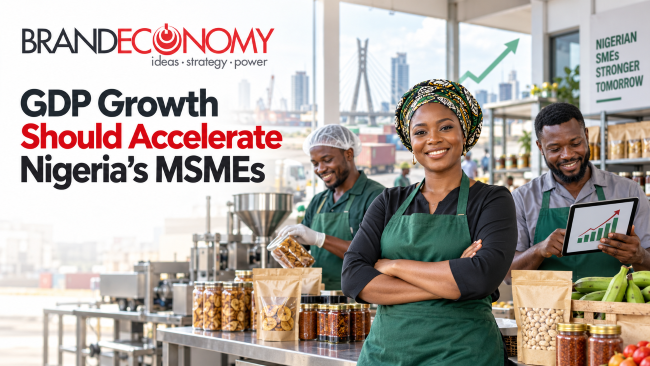
 Nigeria’s economy expanded by 4.43 per cent year-on-year in the second quarter of 2026, ahead of the 4.23 per cent recorded a year earlier. The improvement is welcome, but the harder question is whether faster output can push struggling MSMEs, produce jobs, food security, stronger businesses and durable purchasing power.
Economists interviewed separately by the News Agency of Nigeria in Lagos on Tuesday said the answer rests largely on three engines: oil, agriculture and Micro, Small and Medium Enterprises.




Prof. Sherifdeen Tella of the Department of Economics, Babcock University, Ogun State, urged the Federal Government to raise crude production, confront networks undermining output and strengthen public revenue and foreign-exchange inflows.
He also called for sufficient crude supply to the Dangote Refinery. The prize is not simply more barrels, but more value retained through refining, petrochemicals, logistics and a dependable domestic fuel market.
Growth is improving—but its quality matters
The National Bureau of Statistics reported average crude production of 1.72 million barrels per day in Q2 2026, the highest quarterly level since 2022. Agriculture grew by 4.39 per cent, improving from 2.82 per cent a year earlier, while services accelerated to 4.60 per cent from 3.94 per cent.
Industry, however, slowed sharply to 3.96 per cent from 7.46 per cent. That is the caution inside the celebration: an economy can expand while factories and employment-intensive firms remain constrained by power costs, expensive credit, weak logistics and uncertain demand.
Services generated 56.62 per cent of real GDP, while the non-oil economy accounted for 95.84 per cent. Oil remains disproportionately important to revenue and foreign exchange, but cannot deliver broad prosperity alone. Its earnings must reduce production costs elsewhere.
Oil can finance diversification—not replace it
Tella’s argument is compelling if higher output becomes a financing bridge, not a development destination. Reduced theft and disruption should yield predictable production, transparent receipts and stable feedstock for domestic refiners.
Volume alone is insufficient. Higher prices can strengthen reserves and market sentiment, but also postpone reform—repeating Nigeria’s paradox of oil windfalls alongside weak infrastructure.
A credible strategy would channel part of incremental petroleum revenue into power, transport, agricultural storage, skills and well-governed MSME finance—converting a cyclical advantage into productive capacity.
Agriculture needs productivity, not indiscriminate subsidies
Tella also urged federal and sub-national governments to give agriculture and its value chains greater priority, including targeted support capable of slowing food inflation and reinforcing social stability.
The intervention must extend beyond cheaper inputs. Farmers need security, irrigation, improved seedlings, extension services, storage, rural roads and reliable buyers. Poorly targeted subsidies may leak without lifting yields; support linked to verified output and market access is more defensible.
Agriculture’s faster growth is encouraging, but food security is measured in affordability, lower post-harvest losses and local processing—not GDP alone.
MSMEs remain the missing transmission belt
Prof. Ndubisi Nwokoma of the Department of Economics, Caleb University, said the operating environment favours larger companies and multinationals while many MSMEs struggle. He urged government to cut governance costs and redirect savings towards small-business growth, citing the Asian Tigers’ enterprise development.
The comparison matters. Successful Asian economies combined finance with infrastructure, export discipline, skills and supplier development. Nigeria likewise needs small firms that can become productive suppliers to large companies and government, rather than than remain permanently fragile.
For MSMEs, relief must lower the actual cost of doing business: reliable electricity, affordable working capital, simpler taxes, digital market access and prompt payment on public contracts. Cutting government expenditure is useful, but only if savings are transparently redeployed and outcomes—survival, investment, productivity and jobs—are publicly tracked.
Market implications
The growth mix favours upstream services, pipeline security, refining, agro-processing, warehousing, logistics and digital commerce. Slower industry, however, signals margin pressure for manufacturers exposed to energy, finance and imported-input costs.
Investor relevance
Investors will want evidence that higher oil production is sustainable, domestic crude obligations are commercially workable, agricultural support lifts productivity and MSME programmes reach viable enterprises—not political beneficiaries.
Brand implications
For government, 4.43 per cent is a reputational asset only if citizens encounter it through cheaper food, reliable energy, employment and healthier businesses. Without welfare gains, repetition could widen the gap between official statistics and lived experience.
Banks, energy companies, manufacturers and digital platforms can earn trust through supplier finance, market access and capability programmes that help MSEMEs and smaller businesses scale. Strong brands turn inclusion into measurable enterprise outcomes.
BRANDECONOMY Insight
Nigeria does not face a choice between oil and diversification. It faces a conversion challenge: how to transform every additional barrel into more competitive farms, factories and firms.
The Federal Government should establish an Oil-to-Enterprise Growth Compact: sustain production, publish the use of incremental revenue, secure transparent refinery feedstock, finance productive agricultural value chains and reduce MSME operating burdens.
Quarterly GDP growth is an important signal, not a development verdict. The more consequential scorecard is whether industry recovers, food inflation retreats, small businesses invest and employment expands.
If oil revenue becomes the capital that strengthens those outcomes, 4.43 per cent can mark the beginning of a more resilient growth cycle across the board including the critical MSMEs. If not, it may prove another impressive statistic with too little impact beyond the spreadsheet.