Dangote Refinery’s ₦2.15trn People’s IPO: Is This Industrial Democracy?

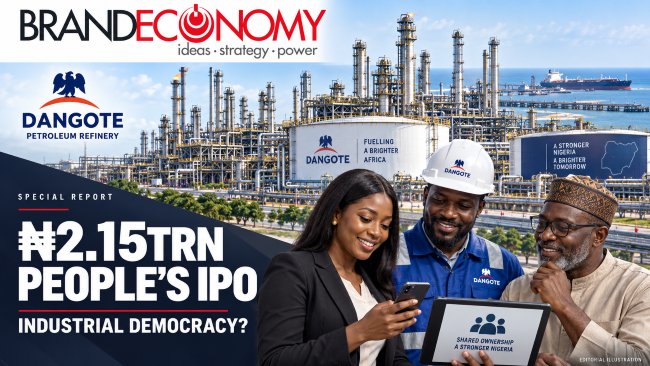 A ₦5,250 entry ticket could bring ordinary Nigerians into one of Africa’s most consequential industrial enterprises. Whether the Dangote Refinery IPO delivers shared prosperity will depend on the price, the protections and the power behind the shares.
For the Nigerian who buys petrol to get to work, diesel to keep a business running or a flight ticket inflated by operating costs, the petroleum industry has usually presented a bill. Dangote Refinery’s proposed public offer presents something different: an opportunity to own part of the enterprise behind the product.



That is the emotional force of its ₦2.15 trillion “people’s IPO”. It invites citizens to move from paying for industrial activity to participating in its financial rewards.
At the September 7 signing ceremony in Lagos, Aliko Dangote presented the offer as an opportunity extending to junior employees, drivers and cooks. Channels Television’s reporting captured the ambition: ownership should reach beyond the affluent.
It is a powerful proposition. But does it amount to the ultimate industrial democracy?
BRANDECONOMY’s assessment: Dangote Refinery IPO could become a landmark in popular industrial ownership. The stronger claim remains to be earned through fair access, responsible valuation, enforceable rights and sustained accountability.
Opening the register is a beginning. What happens after people enter will determine the achievement.
 What the ₦2.15 trillion actually represents
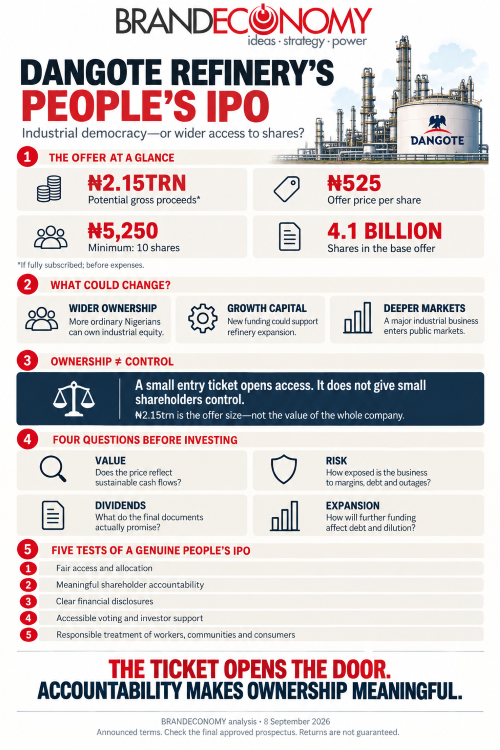 What the ₦2.15 trillion actually represents
The announced base offer comprises 4.1 billion ordinary shares at ₦525 each. Multiplication produces ₦2.1525 trillion in potential gross proceeds if fully subscribed.
This is neither money already raised nor the valuation of the whole refinery.
PUNCH’s September 4 report, attributing the announcement to Dangote Group, said the Securities and Exchange Commission had approved the offer and registered 120.13 billion existing ordinary shares.
The Dangote Refinery IPO offer summary reported by Daba on September 7 sets a minimum application of 10 shares, costing ₦5,250 before any applicable charges. Further applications are in multiples of 10, with full payment required on application.
| Announced item | What it means |
| Offer price: ₦525 | The initial subscription price per share |
| Base offer: 4.1 billion shares | The shares being offered in the announced base transaction |
| Potential gross proceeds: ₦2.1525 trillion | Proceeds at full subscription, before transaction expenses |
| Minimum: 10 shares | A ₦5,250 entry amount before any applicable charges |
| Scheduled opening: September 14, 2026 | The offer is not yet open as of this article’s date |
Daba and Reuters report an October 13 closing date, although one Channels report gives October 9. Investors should rely on the final approved offer documents for the controlling timetable.
Reports of the oversubscription allowance have also changed: earlier coverage cited 15%, while the September 7 offer summary describes capacity to accept up to 30% more, subject to regulatory approval.
These discrepancies do not invalidate the transaction. They underline the difference between a news announcement and a prospectus.
The democratic power of a small entry ticket
A ₦5,250 minimum has significance beyond affordability. It challenges the assumption that ownership of major industrial assets belongs exclusively to billionaires, governments and institutions.
A driver can, in principle, own the same class of ordinary equity as a wealthy investor. The financial scale differs dramatically, but the invitation changes the relationship between citizens and enterprise.
The Financial Times reports an ambition to attract 10 million retail investors across Africa. That is an ambition, not an achieved shareholder count.
Consider the arithmetic. If 10 million people each bought only 10 shares, they would collectively subscribe ₦52.5 billion—approximately 2.44% of the base offer’s potential proceeds. If the entire 4.1 billion-share offer were distributed evenly among 10 million investors, each would receive 410 shares, costing ₦215,250.
Neither calculation forecasts the allocation. Together, they show that mass participation and mass capital mobilisation are different achievements.
A genuinely inclusive offer needs both a small entry ticket and an allocation process that gives small applicants a meaningful opportunity when larger investors arrive.
Wider ownership is not the same as wider control
Assuming the 4.1 billion shares are newly issued in addition to the reported 120.13 billion existing shares, the enlarged share count would be 124.23 billion.
On that basis, the base IPO would represent approximately 3.30% of the enlarged company, before any additional issuance or other capital adjustments.
At ₦525 per share, the same calculation implies a post-issue equity valuation of approximately ₦65.22 trillion. This is BRANDECONOMY’s arithmetic using the reported share counts, subject to the definitive capital structure. It is not enterprise value, which would also require debt and cash adjustments.
The distinction is consequential. Millions of new owners can participate economically while existing holders retain overwhelming voting influence.
That arrangement can still be valuable. A successful founder need not surrender operational leadership for shareholders to benefit. But a dispersed minority cannot be described as controlling the enterprise merely because its membership is large.
Strictly understood, industrial democracy also concerns workers’ participation in decisions affecting their working lives. A public share offer does not automatically create employee board representation, collective bargaining rights or workplace decision-making powers.
The most defensible description at this stage is broader access to industrial equity.
The national opportunity is substantial
The refinery’s industrial achievement gives the offer unusual weight.
Reuters reported in June that the facility, originally designed for 650,000 barrels per day, had processed 700,000 barrels per day during a performance test. A test result should be distinguished from sustained average output.
Its potential contribution extends across domestic fuel supply, exports, logistics, technical employment and demand for supporting services.
When more processing takes place locally, Nigeria has an opportunity to retain additional value from petroleum activity. Engineering companies, maintenance providers, transport operators, insurers and industrial suppliers can compete for associated business.
However, foreign-exchange benefits must be assessed on a net basis. Export receipts and avoided product imports need to be considered alongside imported crude, equipment, debt service and other foreign-currency payments.
Likewise, additional refining capacity can strengthen supply resilience without guaranteeing permanently cheap petrol. Crude prices, exchange rates, taxes, distribution costs and competitive conditions still matter.
The strongest development case therefore combines efficient production with competitive markets and local capability. An IPO can finance part of that progress; it cannot deliver every element by itself.
Investment value begins where the celebration ends
A low minimum subscription does not establish that the shares are cheaply valued.
The critical question is what sustainable earnings and cash flows the purchase price buys.
Investors need to examine margins across an ordinary refining cycle, feedstock availability, plant reliability, working-capital requirements, financing costs and maintenance expenditure. Strong results during unusually favourable market conditions should not be projected indefinitely.
A refinery can generate substantial sales while committing enormous sums to crude inventories and receivables. It can report profit while retaining cash for expansion. Production growth can create value, but only when the returns justify the additional capital.
The same discipline applies to comparisons with other refiners. A serious valuation must reconcile capacity, product mix, efficiency, debt, taxation, country risk and expansion expenditure. Plant size alone cannot settle the argument.
Without reviewing the definitive prospectus and its audited financial disclosures, a confident verdict that ₦525 represents a bargain would be premature.
Admiring the asset and evaluating the security are compatible responsibilities.
Expansion makes capital discipline essential
Reuters’ September 7 reporting put the proposed expansion programme at $14.3 billion, targeting capacity of 1.4 million barrels per day by 2029.
That makes the funding question central: the base IPO’s reported equivalent of roughly $1.6 billion would finance only part of a programme of that scale.
Additional funding might involve retained earnings, borrowing, strategic investment or future equity. The eventual mix will influence dividend capacity, financial risk and possible dilution.
Investors should therefore ask how much of the next growth phase is funded, what remains conditional and which expenditure belongs to the listed company.
A shareholding in the refinery should never be casually presented as ownership of every Dangote Group project. Separate ventures and subsidiaries require separate examination.
The company’s August 18 announcement provides a useful example of why precision matters. Its $1 billion backing programme comprised a completed $600 million private placement and a separate $400 million IPO underwriting commitment. Those are distinct components, not $1 billion already collected from retail subscribers.
Underwriting can support execution of an offer. It does not guarantee a profitable investment.
Dollar dividends: attractive ambition, demanding questions
The prospect of subscribing in naira and receiving dividends in dollars has featured prominently in public discussion of the listing. BusinessDay reported Dangote’s plans for that structure in December 2025.
For Nigerian households concerned about currency depreciation, the attraction is obvious.
Nevertheless, the final documents must establish the policy, approvals, eligibility and payment arrangements. Dividend currency does not guarantee that a dividend will be declared or that the investment’s total return will be positive.
Export revenues also do not equal distributable cash. Foreign-currency operating costs, interest, loan repayments and capital expenditure can absorb receipts.
Nor should the reported retail share incentive be treated as a guaranteed percentage return. Daba’s offer summary describes up to two additional shares for eligible holders, subject to conditions and regulatory approval. It does not justify a universal promise of “20% free returns”.
Financial inclusion works best when attractive features are explained with their conditions intact.
Market implications: a larger exchange, with fresh responsibilities
A refinery listing of this scale could broaden the Nigerian market’s industrial representation and attract investors who have never previously owned listed equities.
Brokers and investment platforms could acquire new clients. Asset managers could gain another major domestic investment option. Other large private enterprises could find a stronger precedent for raising patient capital through public ownership.
The benefits depend on what follows the subscription campaign: efficient allotment, clear account records, accessible reporting and reliable investor support.
Market capitalisation also needs careful interpretation. Admitting the whole company to trading can add its entire quoted equity value to an exchange’s headline size. That is different from injecting an equivalent amount of cash into the company or the economy.
A relatively small freely tradable share pool can coexist with a very large market valuation. Consequently, liquidity, concentration and volatility deserve attention alongside the celebratory market-capitalisation figures.
Brand implications: from founder confidence to institutional trust
The Dangote name supplies visibility and credibility that most issuers would spend years trying to build.
The offer could deepen that relationship. A customer who becomes a shareholder gains a financial reason to follow operational performance and long-term strategy.
But ownership also creates expectations. An investor who enters through a national-pride campaign may experience a falling share price as a broken promise unless the original communication clearly explained the risks.
The brand opportunity is therefore inseparable from investor relations.
Accessible earnings explanations, candid operational updates, responsive complaints handling and transparent dealings with associated businesses should become part of the ownership experience.
The founder’s reputation may attract the first subscription. The institution’s conduct must earn the next decade of trust.
What would make this a genuine people’s IPO?
BRANDECONOMY proposes five tests:
- Fair access: Publish clear allocation rules and report what small applicants actually received.
- Meaningful accountability: Explain voting arrangements, board independence and safeguards around related-party transactions.
- Financial clarity: Disclose debt, cash generation, capital commitments and the precise use of proceeds in language retail investors can understand.
- Participation beyond purchase: Make voting, reporting, dividend administration and complaints processes accessible after listing.
- Public-interest discipline: Combine shareholder returns with fair competition, responsible environmental performance and credible treatment of workers and host communities.
Broad share ownership cannot exempt an industrial champion from scrutiny. Consumers and citizens who own no shares remain stakeholders in the market it serves.
BRANDECONOMY Insight
Dangote Refinery’s people’s IPO could help change Nigeria’s economic imagination: citizens can participate in production through ownership, as well as through employment, enterprise and consumption.
That deserves serious attention.
But the decisive measure will be the quality of ownership created. How many first-time investors remain informed participants? How effectively are minority interests protected? Does new capital produce durable returns? Does industrial expansion strengthen the surrounding economy?
The ultimate achievement would be an institution that can turn its founder’s ambition into prosperity shared on transparent, sustainable terms.
The Dangote Refinery IPO ₦5,250 ticket opens the door. What happens to the people who walk through it will determine whether this becomes industrial democracy.