
The Prof. Adeyeye Storm: Is NAFDAC’s Consumer-Protection Mandate in Deep Crisis?

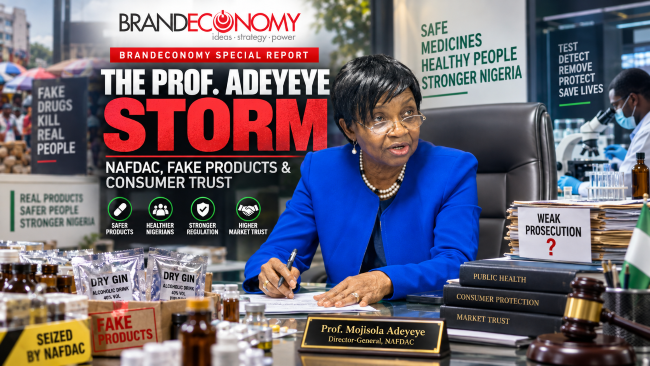 Nigeria’s fake-products crisis is no longer an abstract complaint whispered in pharmacies, open markets and WhatsApp groups. It now has names, places, truckloads, seizures, sealed shops and a rising public anger that refuses to go away.
In February 2025, NAFDAC’s enforcement operations across major drug markets in Lagos, Onitsha and Aba reportedly led to the sealing of more than 11,000 shops. At the Ogbo-Ogwu Bridgehead Market in Onitsha, enforcement teams uncovered large volumes of fake, expired and falsified medicines, with reports citing truckloads of seized products. In another disturbing instance, NAFDAC said prohibited drugs, unregistered narcotics, banned tramadol and counterfeit medicines were hidden inside plumbing-material shops, a concealment method that underlined how sophisticated and brazen the trade had become.



The Idumota drug market in Lagos, Aba in Abia State and Onitsha in Anambra State have since become symbols of a deeper national emergency. These are not marginal markets. They are major distribution arteries in Nigeria’s medicine economy. When fake and adulterated products penetrate such nodes, the consequences travel quickly across states, clinics, pharmacies, patent medicine shops, motor parks, informal retailers and homes.
More recently, the controversy over sachet alcohol has widened the debate from fake drugs to the broader safety of everyday consumption. NAFDAC has ordered manufacturers of alcoholic beverages packaged in sachets, PET bottles and glass bottles below 200ml to recall and destroy such products under agency supervision. The agency says the full ban took effect on January 1, 2026, after years of consultation and moratoriums granted to producers. It argues that small-pack alcohol is cheap, concealable, accessible to minors and dangerous to Nigeria’s young people.
At the centre of the storm is Prof. Mojisola Christianah Adeyeye, Director-General of the National Agency for Food and Drug Administration and Control. Asked recently whether she would resign amid the uproar over fake products, Adeyeye pushed back strongly. She said she returned to Nigeria after decades in the United States to serve, not to enrich herself. She recalled inheriting an agency weighed down by about N3.2 billion in liabilities, broken equipment and weak laboratory capacity. According to her, 70 to 80 per cent of the agency’s equipment was not functioning when she assumed office in 2017.
Her defence is that NAFDAC has been rebuilt, not ruined. She points to debt cleanup, stronger regulatory systems, and the agency’s attainment of World Health Organisation Maturity Level 3 in 2022. She also notes that NAFDAC has gained greater recognition from international regulatory bodies.
But the public question remains brutal and fair: if NAFDAC is stronger, why do fake foods, fake drinks, fake medicines, fake cosmetics, expired goods and adulterated products still feel so present in Nigerian markets?
The Fake-Products Economy
The fake-products challenge is not merely a regulatory nuisance. It is an illicit economy. It thrives on porous borders, weak port surveillance, fragmented distribution, informal retail, compromised supply chains, poverty-driven demand, online anonymity and slow justice.
Nigeria’s problem also sits within a wider African public-health crisis. Research reported internationally in 2024 suggested that about one in five medicine samples reviewed across Africa failed at least one quality test, while earlier WHO estimates indicated that one in 10 medical products in low- and middle-income countries may be substandard or falsified. The consequences are grave: treatment failure, antimicrobial resistance, worsening disease outcomes and preventable deaths.
In Nigeria, inflation has made the crisis more dangerous. As purchasing power collapses, consumers become more exposed to suspiciously cheap alternatives. A mother looking for affordable cough syrup, a student buying cheap alcohol, a trader stocking unverified cosmetics, or a farmer buying adulterated agrochemicals may not be acting carelessly. They may simply be trapped in a market where poverty and deception meet.
That is why enforcement alone cannot win. NAFDAC can raid, seal, arrest and destroy. But unless the incentive structure changes, the fake-goods economy will keep regenerating.
The Prosecution Problem and Archaic Laws
One of the weakest points in Nigeria’s fight against fake and adulterated goods is not the absence of raids. It is the limited fear of consequences.
Counterfeiters calculate risk. If the likelihood of arrest is low, prosecution slow, conviction uncertain and punishment weak, the illegal trade remains attractive. Nigeria’s regulatory agencies often announce seizures running into billions of naira, but the public rarely sees a matching number of successful prosecutions, asset forfeitures, long jail terms or major syndicate disruptions.
This is a major credibility gap.
The legal framework for fake and adulterated products is spread across several laws, including the NAFDAC Act, Food and Drugs Act, Counterfeit and Fake Drugs and Unwholesome Processed Foods Act, trademarks legislation, customs laws, criminal statutes and related consumer-protection provisions. In practice, this creates fragmentation. Different agencies may have overlapping responsibilities; cases may move slowly; evidence chains may be weak; and suspects may exploit procedural gaps.
Worse still, some applicable penalties were designed for an older market reality. They were not built for today’s complex counterfeit economy, where criminal networks can move products through ports, warehouses, open markets, pharmacies, social media, e-commerce platforms and informal logistics chains. A system that treats certain offences as regulatory breaches rather than economic sabotage or public-health crimes will struggle to deter organised operators.
This is where Nigeria must be candid. A person who knowingly manufactures or distributes fake antimalarials, antibiotics, children’s medicines, injectables, alcoholic beverages or adulterated foods is not merely “doing illegal business.” Such a person is gambling with lives at industrial scale.
NAFDAC has repeatedly called for stiffer penalties. Adeyeye’s argument for tougher sanctions reflects a legitimate frustration: a regulator cannot sustainably fight a deadly illicit economy if offenders believe the law is manageable, negotiable or slow.
Sachet Alcohol and the Politics of Pain
The sachet-alcohol controversy shows how public health, jobs, affordability, politics and regulation collide.
NAFDAC says the ban on alcoholic drinks in sachets and containers below 200ml followed years of engagement with industry stakeholders. Manufacturers were reportedly given a long transition window to reconfigure production lines and exit the prohibited pack sizes. The agency now says violators risk heavy fines, facility closures, regulatory watchlisting, suspension or revocation of product registration, and possible prosecution.
Adeyeye has described sachet alcohol as a “monster” damaging the future of children, workers and vulnerable young Nigerians. The policy logic is clear: small-pack alcohol lowers the price of intoxication, makes concealment easier and pushes alcohol deeper into informal youth spaces.
But the pushback is also predictable. Manufacturers raise concerns about jobs, investment and distribution networks. Retailers worry about lost income. Some consumers see the ban as another example of government restricting access without addressing deeper hardship.
That tension does not invalidate NAFDAC’s position. But it means enforcement must be matched with clear communication, transition support, industry accountability and visible fairness.
Why Citizens Are Angry
The anger against NAFDAC is not only about sachet alcohol. It is about accumulated distrust.
Nigerians have heard too many reports of fake medicines, fake alcoholic drinks, unsafe foods, adulterated beverages, expired supermarket items, suspicious skincare products and unregulated “organic” remedies. They have also seen too few prosecutions that feel proportionate to the damage caused.
Reports that NAFDAC received hundreds of complaints about suspected counterfeit products within a single month, removed thousands of non-compliant products during surveillance, and seized or destroyed fake and substandard products valued in the trillions since 2023 prove two things at once: the agency is active, and the problem is enormous.
That is Adeyeye’s paradox. Every seizure proves effort. Every seizure also reminds citizens that dangerous products had already entered the market.
Market Implications
Fake and adulterated products punish honest businesses. They distort pricing, weaken formal retail, depress margins for compliant manufacturers and make quality look expensive. A legitimate pharmaceutical or FMCG company paying for testing, registration, taxes, packaging compliance and distribution integrity cannot compete fairly with a counterfeiter whose business model is deception.
The result is market corrosion. Consumers become cynical. Pharmacies lose credibility. Supermarkets carry reputational risk. Open markets become danger zones. Hospitals and insurers inherit the cost when fake medicines fail.
For Nigeria’s industrial policy, the issue is fundamental. The country wants more local manufacturing, stronger pharma capacity, export-ready consumer goods and deeper formal-sector growth. None of that can scale where product trust is weak.
Brand Implications
This crisis is a hard lesson for Nigerian brands: safety is now part of brand equity.
For food, beverage, medicine, cosmetics, household-care and agrochemical companies, anti-counterfeit action can no longer sit quietly in the legal department. It must be central to brand strategy, packaging design, distribution control, trade marketing, consumer education and crisis communication.
Brands must invest in tamper-proof packaging, QR verification, retailer audits, route-to-market intelligence and rapid public alerts. They must also make authenticity easy for low-income consumers to verify. A trust system that works only for urban smartphone users will fail the mass market.
NAFDAC’s own institutional brand is also on trial. The agency must communicate not only what it has seized, but who has been prosecuted, what laws were invoked, what penalties followed, and how citizens can protect themselves.
Investor Relevance
For investors, Nigeria’s fake-products crisis is a valuation issue. It affects pharmaceuticals, FMCG, retail, logistics, agribusiness, e-commerce, health-tech and manufacturing.
Where counterfeits thrive, distribution risk rises. Insurance cost rises. Regulatory uncertainty rises. Brand-protection spending rises. Consumer trust falls.
But the crisis also creates investable opportunities. Product authentication, supply-chain traceability, quality-testing laboratories, verified pharmacy networks, packaging technology, market surveillance, cold-chain logistics and regulatory technology could become critical infrastructure in Nigeria’s next consumer economy.
The investor question is no longer whether Nigeria has demand. It does. The question is whether products reaching that demand can be trusted.
BRANDECONOMY Insight
Prof. Adeyeye is right to insist that NAFDAC has made institutional progress. But citizens are also right to demand safer shelves, stronger prosecutions and more visible deterrence.
The next phase of NAFDAC reform must move beyond raid-and-destroy enforcement into a national product-trust architecture. Nigeria needs stronger laws, faster special courts or designated prosecution tracks, asset forfeiture for counterfeit syndicates, digital product verification, port intelligence, public recall dashboards, market association accountability and platform responsibility for online sales.
The Adeyeye storm is therefore bigger than Adeyeye. It is about whether Nigeria can build a consumer economy where safety is not a privilege, authenticity is not guesswork, and regulation is not always arriving after danger has already reached the shelf.
NAFDAC may not be in terminal crisis. But its mandate is under severe stress. In a country where fake products can kill quietly, stress-testing the regulator is not disrespect. It is a national necessity.