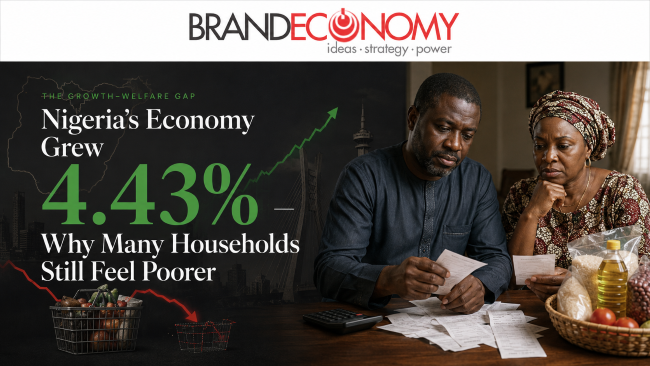
 Nigeria’s economy is expanding at a faster pace, but the latest GDP growth figure has reopened a more consequential question: how much of that progress is reaching household budgets, creating productive jobs and improving everyday living conditions?
Real Gross Domestic Product (GDP) grew by 4.43% year-on-year in the second quarter of 2026, according to the National Bureau of Statistics. That was stronger than the 4.23% recorded in the corresponding quarter of 2025 and the 3.89% reported for the first quarter of 2026.



For policymakers, the acceleration is a welcome signal that economic activity is gaining momentum. For households contending with costly food, transport, energy and essential services, however, a rising national output figure is not yet the same thing as economic relief.
That tension shaped the responses of economic experts who spoke with the News Agency of Nigeria in Abuja on Tuesday. They acknowledged the expansion but cautioned against treating one headline number as proof of a broad-based recovery.
What is driving the expansion?
Agriculture grew by 4.39% in Q2 2026, up from 2.82% a year earlier. Services expanded by 4.60%, compared with 3.94% in Q2 2025, and retained its position as the economy’s largest component. The sector contributed 56.62% of aggregate GDP, marginally above 56.53% in the comparable period.
Industry presented a less reassuring picture. Its growth slowed to 3.96% from 7.46% in Q2 2025. This loss of momentum matters because industrial activity—particularly manufacturing, processing and construction—can produce stronger linkages to formal employment, supplier development, exports and technological capability.
Published official reporting placed manufacturing growth at 3.24% in the quarter, up from 1.60% a year earlier. Development economist Prof. Ken Ife, however, was quoted as characterising manufacturing growth at roughly 1.3% to 1.5%. The figures differ, but his central concern remains relevant: manufacturing is not yet expanding rapidly enough to become the powerful engine of jobs and value addition Nigeria requires.
The services-led structure is not inherently weak. Telecommunications, finance, technology, logistics and professional services can raise productivity and attract investment. But not all services generate the same wages, export earnings or employment security. Growth concentrated in high-productivity segments may coexist with a large pool of low-income, informal work, leaving the aggregate statistic healthier than the median household.
GDP measures production, not the distribution of progress
Ife argued that GDP is indispensable for measuring the value of economic activity but insufficient as a welfare scorecard. It does not show who received the income generated, whether poverty declined, how purchasing power changed or which regions and demographic groups benefited.
That distinction is essential. An economy can grow while per-capita gains remain modest, income becomes more concentrated or the cost of necessities outpaces household earnings. Growth is most socially meaningful when it raises labour productivity, creates jobs and delivers real—not merely nominal—income gains.
Nigeria’s nominal GDP rose to ₦119.29 trillion in Q2 2026 from ₦100.73 trillion a year earlier, an increase of 18.43%. After adjusting for economy-wide price changes, real growth was 4.43%.
The wide difference shows that higher prices accounted for a substantial part of the increase in current-price output. Technically, the adjustment uses the GDP deflator, which measures prices across domestically produced goods and services and is not the same as consumer-price inflation. It therefore cannot, by itself, quantify the pressure on a family’s shopping basket.
Still, the gap reinforces Ife’s concern that strong price effects can enlarge the naira value of the economy without creating a comparable improvement in purchasing power.
He also identified Nigeria’s long-standing production structure as a constraint. Exporting raw commodities while importing large volumes of finished goods transfers manufacturing, skills and employment opportunities abroad. Without deeper domestic processing and competitive production, GDP growth may generate less employment than its headline rate suggests.
The second-half outlook: upside with familiar risks
Ife expects seasonal activity to support growth in the third and fourth quarters. Harvests could lift agricultural output, while spending during the final months of the year and Christmas season may strengthen trade, transport and consumer services.
The outlook is far from risk-free. Agriculture remains exposed to flooding, insecurity, post-harvest losses and the high cost of moving produce from farms to urban markets. Expensive energy and transport can erase farmers’ margins while raising food prices for consumers.
Oil remains another swing factor. Ife noted that oil-sector growth was about 7.31% in Q2 2026, above 2.57% in the first quarter but well below the 20.46% surge recorded a year earlier.
Higher production can support exports, public revenue and foreign-exchange liquidity; a fall in output or crude prices would weaken those channels. Increased domestic refining could provide a more durable benefit if it stimulates local supply chains, reduces avoidable import dependence and strengthens manufacturing.
Ife further argued that the growth rate must be judged alongside population expansion and urbanisation. His point is not that aggregate growth lacks value, but that growth must comfortably exceed demographic pressures—and be translated into productive employment and higher real income—before living standards improve visibly.
Market implications
For businesses, the Q2 result signals a growing market but not necessarily a buoyant consumer. Companies should distinguish between expansion in national output and strength in discretionary household demand.
Where real incomes remain constrained, shoppers trade down, buy smaller quantities, delay purchases and prioritise essential value.
The sectoral picture points to opportunities in agricultural storage, processing, cold chains, irrigation, logistics and climate resilience. It also supports continued interest in digital finance, telecommunications and business services.
Yet the industrial slowdown highlights persistent friction around power, transport, financing, imported inputs and operating costs.
The commercial winners will be businesses that solve these bottlenecks or deliver affordability without degrading quality. Volume growth built on accessible pricing, efficient distribution and local sourcing may prove more defensible than strategies dependent on repeated price increases.
Investor relevance
Investors should look through the headline GDP rate to the composition, durability and cash-flow transmission of growth. Services may offer scale and attractive margins, but investors must separate high-productivity platforms from low-margin activity that grows without strong consumer solvency.
Agriculture’s acceleration is constructive, although weather, insecurity, logistics and commodity-price volatility remain material risks. Industry’s deceleration warrants attention because a stronger productive base is needed to reduce import exposure, improve export competitiveness and create formal jobs.
Consumer-facing valuations should therefore be tested against real disposable income, sales volumes, price elasticity and working-capital pressure—not nominal revenue growth alone.
Oil production, exchange-rate stability, interest rates, power costs and the execution of domestic refining will remain central variables in corporate earnings and sovereign risk.
Brand implications
The growth figure creates a communication challenge for government and corporate brands. Declaring victory from a macroeconomic statistic while citizens still feel financially strained can deepen distrust.
The credibility of the reform narrative will depend less on the size of GDP than on visible evidence of more jobs, better public services, lower cost pressures and rising household resilience.
Former President of the Chartered Institute of Bankers of Nigeria, Mr Okechukwu Unegbu, made that welfare test explicit. He questioned what 4.43% growth means to the average Nigerian if poverty is not declining and called for greater investment in education and other forms of human capital.
Unegbu also demanded clearer accountability for the fiscal resources associated with the removal of fuel subsidy.
For citizens, transparency is not an abstract governance principle; it is the bridge between sacrifice and trust. Government must show how reform-created fiscal space is being converted into productive infrastructure, social protection, education, health and employment.
Corporate brands face a parallel obligation. They should avoid celebratory macroeconomic messaging that conflicts with customers’ lived reality. Brands that demonstrate empathy through transparent pricing, dependable quality, accessible product formats and locally relevant innovation will be better positioned to retain trust during a fragile recovery.
BRANDECONOMY Insight
Nigeria’s 4.43% growth is real progress, but GDP is the economy’s production score—not the citizen’s receipt.
The next phase of economic management must focus on the transmission mechanism between aggregate output and household welfare.
Alongside every quarterly GDP release, government should publish a concise growth-to-welfare dashboard tracking real GDP per person, employment and job quality, real household income or consumption, food affordability, sector productivity, poverty indicators, and the burden of energy and transport costs.
Policy must then target the weakest links: reliable power, safer farming communities, lower logistics costs, stronger education and skills, domestic processing, and financing for productive enterprises. These are the channels through which growth becomes income and income becomes dignity.
The political and economic question is no longer whether Nigeria can produce a positive GDP number. It is whether the country can build an economy in which output growth consistently reaches household balance sheets.
Until that transmission improves, the recovery will remain statistically defensible but socially incomplete.