
Oyetola’s ₦1.83trn Blue Economy Scorecard: From Revenue Growth to Trade Advantage

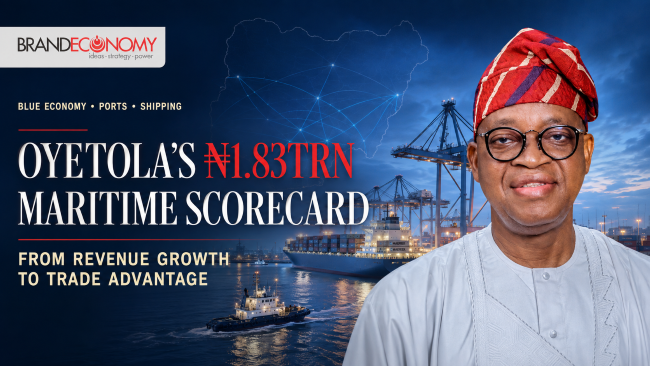 Higher agency collections, Blue Economy reforms and stronger international standing signal progress under Oyetola. The next challenge is to make Nigeria a more competitive place to move cargo, operate vessels and build maritime businesses.
Nigeria’s maritime reform programme is producing a stronger revenue story. Its next opportunity is to deliver an equally compelling productivity story: faster cargo movement, lower avoidable costs, more Nigerian-owned shipping capacity and better livelihoods.



Minister of Marine and Blue Economy, Dr Adegboyega Oyetola, says agencies under his ministry generated ₦1.83 trillion in 2025, compared with ₦700.79 billion in 2023—an increase he put at about 160 per cent.
In a three-year scorecard released in Lagos through his Special Adviser, Dr Bolaji Akinola, Oyetola outlined advances in port infrastructure, security, regulation, indigenous shipping, workforce development, fisheries and inland-waterway safety.
The statement, reported by the News Agency of Nigeria, presents a widening effort to convert Nigeria’s 853-kilometre coastline and inland waterways into sustainable economic value.
For businesses and investors, the significance extends beyond government receipts. A more reliable maritime system can improve the economics of manufacturing, agriculture, energy and regional trade. But that outcome depends on how effectively reforms change the cost and predictability of doing business.
Revenue growth: a strong signal, not the whole picture
Oyetola attributed the rise in collections to digitisation, automation, tighter revenue assurance, regulatory changes and the closure of financial leakages. He said these measures were helping create a more transparent environment for domestic and foreign investment.
Better collection is an important institutional gain. Revenue previously lost through weak systems can support public finances without necessarily requiring additional charges.
However, agency revenue is not the same as the blue economy’s contribution to GDP, private-sector turnover or export earnings.
A fuller assessment should separate improvements in collection efficiency from changes in tariffs, transaction volumes and exchange-rate effects on foreign-currency-linked receipts. Inflation also matters when comparing naira figures across years.
The most persuasive evidence of transformation would combine stronger public revenue with lower costs per transaction, shorter delays and expanding commercial activity. Nigeria should become better at earning from maritime growth, not merely collecting from maritime users.
A national framework—and a more connected port system
Oyetola identified the May 2025 approval of Nigeria’s first National Policy on Marine and Blue Economy as a pivotal reform. The policy, he said, replaced fragmented approaches with a common direction for shipping, fisheries and emerging opportunities, including offshore energy and marine biotechnology.
That coherence matters. Investors need to understand which institution licenses a project, who regulates it and how commercial development will coexist with environmental protection.
At the ports, Oyetola reported ongoing upgrades at Apapa, Tin Can Island, Onne, Rivers, Calabar and Warri, covering channels and cargo-handling infrastructure.
He also cited Nigerian Ports Authority acquisitions of tugboats, pilot cutters and dredging equipment, alongside electronic truck scheduling, holding bays and expanded inland barging to ease Apapa congestion.
According to the minister, the World Bank and S&P Global placed Tin Can Island 10th and Lagos Port Complex, Apapa, 12th among the world’s 20 most improved container ports.
The distinction is important: improvement rankings measure progress, not an automatic position among the world’s best-performing ports. Vessel-side gains must also translate into quicker cargo release and dependable inland delivery.
Plans for deep seaports in Akwa Ibom, Cross River and other locations, together with inland dry ports such as Funtua in Katsina, could extend the benefits beyond coastal cities.
Their commercial value will depend on connecting cargo demand with roads, rail, barges, customs services and distribution centres. A new terminal without efficient inland connections risks relocating a bottleneck rather than removing it.
Market implications: lower friction, stronger businesses
Oyetola said regulatory interventions had prevented more than ₦86 billion in unjustified demurrage charges and resolved nearly 300 commercial disputes through Alternative Dispute Resolution.
He also reported action against unauthorised shipping charges and stronger freight and foreign-exchange verification intended to limit capital flight.
The new Nigerian Ports Economic Regulatory Agency, NPERA, provides a stronger platform for economic oversight. Its value will lie in predictable decisions, transparent charges and effective remedies—not simply the existence of another institution.
For manufacturers, avoidable port delays tie up working capital in goods awaiting release. For agricultural exporters, unreliable logistics can erode quality and jeopardise contracts. For retailers, accumulated charges can feed into consumer prices.
Reducing these frictions could therefore produce benefits well beyond the waterfront.
Regulation must nevertheless balance user protection with legitimate investment returns. Arbitrary charges weaken competitiveness; unpredictable regulatory intervention can also deter terminal operators and shipping companies from committing capital.
Security gains must become commercial savings
Oyetola reported four consecutive years without piracy in Nigeria’s territorial waters, attributing the achievement partly to assets deployed under the Deep Blue Project.
He said improved security had removed costly piracy surcharges. That claim should not be interpreted as confirmation that every war-risk premium or security-related shipping charge has disappeared: insurance assessments and carrier pricing are distinct commercial decisions.
The practical test is whether cargo owners see sustained reductions in the costs they actually pay.
The minister also highlighted Nigeria’s return to the International Maritime Organization’s Category C Council in November 2025 after a 14-year absence.
Another milestone was the lifting of the 12-year United States Coast Guard conditions of entry affecting vessels arriving from Nigeria. The Coast Guard’s August 19, 2026 advisory confirmed Nigeria’s removal following its assessment of port antiterrorism measures.
These developments strengthen Nigeria’s maritime standing. Turning that reputational improvement into additional vessel calls, better commercial terms and new investment requires consistent operational performance.
Indigenous shipping: ownership needs viable economics
Oyetola said plans for a national shipping carrier through a public-private partnership had advanced and disbursement of the Cabotage Vessel Financing Fund had commenced to support Nigerian vessel acquisition.
He also reported the resolution of a 16-year impasse that had obstructed the operationalisation of the Regional Maritime Development Bank.
Together, these initiatives could address a central constraint: access to financing suited to expensive, long-lived maritime assets.
But acquiring a vessel is only the beginning. Commercial success requires cargo contracts, competent crews, maintenance arrangements, insurance and reliable debt servicing.
For a proposed national carrier, private participation must mean commercially accountable management and transparent risk allocation. A national flag does not, by itself, create a competitive shipping business.
Similarly, vessel-financing programmes should be judged by funds actually released, vessels delivered, utilisation, Nigerian employment and loan repayments. A development bank’s impact will depend on capitalisation and lending discipline, not institutional inauguration.
People, fisheries and the wider blue economy
The scorecard also covered expanded seafarer training and sea-time placements. Oyetola reported average earnings gains exceeding 80 per cent and cited NPERA’s role in facilitating a ₦200,000 monthly minimum wage for covered maritime workers.
Clear disclosure of the workers covered, comparison periods and employment outcomes would strengthen these claims. Training creates durable value when it leads to recognised qualifications, practical experience and sustained work.
Beyond shipping, the minister reported support for Naira-for-Crude logistics, distribution of thousands of lifejackets and plans to introduce fibreglass replacement boats.
Waterway safety requires these investments to be reinforced by vessel standards, loading controls, operator competence and emergency response. Distributing equipment is an input; preventing deaths is the outcome.
Oyetola put fish production at 1.4 million metric tonnes in 2025 and reported 100 per cent compliance with turtle excluder device requirements. These devices allow turtles caught in trawl nets to escape; compliance is an important safeguard, not a complete measure of fisheries sustainability.
The economic opportunity includes better cold storage, processing, quality assurance and distribution. Reducing post-harvest losses can improve incomes and food availability without relying solely on larger catches.
He also cited internal digitisation through an Enterprise Content Management System. Such reforms should ultimately make approvals, records and accountability more reliable.
Investor relevance: finance the operating model
The reform programme could widen opportunities in port services, inland logistics, vessel operations, ship repair, cold-chain infrastructure and fisheries processing.
The strongest propositions will connect identifiable demand to dependable cash flows. Investors should examine cargo commitments, asset utilisation, concession terms, tariff predictability, currency exposure, environmental obligations and connectivity.
Announced projects, approved frameworks and operating assets are different investment stages. Each carries a different risk profile and financing requirement.
Public policy can make an opportunity more attractive. It cannot substitute for project-level commercial viability.
Brand implications: reliability is the maritime promise
Nigeria’s maritime brand is built through repeated encounters: a vessel arriving on schedule, cargo clearing predictably, an invoice matching published charges and a dispute receiving a timely resolution.
International recognition can help change perceptions. Consistent service is what makes those perceptions endure.
For Oyetola and the ministry, the strongest communications strategy is therefore a transparent record of delivery that businesses can recognise in their own operations.
For Nigerian shipping and logistics brands, the opportunity is to compete through reliability, traceability and customer service—not proximity to government announcements.
BRANDECONOMY Insight
Oyetola’s scorecard sets out a substantial reform agenda. The next step should be a public Blue Economy Competitiveness Dashboard linking institutional achievements to commercial and social outcomes.
It should track cargo-release times, vessel turnaround, logistics costs on major trade routes, dispute-resolution timelines, private investment reaching financial close, Nigerian-owned vessel utilisation, seafarer employment, fisheries losses and waterway fatalities.
Agency revenue should remain on that dashboard—but alongside inflation-adjusted comparisons, revenue-source breakdowns and independently checkable service measures.
The strategic prize is larger than a higher collection figure. It is a maritime economy that helps Nigerian businesses produce, trade and employ more competitively while protecting the ecosystems and communities on which it depends.
Nigeria’s blue economy transformation will become convincing when stronger government receipts are matched by stronger business performance and better lives.