

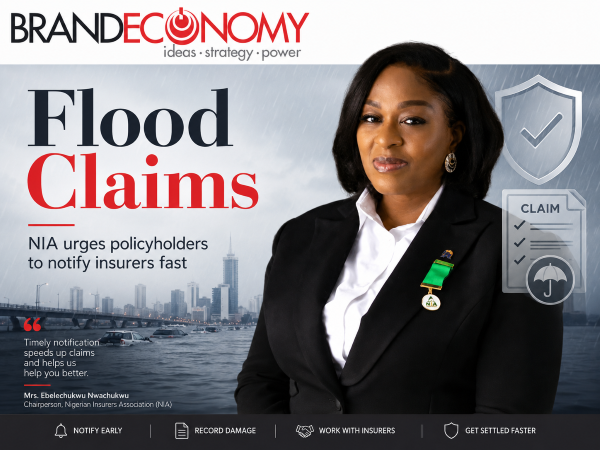
 The Nigerian Insurers Association says policyholders affected by recent flooding in Lagos should contact their insurers, brokers or agents immediately. The appeal is more than a claims reminder; it is a warning that climate risk is now a balance-sheet issue for households, businesses, property owners and insurers.
The Nigerian Insurers Association, NIA, has urged policyholders whose homes, vehicles, businesses and other assets were affected by recent flooding in parts of Lagos State to promptly notify their insurers and begin the claims process.




The appeal was made in Lagos by the Chairperson of the Association, Mrs Ebelechukwu Nwachukwu, who is also the Managing Director of Rex Insurance.
Nwachukwu expressed sympathy to individuals, families and businesses hit by flooding after days of persistent heavy rainfall, noting that the Association stood with those who suffered losses involving lives, homes, vehicles, commercial premises and valuable assets.
Her message was direct: where there is insurance cover, early notification matters.
Report Early
Nwachukwu advised affected policyholders to immediately contact their insurance companies, brokers or agents to allow proper assessment and processing of claims.
According to her, early notification and submission of relevant supporting documents will help insurers assess losses more quickly and settle genuine claims in line with policy terms.
“The association assures the public that its member companies remain committed to providing professional support and prompt settlement of all genuine claims in line with the terms and conditions of insurance policies,” she said.
The point is important because insurance is a contract. Claims are usually easier to process when evidence is fresh, documents are available and affected assets can be inspected before repairs, disposal or further damage.
Keep Evidence
For policyholders, the first practical step after a flood is documentation.
Affected persons should take clear photographs and videos of damaged property, vehicles, stock, equipment and premises. They should keep receipts, policy documents, repair estimates, police or emergency reports where relevant, and any correspondence with landlords, estate managers or authorities.
They should also avoid starting major repairs or disposing of damaged assets before notifying the insurer, except where urgent action is needed to prevent further harm or protect lives.
For businesses, this means keeping inventory records, purchase invoices, delivery notes, asset registers and financial records in order.
In a flood, the claim is not only about what was lost. It is about what can be proven.
Flood Claims Matter
Nwachukwu said policyholders requiring help on flood claims procedures should contact their insurers, insurance brokers, insurance agents or the NIA for guidance.
This is a useful reminder in a market where many customers still do not fully understand what their policies cover, what exclusions apply, or how quickly they must notify insurers after a loss.
Flood-related claims may arise under different policies, depending on coverage purchased. These may include property insurance, motor insurance, business interruption cover, goods-in-transit cover, household insurance and certain commercial policies.
The critical issue is that not every policy automatically covers every flood-related loss.
Policyholders should therefore check the exact wording of their policies and seek clarification from their insurer or broker.
Prevention First
The NIA Chairperson also stressed the need for better environmental sanitation, responsible waste disposal and regular clearing of drainage channels to reduce flood risks.
That message should not be treated as routine public advice.
Urban flooding in Lagos is often worsened by blocked drains, poor waste disposal, construction on drainage paths, weak maintenance of canals and rising pressure on city infrastructure. Across West Africa, recent heavy rains have caused major disruption, with Lagos among the cities affected by flooding during the current rainy season.
Insurance helps after a loss. It does not replace prevention.
A community that clears its drains, stops dumping refuse in waterways and respects planning rules reduces the probability of damage. A business that stores stock above floor level, protects electrical systems and reviews flood exposure may reduce both losses and downtime.
Climate Reality
Nwachukwu noted that disasters may still happen despite preventive efforts. That, she said, highlights the importance of insurance as a financial-protection tool for individuals and businesses.
This is the new reality.
Flooding is no longer an occasional inconvenience in many Nigerian cities. It is becoming a recurring operational risk for households, landlords, tenants, SMEs, schools, hospitals, manufacturers, logistics firms, retailers and real estate investors.
The climate-risk conversation has moved from public policy into private balance sheets.
When floodwater enters a shop, factory, office, home or warehouse, the cost appears immediately: damaged stock, destroyed furniture, ruined vehicles, electrical faults, relocation costs, lost income and sometimes business closure.
Without insurance, recovery depends on savings, loans, family support or government relief. With the right cover, recovery can be faster and less financially destructive through well structured policies and flood claims .
The Trust Test
The NIA’s appeal also places responsibility on insurers.
If policyholders notify early, insurers must respond professionally. They must provide clear guidance, acknowledge claims quickly, send loss adjusters promptly, communicate policy positions fairly and settle valid claims without unnecessary delay.
This matters because claims settlement is the moment of truth in insurance.
Customers may buy insurance because of price, persuasion or regulation. But they believe in insurance when claims are paid.
For Nigeria’s insurance industry, every flood season is therefore a brand test. The industry must show empathy, discipline and speed at the exact moment customers are most vulnerable.
Market Implications
The Lagos floods should sharpen the market conversation around catastrophe risk, household protection and business continuity.
Insurance penetration in Nigeria remains relatively low, even though the country is exposed to flood, fire, road, health, agricultural and commercial risks. The more frequent and costly climate-related incidents become, the more urgent it is for insurers, brokers, regulators and businesses to improve product awareness and adoption.
The opportunity is significant.
Demand could grow for home insurance, SME packages, motor comprehensive policies, flood extensions, business interruption cover, parametric insurance, agricultural cover and real estate risk advisory.
But growth will depend on trust. Customers must understand what they are buying, what is covered, what is excluded, how claims work and why insurance is not merely a regulatory burden.
Brand Implications
For insurers, this is a moment to build relevance.
Insurance brands that respond visibly and fairly to flood claims can strengthen trust and deepen relationships with policyholders. Those that delay, hide behind unclear policy wording or communicate poorly risk damaging not only their own reputation but the perception of the entire industry.
For corporate organisations, insurance is now part of brand resilience.
A retail chain that cannot reopen after flooding loses customers. A logistics company whose vehicles are damaged without cover loses service credibility. A school, hotel, hospital or housing estate that fails to plan for flood risk exposes its brand to reputational and financial damage.
Brands are judged not only by how they grow, but by how they recover.
Investor Relevance
For investors, flood risk affects more than insurance companies.
It has implications for property valuations, real estate development, retail networks, logistics corridors, manufacturing sites, bank collateral, mortgage portfolios, leasing businesses and infrastructure assets.
Investors should pay attention to three questions:
First, where is the asset located?
Flood-prone areas may carry higher maintenance costs, lower tenant confidence and greater insurance complexity.
Second, what protection exists?
Drainage, elevation, water barriers, emergency power systems and risk-transfer arrangements matter.
Third, what insurance cover is in place?
A business may look profitable until one uninsured flood event wipes out stock, equipment and cash flow.
Climate risk is now investment risk.
What Policyholders Should Do Now
Affected policyholders should act quickly.
- Notify immediately
Contact the insurer, broker or agent as soon as possible. - Document the loss
Take photographs and videos before cleaning up, where safe. - Preserve records
Keep policy documents, receipts, invoices, repair estimates and correspondence. - Prevent further damage
Move undamaged items to safety and protect the premises where possible. - Avoid unauthorised disposal
Do not throw away damaged items before the insurer or loss adjuster has had a chance to assess them, unless safety requires it. - Ask questions
Request clear guidance on required forms, timelines and documents. - Follow up properly
Keep records of all calls, emails, visits and claim numbers.
What Businesses Should Check
Business owners should not wait until the next rain.
They should review their insurance portfolio now, including:
- Property cover
- Stock and equipment cover
- Motor comprehensive cover
- Business interruption cover
- Goods-in-transit cover
- Public liability cover
- Flood or special-perils extensions
- Policy limits and deductibles
- Claims-notification timelines
- Emergency contacts for insurer and broker
A policy bought years ago may no longer match the value of current assets.
Underinsurance is another hidden danger. If assets are insured below their true value, claim payments may be reduced.
BRANDECONOMY Insight
The NIA’s message is simple, but strategically important: notify your insurer fast.
Yet the deeper lesson is bigger.
Flooding is no longer just an environmental problem. It is a household-finance problem, an SME-survival problem, a real estate problem, a mobility problem, a banking-collateral problem and an insurance-industry credibility test.
For policyholders, insurance is protection only when the right cover exists and the claims process is activated on time.
For insurers, this is the moment to prove that the industry can deliver relief, not just sell policies.
Nigeria’s flood risk is rising. The winners will be the households, businesses, insurers and investors that treat resilience not as a slogan, but as a financial strategy when flood claims are promptly settled.